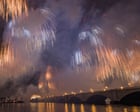
We all love a spectacular holiday display. But launching 850,000 fireworks into the sky over a single city in just 40 minutes crosses the line from celebration into a full-blown public health hazard.
That is exactly what happened in Washington, D.C., during the recent Freedom 250 Independence Day celebrations. The nation’s capital briefly earned the infamous title of the most polluted major city in the entire world. Between 3:00 AM and 5:00 AM on Sunday, July 5, Swiss air quality technology company IQAir tracked Washington overtaking notorious global pollution hotspots like Jakarta and Kinshasa.
The immediate trigger was an unprecedented pyrotechnic push to break a world record. Organizers deployed roughly 50 times the number of shells used in a typical D.C. Fourth of July event. For hours after the grand finale, millions of residents breathed air that was thick, acrid, and dangerous.
Inside the Numbers of the D.C. Air Crisis
The data behind the smoke tells a scary story. Air quality monitors across the district started lighting up with severe warnings. According to an analysis by Clarity Movement, which partners with the local Department of Energy and Environment, hourly concentrations of fine particulate matter soared to 6.7 times their pre-fireworks baselines.
Every single one of the city's 26 air quality sensors hit levels deemed hazardous or unhealthy. The Environmental Protection Agency uses a standard 24-hour safety cap of 35 micrograms per cubic meter for fine particle pollution, known as PM2.5. During the peak of the post-fireworks haze around 4:00 AM on Sunday, at least one municipal monitoring station registered a staggering PM2.5 concentration above 200 micrograms per cubic meter.
Local governments had no choice but to issue Code Red and Code Purple air quality alerts. Code Purple signals that the air is actively dangerous for everyone, not just vulnerable populations.
Medical infrastructure felt the strain almost instantly. The D.C. Fire and EMS Department reported 96 patient contacts and 40 hospital transports. George Washington University Hospital logged an intense 289 patient contacts over the holiday weekend. While an intense triple-digit heatwave contributed heavily to those numbers, the sudden blanket of toxic smoke created a worst-case scenario for anyone with respiratory vulnerabilities.
The Toxic Chemistry in the Air
Most people look up at fireworks and see beautiful colors. I look at them and see a complex, airborne chemical soup. To get those vibrant reds, blues, and greens, pyrotechnic companies pack shells with heavy metals and toxic propellants.
- Strontium and Lithium: Used to create brilliant reds.
- Barium: Provides the intense green hues.
- Copper: Responsible for the sharp blues.
- Sulfur and Potassium: Act as the gunpowder propellants that drive the explosions.
When these elements combust, they do not just disappear. They fracture into microscopic particles less than 2.5 micrometers in diameter. These particles are tiny. They are small enough to bypass your body's natural respiratory filters, lodge deep inside your lung tissue, and pass directly into your bloodstream.
The American Lung Association points out that Americans shoot nearly 300 million pounds of fireworks into the atmosphere annually. This releases massive waves of sulfur dioxide, carbon monoxide, and fine soot. When you compress that volume into a tight 40-minute window over a concentrated metropolitan area, the environment simply cannot absorb it.
Rain Saved the City from Disaster
Washington got incredibly lucky. It could have been much worse.
The southwest region of the District, especially around West Potomac Park and the National Mall, bore the brunt of the pollution because it sat directly downwind of the primary launch sites. Meteorological conditions overnight trapped the thick smoke low to the ground.
Heavy thunderstorms rolled through the region on Sunday evening. The downpour acted as a natural atmospheric scrubber, washing the remaining particulate matter out of the air and bringing things back to baseline by Monday. Russell Dickerson, an atmospheric scientist at the University of Maryland, noted that the city essentially dodged a bullet. Without those timely storms, the hazardous smog would have hovered over the metro area for days, compounding the health crisis under the summer heat.
Shifting to a Smarter Way to Celebrate
We do not need to ban public celebrations, but we have to stop pretending that massive smoke events carry no consequences. The push by the Freedom 250 organizers to break a global record by firing 850,000 shells showed a blatant disregard for the health of local residents.
Cities worldwide are already moving away from traditional pyrotechnics. High-tech drone light shows offer incredible visual storytelling without dropping heavy metals into the soil or filling our lungs with sulfur. Laser displays can provide the same communal awe with zero localized emissions.
If your city still relies on heavy pyrotechnic displays, you need to protect yourself during future holidays.
- Check real-time data: Do not guess. Use independent monitoring networks like PurpleAir or the EPA’s AirNow app to see what is happening in your specific zip code.
- Invest in filtration: Run high-efficiency particulate air (HEPA) filters indoors with the windows tightly shut during and after major firework events.
- Mask up if you go: If you are determined to watch a massive display in person, wear an N95 mask. Standard cloth or surgical masks do nothing against microscopic PM2.5 particles.
- Watch the wind: Always position yourself upwind of the launch pad to ensure the bulk of the heavy smoke blows away from you.
Tradition is great, but it shouldn't leave an entire city gasping for air. It's time to rethink how we mark our milestones.