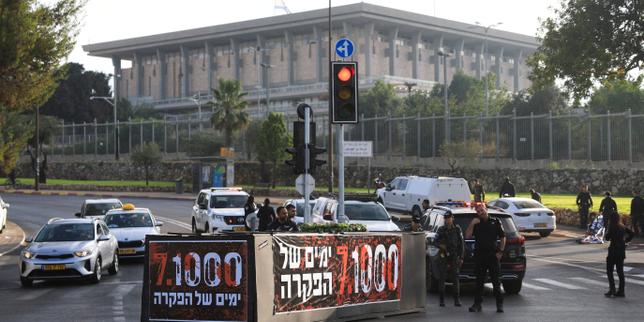
Benjamin Netanyahu's government just pushed through a highly controversial bill to investigate the country's worst security failure. It passed its first reading in a 59-0 vote. You might wonder why the vote was completely unanimous. It's because every single member of the opposition walked out. They boycotted the vote entirely, leaving an empty hall and a brewing constitutional crisis.
The political fight over how to investigate the October 7, 2023 catastrophe isn't just about assigning blame. It's about who gets to control the narrative of Israel's biggest disaster since the Holocaust.
The public wants answers. Families of the victims want justice. Yet, the current administration is fast-tracking a piece of legislation that lets the politicians choose their own investigators. It's a move that critics say is explicitly designed to whitewash history and protect those at the top.
The Push for a Politically Controlled Probe
The new bill, spearheaded by Likud lawmaker Ariel Kallner, proposes a six-member investigative committee. Under normal circumstances, Israel handles major national failures through an independent state commission of inquiry. In that traditional setup, the president of the Supreme Court appoints an independent panel completely free from political interference. That's how Israel investigated the failures of the 1973 Yom Kippur War.
This new plan tears up that rulebook.
Instead of letting judges pick the investigators, this bill gives that power to the Knesset. A two-thirds majority of lawmakers—80 out of 120—would need to agree on the committee members. If they can't agree within two weeks, the ruling coalition picks three members and the opposition picks three.
On paper, that sounds fair. In reality, it's a trap.
The opposition has already made it clear they won't participate in what they call a sham. The bill contains a specific clause allowing the commission to start operating with just three members. If the opposition stays out, Netanyahu's coalition will have total control over the panel. They will decide who gets investigated, what questions get asked, and what documents see the light of day.
Why the Judiciary is Being Sidelined
Netanyahu has adamantly refused to set up a standard state commission of inquiry. He argues that the judiciary is heavily biased against his right-wing government. The relationship between the current administration and the Supreme Court has been toxic for years, punctuated by massive protests over judicial reforms before the war even began.
By bypassing the Supreme Court, the government ensures that the individuals leading the probe aren't independent judges. The Speaker of the Knesset will hold ultimate authority over the appointment process. This essentially hands the reins to the governing coalition.
Real Anger from Bereaved Families
The backlash to this vote wasn't confined to the halls of parliament. The October Council, a group representing hundreds of survivors, former hostages, and bereaved families, issued a blistering statement right after the vote. They called the ruling bloc the "coalition of the massacre."
The group believes the law is a blatant attempt by politicians to absolve themselves of blame. For these families, the wound is still completely open. Just days before this vote, thousands of Israelis filled the streets of Tel Aviv to mark 1,000 days since the Hamas onslaught. They didn't hit the streets to demand a political committee. They demanded a fully independent, legally binding state commission.
"This disgraceful bill is not intended to uncover the truth, but to bury it alongside our loved ones."
- The October Council Statement, July 6, 2026
The frustration is boiling over. Family members feel that their trauma is being traded away for political survival. The ultra-Orthodox parties, including Shas and United Torah Judaism, backed the bill as part of a wider legislative deal. Reports indicate they supported Netanyahu's inquiry plan in exchange for a freeze on military draft sanctions against their community. The optics are terrible, and the public knows it.
Shifting the Blame to the Military
If you look at the public statements coming from the prime minister's office, a clear pattern emerges. The official messaging often points directly toward failures within the military and intelligence services, specifically Aman and the Shin Bet.
No one disputes that the military failed catastrophically on October 7. The army has already admitted to major operational blind spots. But the opposition argues that Netanyahu is using these intelligence failures to completely deflect from his own long-term policy decisions. For years, his strategy allowed millions of dollars in Qatari cash to flow into Gaza to keep Hamas functional, aiming to keep the Palestinian leadership divided. A politically appointed panel is highly unlikely to scrutinize those long-term geopolitical strategies.
The Opposition's High-Stakes Bet
Opposition leaders are betting everything on a total boycott. Yair Lapid, the leader of the opposition, stated bluntly that his bloc will not provide cover for a whitewash. He pledged that the very first action of a future government will be to scrap this panel and launch a genuine state commission of inquiry.
Other key political figures are echoing this fierce stance:
- Gadi Eisenkot: The leader of the Yashar party and a former military chief argued that only leaders who fear the truth create biased committees to retroactively engineer public perception.
- Naftali Bennett: The former prime minister stated that a government fleeing an investigation simply dooms the nation to future disasters.
- Yair Golan: The head of The Democrats party emphasized that no vote in the Knesset will save the responsible parties from eventual accountability.
This boycott means the law will likely pass its final readings next week. The coalition is in a massive rush. They need to push this through before the Knesset dissolves on July 17 ahead of the upcoming national elections.
What This Means for Israel's Future
This isn't an isolated political dispute. It's part of a broader, chaotic legislative blitz taking place right now. The coalition is simultaneously advancing laws to weaken the Attorney General's powers and allow gender segregation in some public institutions. Finance Minister Bezalel Smotrich recently went as far as comparing the Supreme Court to a criminal enterprise, escalating the rhetoric to unprecedented heights.
The Attorney General, Gali Baharav-Miara, warned that the inquiry bill is "tailor-made" to serve the political objectives of the current leadership. The supreme court has explicitly stated that ignoring legal protocols risks causing the country's social order to disintegrate entirely.
Israel is moving toward a massive constitutional showdown. If the government passes this law, launches a friendly panel, and ignores the judiciary, the country will remain profoundly divided. An inquiry that half the population views as fake cannot heal a fractured nation.
Next Steps for Following This Developing Story
Don't lose track of this story as it enters its most critical phase. Here is exactly what you need to watch over the next few days:
- Watch the Constitution Committee: The bill has returned to the Knesset Constitution, Law, and Justice Committee. Watch for quick revisions designed to fast-track the second and third readings before July 17.
- Track the Opposition's Legal Challenges: Look out for immediate petitions to the High Court of Justice. Civil rights groups and opposition figures will likely file injunctions the moment the bill passes into law.
- Monitor Street Protests: Public anger is growing. Watch the weekly demonstrations in Tel Aviv and Jerusalem. The scale of these protests will heavily influence whether moderate members of the coalition get cold feet before the final vote.