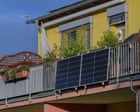
For decades, generating your own renewable electricity meant owning a house with a clear, south-facing roof and dropping thousands of pounds on professional installation. If you lived in a rented flat or a high-rise, green energy wasn't an option. You watched your utility bills climb while locked out of the transition entirely. That barrier just shattered.
Regulatory changes in Great Britain mean plug-in balcony solar panels are officially on sale through major high-street retailers like Argos, alongside expected rollouts from Amazon, Currys, B&Q, and Screwfix. Commonly known as Balkonkraftwerk across Germany and Spain, these compact DIY energy systems let anyone with an outdoor railing, terrace, or shed roof plug straight into a standard wall socket and start shaving money off their bills.
Let's look at what these kits actually deliver, what the fine print says, and whether dropping four to five hundred quid on a mini solar setup makes financial sense for your home.
How Plug-In Balcony Solar Works
The concept is dead simple. Instead of heavy roof arrays wired into a fuse box by certified specialists, a balcony solar kit consists of one or two lightweight panels and a microinverter.
You mount the panels securely onto a balcony railing or flat surface, point them toward the sun, and run a heavy-duty cable straight into a standard three-prong wall socket. The panels capture sunlight, convert it to DC power, and the microinverter translates it into AC electricity that matches your mains supply.
The power flows directly into your home circuit, feeding appliances like fridges, standby electronics, or whatever happens to be running at that moment. Because you are pulling fewer watts from the national grid, your meter slows down.
The Numbers Don't Lie: Costs and Savings
Let's address the elephant in the room: how much money will this actually save you?
Basic plug-in solar kits start around £400 to £500, with larger configurations scaling past £900 depending on total wattage capacity. The 800-watt systems permitted under current British regulations are roughly a fifth the size of a standard residential rooftop array. They won't run your entire house, and they certainly won't take you completely off-grid.
Industry estimates suggest an average annual saving between £70 and £110. Under optimal conditions, a kit might pay for itself in roughly four years. In less-than-ideal weather or with poor orientation, that payback window stretches closer to a decade.
Timing is also worth noting. Launching these kits in late August means peak summer generation windows are closing just as autumn weather rolls in. Your immediate returns over the next few months will be modest compared to what you will see next spring.
The Catch: Why You Can't Just Plug and Forget
Before you rush out to buy a kit, you need to navigate a few practical hurdles.
First, there is the usage mismatch. These systems do not include plug-in batteries under the initial regulatory framework. That means if you aren't home during peak daylight hours using electricity, the power flows straight back into the grid without storing for evening use. To maximize your investment, you have to change your habits—setting washing machines, dishwashers, or immersion heaters on timers to run while the sun is beating down on your panels.
Second, property rules apply. If you rent your flat, you cannot simply bolt heavy glass panels onto a balcony without landlord or freeholder consent. Listed buildings and certain conservation areas carry strict planning restrictions too.
Third, safety is paramount. Consumer groups and network operators stress that older wiring systems may need professional evaluation if you push higher wattages. Furthermore, you must notify your local Distribution Network Operator (DNO) when you connect your system, and you are strictly forbidden from daisy-chaining extension leads or multi-way adapters. Buy a complete, approved kit that appears on the Energy Networks Association (ENA) compliance register rather than piecing together random components.
What You Should Do Next
If you want to take control of your energy footprint and you have a well-lit balcony, terrace, or garden wall:
- Check your lease or tenancy agreement to confirm whether you need permission to mount outdoor equipment.
- Inspect your outdoor socket placement and ensure it can safely handle a dedicated microgeneration feed without extension cords.
- Research approved kits from major retailers, verifying their compliance status through the ENA type test register.
- Adjust your daytime power consumption habits to run heavy appliances while the sun is out.