Venezuela is reeling from the most catastrophic seismic event the country has experienced in over a century. Within a span of just 40 seconds on Wednesday, June 24, 2026, two massive earthquakes ripped through the northern coast. The first registered as a magnitude 7.2 foreshock. The second, a terrifying magnitude 7.5 mainshock, brought concrete high-rises crashing down and split critical highways wide open.
By Saturday, the official death toll surged past 1,430 people. More than 3,200 individuals are injured. Hospitals in Caracas and La Guaira are completely overwhelmed. Tens of thousands of families are missing loved ones, and rescue crews are fighting a desperate battle against the clock. This isn't a typical disaster response scenario. It's a race through shifting rubble while the ground literally continues to move underfoot. Over 430 aftershocks have already rattled the region, including a sharp 5.6 magnitude offshore tremor that triggered fresh panic across the Aragua region.
The Nightmare 40 Seconds That Changed Everything
Most earthquakes give communities a moment to breathe between shocks. This time, residents got less than a minute. The double blow caught people entirely off guard. Families who ran outside during the first 7.2 tremor were trapped on narrow streets as the second, more powerful 7.5 quake brought upper floors down into the paths below.
The structural damage is devastating. In La Guaira, the coastal state identified as the disaster zone epicenter, entire blocks of high-rise apartment complexes were razed to the ground. Roads connecting the coast to the capital are blocked by massive landslides or severed by deep fissures. The United Nations puts initial direct economic losses at $6.7 billion. For an economy already facing structural strain, this is an unthinkable financial blow.
Look at the geography of northern Venezuela. The country sits right at the complex boundary where the Caribbean tectonic plate grinds past the South American plate. It's a known seismic hotspot. But local fault lines haven't released stress like this since the late 19th century. The sheer energy released by these shallow twin quakes shook structures more than 1,000 miles away, causing high-rises to evacuate as far south as the Brazilian Amazon.
Inside the Race for Survivors
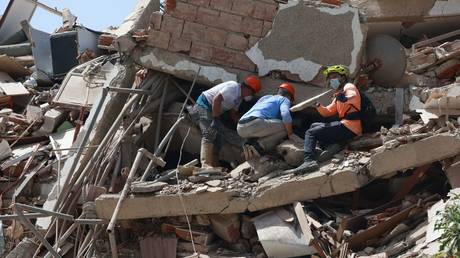
Right now, the scene on the ground is chaotic but deeply determined. It's a grueling mix of heavy machinery where available, and bare hands where it's not. Local volunteers and emergency workers are climbing over unstable slabs of concrete, using specialized acoustic sensors and search dogs to listen for faint signs of life trapped beneath the wreckage.
Time is the enemy here. The "golden window" for pulling survivors from collapsed buildings closes rapidly after 72 hours. Dehydration, crush injuries, and suffocating dust make every passing minute a matter of life and death.
Casualty and Displacement Status (As of June 27, 2026)
------------------------------------------------------
Confirmed Fatalities: 1,430
Reported Injuries:    3,238
Displaced Persons:    3,142
Aftershocks Recorded: 430+
The numbers don't capture the actual human toll. Thousands are forced to sleep on the open asphalt, terrified to step inside any building that's still standing. Fifty-year-old resident Suhayl Sarquiz told reporters that her apartment building is entirely uninhabitable. She and her son are now living on the street, joining thousands of others who lost absolutely everything in under a minute.
An International Surge to Support the Coast
Local first responders are stretched past their breaking points. Recognizing the immense scale of the tragedy, Venezuela's interim authorities have opened airspace to international relief teams.
National Assembly President Jorge Rodríguez confirmed that over 1,600 specialized foreign rescue personnel arrived via 17 emergency flights. Another 25 flights are expected within the next day. The United States government directed search teams, medical assets, and heavy humanitarian aid to deploy immediately to support the recovery.
NGOs are moving heavy infrastructure directly into the hardest-hit zones. Samaritan's Purse dispatched a large cargo aircraft loaded with emergency shelter materials, solar lights, and an entire Emergency Field Hospital capable of treating more than 100 patients a day. This field hospital includes dedicated operating rooms and a critical care unit, a desperate necessity given that local clinics are structurally compromised or out of power.
Why the Crisis Could Deepen
The danger hasn't passed with the initial tremors. The U.S. Geological Survey issued predictive modeling suggesting that based on structural density and historical data, the true final death toll could ultimately climb higher if remote or completely cut-off areas reveal similar levels of destruction.
Aftershocks pose a continuous, lethal threat to rescue teams. Structurally weakened concrete blocks can pancake under the minor vibrations of a magnitude 4 or 5 aftershock, crushing anyone underneath and trapping rescuers who are currently tunneled into the debris.
Water and sanitation systems are completely broken across several coastal municipalities. Without clean drinking water, emergency medical officials warn that the risk of secondary health crises like waterborne disease outbreaks will spike within days. Securing supply lines to deliver clean water and food remains the top logistical priority for international teams trying to access isolated communities along the coast.
What Needs to Happen Right Now
If you want to help or keep track of the immediate recovery steps, here's what global relief organizations and regional logistics experts are prioritizing:
- Establishing Secure Air Bridges: Clearing specific landing zones in La Guaira and Caracas to ensure heavy medical equipment can bypass collapsed road networks.
- Deploying Heavy Shoring Equipment: Getting hydraulic jacks, concrete cutters, and heavy cranes into urban centers to lift major slabs without triggering further collapses.
- Immediate Clean Water Supply: Setting up mobile water purification units to serve displaced populations sleeping in temporary camps.
- Structural Integrity Auditing: Deploying engineers to assess partially damaged buildings so families can eventually move back into safe structures and off the streets.
The long-term recovery will take years, but the focus right now is entirely on the next few hours under the concrete rubble.