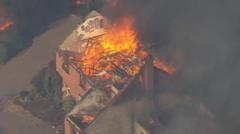
Apocalyptic scenes don't usually belong in the West Midlands. Yet, thick black smoke and intense orange flames swallowed up neighborhoods during the UK's hottest day of the year, leaving residents scrambling and emergency services stretched to the absolute breaking point. If you've only ever associated devastating, home-destroying wildfires with sun-baked regions like California or Southern Europe, Thursday's disaster in Stourbridge should shatter that illusion completely.
West Midlands Fire Service faced extreme levels of demand as an aggressive grass and woodland fire tore through roughly 40 acres of land near the Stourbridge golf course. Drone footage published by emergency crews mapped horrifying thermal signatures, showing intense heat advancing directly toward residential properties while thick plumes choked the town. Six homes suffered structural damage, care home residents required urgent evacuation, and Stourbridge town hall transformed overnight into a makeshift rescue center for displaced families.
The Reality Behind the Stourbridge Wildfires
You might wonder how a grassfire in a quiet corner of England escalated so fast. It's not just bad luck. It's a brutal combination of exceptional heatwaves and prolonged dry conditions that turn ordinary scrubland into tinderboxes. When temperatures peak during the summer, minor ignition sources or dry conditions can spark blazes that travel across roads and leap barriers before crews can even get wheels on the ground.
About 60 firefighters rushed to the scene after emergency calls flooded in right around 1.30pm. But they weren't fighting just one isolated patch of grass. This was part of a wider regional crisis. Across the wider West Midlands and neighboring counties, fire crews battled concurrent major incidents, including blazes in Stoke-on-Trent, Castle Vale, and Pershore, alongside a major incident declared in Stratford-upon-Avon.
The chaos spilled right onto critical infrastructure. National Highways had to shut down the northbound M6 between junctions 5 and 6 because dense smoke blinded drivers and zero-visibility conditions created miles of severe tailbacks. Fire commanders refused to reopen lanes until they were certain the neighboring flames were entirely extinguished, trapping motorists for hours.
Why Local Communities Are Sounding the Alarm
Local politicians and environmental experts aren't mincing words about what happened. Councillor Andrew Tromans described the situation in Norton and Stourbridge as apocalyptic, arguing that local authorities need to wake up and hold emergency discussions on climate resilience.
Dr. Thomas Smith, an environmental geography expert from the London School of Economics, pointed out just how abnormal this is. Historically, UK wildfires don't tear through residential streets and reduce homes to ash. But drier summers are shifting the baseline. We are now experiencing aggressive fire behavior that burns hotter, moves faster, and poses a direct, physical threat to suburban neighborhoods.
Four people, including a child and three firefighters, were hospitalized for smoke inhalation and heat exhaustion, while multiple others received treatment on-site. The physical toll on first responders highlights a terrifying truth: our emergency services are running on fumes when multiple high-intensity incidents pop off simultaneously.
What Needs to Change Right Now
If you live near woodland, dry fields, or open parkland, you can't afford to ignore local fire warnings. Here's what you actually need to do when summer temperatures skyrocket:
- Keep windows shut if smoke is blowing through your area to protect your lungs from toxic particulate matter.
- Never attempt to tackle a fast-moving grassfire yourself—get out immediately, move upwind, and dial 999.
- Stay away from active fire zones. Don't drive down to take photos or rubberneck, as you risk blocking vital access routes for fire engines.
- Push for local mitigation. Support local council initiatives that clear dry brush, create firebreaks near residential boundaries, and update community emergency response plans.
The smoke has cleared from Stourbridge, but the underlying vulnerability remains. We can't keep treating these extreme heat events as one-off anomalies.