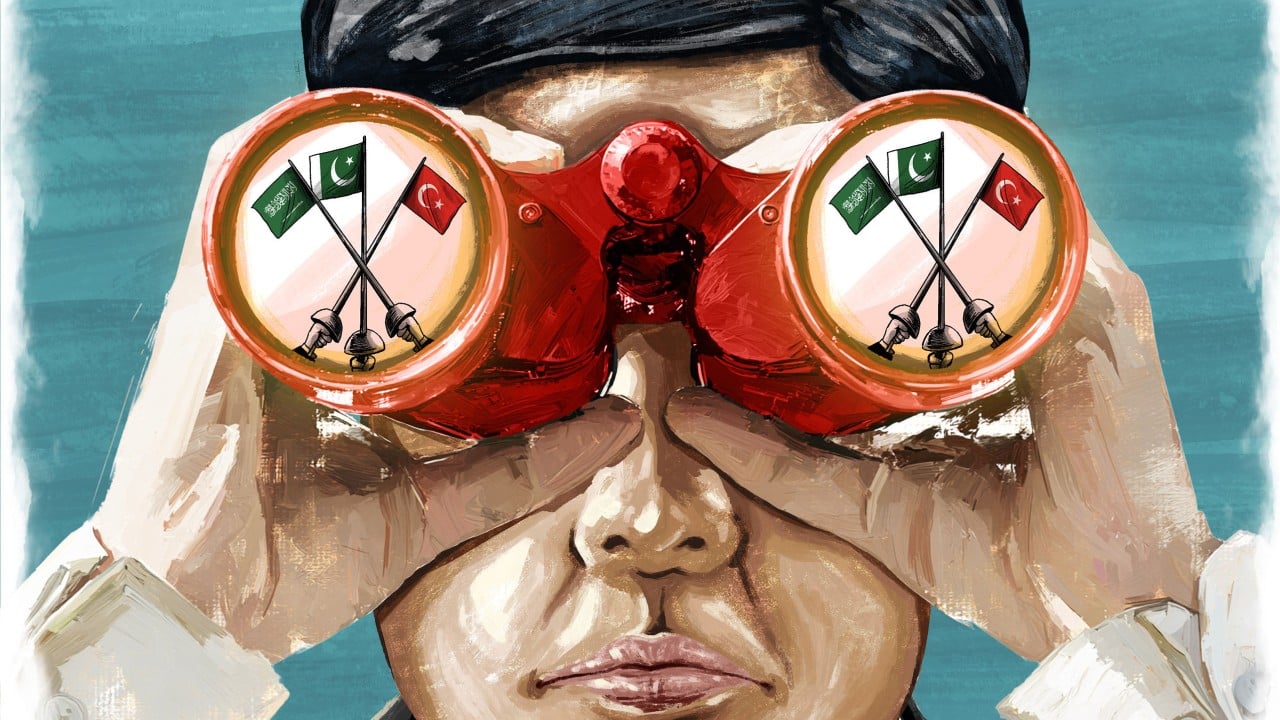
The ink was barely dry on the Mecca Joint Defence Agreement when foreign policy offices from Washington to Beijing started recalculating. When Saudi Arabia, Turkey, and Pakistan officially signed a trilateral mutual defense pact, the immediate narrative focused on waning American influence in the Gulf. But looking only at Washington misses the bigger picture. Beijing is now facing a brand-new geopolitical riddle. A powerful new security axis has emerged right in China's vital economic backyard, and the implications are far more complicated than simple anti-Western posturing.
For years, China played a comfortable game in the Middle East and South Asia. Beijing acted as the pragmatic economic partner, building infrastructure through the Belt and Road Initiative, buying oil, and carefully avoiding security entanglements or taking sides in local wars. That luxury is gone. The Mecca Pact changes the equation because it creates an independent center of military gravity built by three heavyweights who maintain deep, overlapping ties with China itself.
Walking a Diplomatic Tightrope
Beijing loves stability, bilateral deals, and keeping its options open. The arrival of the Mecca Pact complicates every single one of those preferences. Pakistan is arguably China’s closest strategic partner, often styled as an all-weather iron brother. Saudi Arabia is Beijing's premier energy supplier and a crucial anchor for trade in the Middle East. Turkey occupies a vital geostrategic crossroads, maintaining an independent foreign policy that often clashes with Western priorities while keeping commercial bridges intact with everyone.
When these three states decide that an armed attack on one is an attack on all, they aren't just sending a message to Iran or hedging against the United States. They are institutionalizing their own security framework. For China, this means Beijing can no longer treat its relationships with Riyadh, Ankara, and Islamabad as separate bilateral tracks. Everything is now interconnected. If a regional flare-up drags one of these nations into a conflict, China's economic investments and diplomatic posture across the entire arc from the Persian Gulf to South Asia face immediate pressure.
The Nuclear and Military Complications
Let's address the elephant in the room: security guarantees. While the pact mimics collective defense architectures, analysts point out massive structural hurdles. Turkey is anchored in NATO, Saudi Arabia relies heavily on historical American security architecture, and Pakistan possesses independent nuclear deterrence capabilities. Beijing has traditionally tried to keep regional nuclear dynamics frozen or strictly contained, especially regarding India's sensitivities in the neighborhood.
When Pakistan enters a formal mutual defense arrangement with Saudi Arabia and Turkey, New Delhi gets deeply nervous. That anxiety ripples right back to Beijing. India views these shifting alignments through a zero-sum lens, meaning China's close ties to Islamabad and Riyadh will face heightened scrutiny from Indian strategists. Beijing finds itself caught between wanting to celebrate any reduction of exclusive American hegemony and worrying that an aggressive new Islamic military bloc could destabilize the very trade routes China relies upon for energy imports.
What Beijing Stands to Gain
It isn't all bad news for the leadership in Zhongnanhai. Every time a regional security initiative bypasses Washington, Beijing sees an opening to expand its diplomatic footprint. The United States has spent decades acting as the primary security manager in the Middle East. If Saudi Arabia and its partners are looking elsewhere for long-term stability and economic integration, China is uniquely positioned to reap the commercial benefits.
Furthermore, Beijing has mastered the art of non-interference. While Turkey talks about expanding the pact to include countries like Egypt, and military committees begin setting up permanent structures, China will likely stay in the background. Beijing wants the economic stability that comes with regional defense pacts without sending a single soldier to patrol the Gulf of Oman or the Red Sea.
The Real Test Ahead
The true test of the Mecca Pact won't be signed documents or grand communiqués issued from holy sites. It will happen during the next regional crisis. If a Houthi drone strike or a broader escalation involving Iran tests the boundaries of this trilateral agreement, the cracks will show immediately.
If the pact holds together and successfully deters aggression, it signals a permanent multipolar shift where regional powers manage their own backyard. If it fractures under pressure, it leaves behind a messy security vacuum. Either way, Beijing can no longer sit back as a pure economic player. The era of easy, transactional diplomacy in the Middle East and South Asia is officially over. China has to adapt to a world where its closest friends write their own security rules.