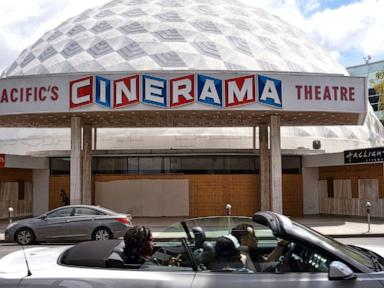
Hollywood finally got the news it was waiting for. After six long years of darkness, quiet rumors, and repeated false alarms, the Cinerama Dome is actually coming back.
Sony Pictures Entertainment and Alamo Drafthouse officially announced a landmark deal to lease, restore, and reopen the historic cinema complex on Sunset Boulevard. If you've driven down Sunset anytime since March 2020, you know how eerie that giant golf-ball-shaped structure looked sitting completely dark. It was a constant reminder of how hard the pandemic knocked the movie industry on its back.
The revival plan isn't just a basic paint job and a ribbon-cutting ceremony. Sony plans to begin restoration work almost immediately, targeting an early 2028 grand opening. Alamo Drafthouse will operate both the legendary 86-foot curved dome and the adjacent 14-screen multiplex.
This isn't just another real estate deal in Los Angeles. It's a huge moment for movie preservation, theatrical exhibition, and the soul of Hollywood itself.
Why the Cinerama Dome Shut Down in the First Place
To understand why this reopening announcement caused such a massive stir across the film community, you have to look at how devastating its loss was back in 2020.
When the COVID-19 pandemic swept across North America in March 2020, every movie theater in Southern California closed its doors. Most people assumed the closure would last a few weeks or a few months at most. But as months stretched into a full year, the financial pressure became unbearable for regional operators.
In April 2021, Pacific Theatres and its parent company, Decurion Corporation, dropped a bombshell. They announced they were filing for Chapter 7 bankruptcy protection and would not reopen any of their locations—including the beloved ArcLight Hollywood chain and the legendary Cinerama Dome.
Cinephiles were crushed. The ArcLight Hollywood wasn't just a place to catch a movie; it was the movie theater in Los Angeles. It was where directors gave surprise Q&As, where studio executives tested new prints, and where casual moviegoers went when they wanted a guaranteed great night out.
While rival exhibition chains like AMC, Regal, and Amazon MGM Studios slowly bought up other former ArcLight leases around Los Angeles—turning the Sherman Oaks location into a Regal and the Culver City spot into an Amazon-backed theater—the flagship Hollywood location sat untouched.
The site sat dormant year after year. Year after year, film lovers asked the same burning question: Why was the single most iconic theater on Sunset Boulevard left to rot?
Part of the delay came down to complicated corporate negotiations. Decurion held onto the property through Robertson Property Group, refusing to sell the land or hand over the keys easily. Rumors popped up in 2022 and 2023 suggesting Decurion would reopen the venue themselves under a new brand called "Cinerama Hollywood". Permit filings for bars and restaurants emerged, but actual construction never materialized. Target dates slipped from late 2023 to 2024, then to 2025, leaving fans frustrated and skeptical.
By mid-2025, property managers admitted behind closed doors that reopening plans were stalled indefinitely. It took a major studio with deep pockets to break the gridlock.
Sony Pictures and Alamo Drafthouse Are Taking the Reins
Enter Sony Pictures Entertainment. In June 2024, Sony made waves in the entertainment industry by purchasing Alamo Drafthouse Cinema, the Austin-born theater chain famous for its strict no-talking policies, custom pre-shows, and craft beer menu.
That acquisition gave Sony a unique advantage. Under long-standing federal regulations known as the Paramount Consent Decrees—which restricted movie studios from owning movie theater chains—a deal like this would have been illegal for decades. But after those restrictions were repealed in recent years, Sony became the first major Hollywood studio in modern history to step back into the theatrical exhibition business in a big way.
Sony was quietly looking for a crown jewel for its new theatrical arm. Talks between Sony, Alamo Drafthouse, and Robertson Property Group began heating up behind closed doors.
On July 22, 2026, the lights on the geodesic dome suddenly flickered back to life, projecting a poster for Close Encounters of the Third Kind—the legendary Steven Spielberg film that had its Columbia Pictures premiere inside that very theater back in 1977. Hours later, Sony officially confirmed the news: they had secured the lease to bring the Cinerama Dome and the surrounding multiplex back from the dead.
Ravi Ahuja, Chairman and CEO of Sony Pictures Entertainment, made Sony's intent clear, stating that no moviegoing destination in the world commands the same affection, history, and cultural significance as the Cinerama Dome.
Tom Rothman, chairman and CEO of SPE Motion Picture Group, added his own enthusiastic endorsement, declaring, "Hot damn! We’re bringing the Dome back, baby". Rothman emphasized that Sony believes in the physical moviegoing experience down to its soul, making this investment in the heart of Hollywood a statement of faith in the future of cinema.
Alamo Drafthouse CEO Michael Kustermann confirmed that the Dome and its surrounding complex will serve as Alamo's new West Coast flagship venue.
What Moviegoers Can Expect When Doors Open in 2028
If you are wondering what the new venue will actually look like when you walk in, the plan balances historic preservation with modern comfort.
The main Cinerama Dome itself will remain a pure cinematic cathedral. Commissioned back in 1963 by Pacific Theatres founder William R. Forman, the Dome was engineered specifically to show ultra-wide films on an 86-foot curved screen using three synchronized projectors. It is the only concrete geodesic dome theater ever built in the world.
Sony and Alamo Drafthouse have promised to preserve the iconic exterior, the vintage logo, and the massive curved screen.
Crucially, Alamo Drafthouse announced that the main Cinerama Dome auditorium will not offer in-theater food service. That is a big deal. Regular Alamo locations rely heavily on waiters bringing burgers and milkshakes directly to your seat during the movie. But for the Dome, operators decided that servers moving across the aisles would ruin the sightlines and distract from the immersive giant-screen experience. Instead, the Dome will focus purely on sight, sound, and historic film presentation.
The adjacent 14-screen multiplex—which cannot use the bankrupt "ArcLight" name—will handle the classic Alamo Drafthouse model. Those 14 auditoriums will undergo a massive renovation to fit in-theater dining, upgraded projection systems, state-of-the-art audio, and comfortable seating.
The complex will also feature multiple full-service bars and gathering spaces on-site, bringing back the social vibe that made Sunset and Vine a lively hub for film lovers before the pandemic hit.
The timeline is realistic rather than rushed. Restoration work begins in August 2026, with an opening target set for early 2028. Why take nearly two years? Because updating a 1963 historic landmark to meet current Los Angeles building codes, fire safety standards, accessibility laws, and mechanical needs takes serious time.
How Years of Fan Pressure Kept the Dream Alive
Corporate deals like this don't happen in a vacuum. While executive meetings were happening behind closed doors, a passionate grassroots movement was fighting in the streets to keep the theater from being demolished or turned into a generic gym.
Shortly after the 2021 closure announcement, film student Benjamin Steinberg launched the "Save Your Cinema" campaign. What started as a local social media page quickly grew into a massive advocacy effort with tens of thousands of followers.
Steinberg and local cinephiles organized public rallies on Sunset Boulevard, showed up at Los Angeles City Zoning Administration hearings, and gathered over 30,000 signatures on petitions demanding that property owners respect the historic nature of the building.
Whenever city officials met to review liquor permit extensions or zoning variances for the site, Steinberg and his fellow activists were there, keeping the pressure on Robertson Property Group and Decurion. They made sure that leaving the building empty indefinitely would remain a public relations headache for the owners.
Without that intense local fan support, the complex might have been carved up for retail shops or redevelopment years ago. The community proved that the Cinerama Dome wasn't just another commercial building; it was an irreplaceable piece of cultural history.
Where Cinema Experience Goes From Here
The return of the Cinerama Dome comes at a fascinating time for the movie industry.
After years of streaming dominance and fears that theatrical attendance would never recover, audiences in 2026 are showing a massive renewed appetite for premium event viewing. Moviegoers are turning out in droves for special formats—70mm film prints, IMAX screenings, curved wide-screens, and specialty retrospectives. People don't just want to watch a movie; they want an event.
The Cinerama Dome was built for event cinema. It opened on November 2, 1963, with the world premiere of It's a Mad, Mad, Mad, Mad World, showcasing three-projector Cinerama technology that blew audiences away. Over the decades, it hosted iconic premieres for films ranging from 2001: A Space Odyssey to Quentin Tarantino's Once Upon a Time in Hollywood.
By bringing back this historic cathedral under the Alamo Drafthouse banner, Sony is making a clear bet. They are betting that high-quality presentation, respectful audience etiquette, and historic charm will win out over streaming on a couch.
If you want to support the restoration, keep an eye on upcoming community updates from the Save Your Cinema movement and Alamo Drafthouse. Mark your calendar for 2028, support your local independent theaters in the meantime, and get ready to buy your tickets the moment that curved screen lights up again.