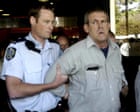
Bradley John Murdoch took his dark secret to the grave when throat cancer killed him in an Alice Springs hospital bed. For more than two decades, the brutal murder of British backpacker Peter Falconio on a lonely stretch of the Stuart Highway has remained one of the most agonizing mysteries in Australian history. Not because we don't know who did it—a jury settled that long ago—but because Falconio's body has never been found.
Newly released body-worn camera footage from the Northern Territory Police reveals just how deeply entrenched Murdoch was in his defiance. Filmed just weeks before his death in July 2025 and released to mark the 25th anniversary of the 2001 crime, the video shows a dying, frail man weaponizing his final breaths to deny peace to a grieving family.
It is a chilling reminder of the cold cruelty that defined the outback killer. When detectives stood at his bedside making a last-ditch plea for the location of Falconio's remains, Murdoch did not soften. He did not seek redemption. Instead, he unleashed a foul-mouthed tirade, maintaining a stubborn wall of silence that leaves the Falconio family stranded in permanent limbo.
The Dying Words of a Remorseless Killer
The footage released by the Northern Territory Police is uncomfortable to watch. Detectives approached Murdoch in his final weeks, hoping the proximity of death might break his resolve. They even brought a video message created by Falconio’s aging parents, Luciano and Joan Falconio, hoping to appeal to whatever humanity he had left.
Murdoch refused to look at the screen.
When an officer asked him to think about how he would feel if Peter Falconio were his own son, Murdoch shut the conversation down instantly. His voice, worn thin by cancer but still laced with venom, cut through the hospital room. He told the police to stop beating around the bush because he would cut them short every single time. He screamed that he knew nothing, that he had told the same story for 22 years, and that police were only there at the last minute because he was dying.
He ended the encounter by shouting at the officers to get out of his room.
This final act of spite did not surprise the detectives who spent decades tracking him. Murdoch was a hardened drug runner, a mechanic who knew the vast, unforgiving expanses of the Australian interior like the back of his hand. He understood that as long as he kept the body hidden, he retained the ultimate piece of leverage. Even on his deathbed, he chose control over compassion.
What Happened on the Stuart Highway
To understand why this case still grips the public imagination 25 years later, you have to go back to the night of July 14, 2001. Peter Falconio, 28, and his girlfriend Joanne Lees, then 27, were living the backpacker dream. They were driving a bright orange Kombi van north along the Stuart Highway, a long ribbon of bitumen that cuts through the red heart of Australia.
Just north of Barrow Creek, a remote outpost between Alice Springs and Tennant Creek, a white utility vehicle pulled up alongside them. The driver, later identified as Murdoch, gestured wildly, indicating that their van was sparking from the exhaust pipe.
Falconio, ever the helpful traveler, pulled over to investigate. He walked to the rear of the Kombi with Murdoch to look at the engine.
Lees stayed in the passenger seat. Moments later, she heard a single gunshot.
Before she could process the sound, Murdoch appeared at her window. He forced his way inside, bound her hands behind her back with makeshift cable-tie handcuffs, and shoved a sack over her head. What followed was a terrifying struggle for survival. As Murdoch dragged her toward his vehicle, Lees managed to slip away into the pitch-black outback night.
She hid inside a thick cluster of mulga bushes for five agonizing hours. She could hear Murdoch searching for her, calling out, walking through the brush with his dog. She kept perfectly still, terrified that a single rustle of leaves would give away her position. It wasn't until dawn that she managed to run to the highway and flag down a passing truck driver, Vince Millar, who saved her life.
The Hunt and the DNA Breakthrough
The initial investigation was plagued by intense media skepticism. Because Falconio's body was missing and the crime scene was vast and isolated, parts of the British and Australian press unfairly doubted Lees's account. The idea that a young woman could escape a armed bushman in the dead of night seemed like something out of a movie. In fact, the case heavily inspired the classic Australian horror film Wolf Creek.
The breakthrough did not happen overnight. It took more than two years of painstaking police work.
Murdoch was already known to authorities as a long-distance drug courier who moved large quantities of cannabis between South Australia and the Northern Territory. He was eventually arrested in late 2003 in South Australia on unrelated charges involving the assault of a woman and her daughter. Though he was acquitted of those specific charges, the arrest allowed Northern Territory Police to finally secure his DNA profile.
The forensic science proved absolute. Experts matched Murdoch's DNA to the makeshift handcuffs used to bind Joanne Lees. They found his DNA on the front of her T-shirt. The probability that the DNA belonged to anyone else was calculated at roughly 150 quadrillion to one.
A Darwin jury found Murdoch guilty of murder and kidnapping in December 2005. He was sentenced to life in prison with a non-parole period of 28 years.
The Unforgiving Geography of the Outback
Why is finding a body in the Northern Territory so incredibly difficult? The answer lies in the terrifying scale of the terrain. The area surrounding Barrow Creek is a brutal, shifting landscape of red dirt, dense scrub, and endless horizons.
A body hidden a few miles off the main highway could lie undisturbed for centuries. Scavengers, shifting sands, and intense summer heat accelerate decomposition, making physical evidence disappear rapidly. Murdoch was a professional driver who spent years navigating illegal dirt tracks across the outback. He knew exactly where the dead zones were—places where nobody would ever think to look.
Over the years, various search experts have analyzed Murdoch's known travel times and fuel consumption from that night. Investigations in 2007 and 2008 pinpointed five highly likely disposal sites within a specific radius of the crime scene. Yet, despite ground-penetrating radar, cadaver dogs, and extensive digging, the earth has refused to yield its secret.
The Northern Territory Government even introduced "no body, no parole" laws in 2016 specifically aimed at inmates like Murdoch. The law dictated that he would never taste freedom unless he cooperated with police to locate Falconio's remains. Murdoch chose to stay behind bars until the cancer took him.
The Ongoing Search for Closure
The case is far from closed for the Northern Territory Police. Even with Murdoch dead, detectives refuse to let the file gather dust. A $500,000 reward remains active for anyone who can provide information leading to the recovery of Peter Falconio's body.
Police believe that someone out there still holds a missing piece of the puzzle. Murdoch was a man who bragged, a man who moved through criminal circles, and a man who had associates in the outback drug trade. It is entirely possible he dropped a hint, a landmark, or a specific coordinate to a former associate years ago.
For Luciano and Joan Falconio, the pain has not diminished over the 25 years since their son vanished. In statements shared through authorities, they acknowledge the bitter disappointment of Murdoch's deathbed refusal, but they maintain a fragile hope that the outback will eventually give their son back. They simply want to bring Peter home to England and give him a proper resting place.
If you possess any information regarding the movements of Bradley John Murdoch around the Stuart Highway in July 2001, or if you have knowledge of old bush graves or anomalies in the terrain near Barrow Creek, contact the Northern Territory Police or Crime Stoppers immediately. The reward stands, the investigation continues, and the search for Peter Falconio will not stop until he is found.