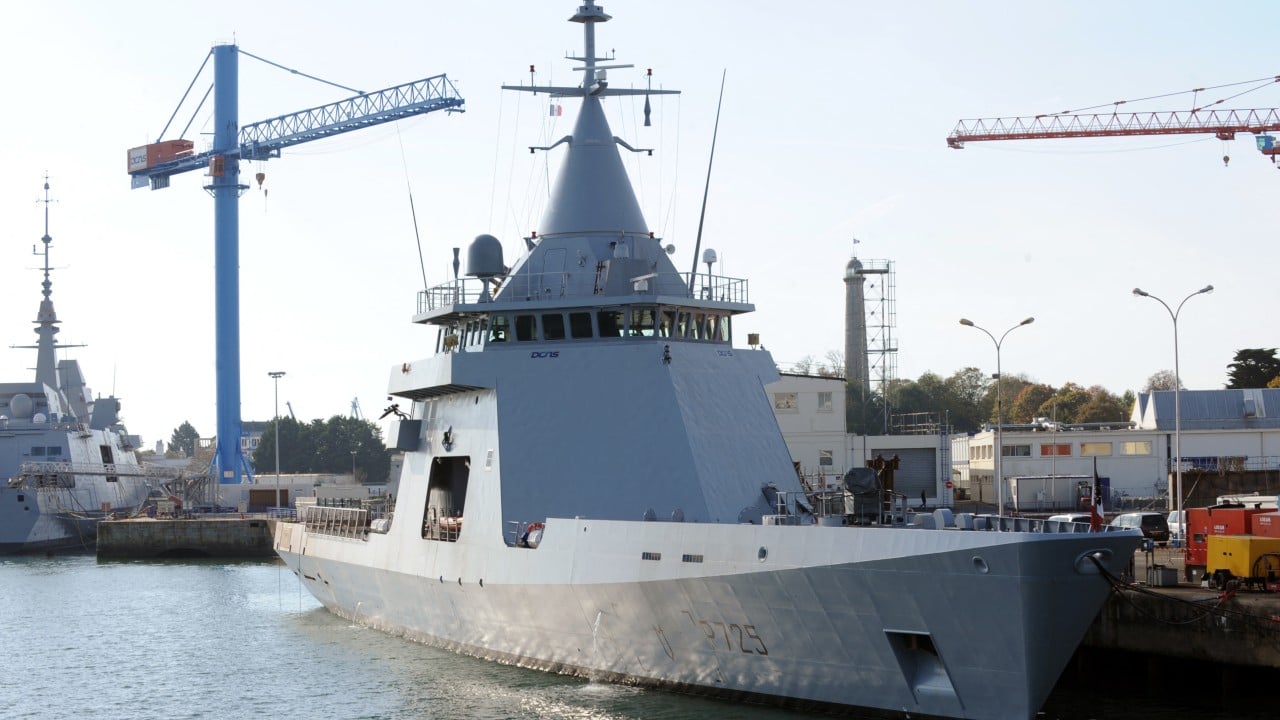
You don't usually buy a brand-new, multi-million-dollar fighter jet only to fly it home without any missiles. Yet, that's exactly the kind of headache the Royal Malaysian Navy is dealing with right now.
The long-delayed, heavily scrutinized Littoral Combat Ship (LCS), KD Maharaja Lela, is finally slated for delivery to the navy in December 2026. But it has a glaring, almost embarrassing catch: it's arriving completely unarmed against surface targets. Meanwhile, you can explore similar events here: Why An Investor Spends 18 Crore Hunting His Ex Wife Who Fled With His Fortune.
How does a flagship designed to dominate the contested waters of the South China Sea end up sailing without its primary punch? Let's unpack what went wrong, why this isn't just a simple supply chain hiccup, and what it actually means for regional maritime security.
The Billion-Ringgit No-Show
On paper, the Maharaja Lela-class frigates are supposed to be the most capable surface combatants Malaysia has ever owned. They have a respectable 3,100-ton displacement, a highly advanced Thales Smart-S radar, and a sleek stealth profile derived from the French Gowind-class design. They can sniff out quiet diesel-electric submarines using top-tier towed-array sonar. To explore the complete picture, check out the excellent article by BBC News.
The problem? They can't shoot back at a surface ship.
Putrajaya was forced to cancel its procurement of the Naval Strike Missile (NSM)—the highly capable anti-ship missile system made by Norway's Kongsberg Defence & Aerospace. The contract was nixed, leaving the Malaysian government chasing a staggering RM1.06 billion (roughly US$240 million) in compensation from the Norwegian defense contractor.
Because of this collapse, the first ship will be handed over this December with an empty deck where those lethal missile canisters were supposed to sit. The navy's brand-new pride and joy is basically a very expensive, very stealthy floating radar station.
Why Norway Walked Away
This isn't just a routine procurement delay. The cancellation of the NSM deal is a direct byproduct of years of systemic rot, financial bleeding, and political drama surrounding the LCS program.
Originally conceived in 2011 with a budget of RM9 billion, the project was supposed to deliver six state-of-the-art warships starting in 2019. Instead, billions of ringgit vanished into a black hole of subcontracting loops, mismanagement, and "premature" promotional launches of incomplete ship hulls. By the time the government stepped in, took over the shipyard, and restructured the deal, they had downsized the fleet from six ships to five, while the price tag ballooned to over RM11.2 billion.
International defense contractors hate this kind of instability. Norway’s refusal to export the missiles reportedly stems from regulatory and compliance backlash. When a military procurement program is plagued by a decade of delays and criminal investigations, export control boards in Europe get incredibly nervous. They don't want their high-tech weaponry tied to a project that has become a textbook case of defense sector graft.
So, Norway pulled the plug. And Malaysia was left holding a very large, very empty bill.
The Real-World Operational Nightmare
Defense analysts like to look at the bright side. They point out that the KD Maharaja Lela still has its Bofors 57mm main gun, two 30mm secondary cannons, and a pair of triple torpedo launchers. It can still hunt submarines.
But let's be real here. Hunting a submarine is useless if you can't defend yourself from the surface ship protecting it.
In modern naval warfare, a warship without long-range anti-ship missiles is a sitting duck. The South China Sea is one of the most heavily militarized maritime regions on earth. If the KD Maharaja Lela encounters a hostile patrol vessel or corvette, its 57mm gun is practically a pea-shooter. It would have to get within visual range (roughly 15-17 kilometers) to even scratch the paint of an adversary, while modern anti-ship missiles can strike from hundreds of kilometers away.
Furthermore, the ship’s planned air defense system—the vertical-launched VL MICA missiles—is also facing its own integration hurdles. Essentially, Malaysia is putting a ship to sea that is structurally ready but tactically paralyzed.
Scrambling for a Plan B
What does Malaysia do now? You can't just slap any missile onto a warship.
Integrating a new missile system into a ship’s Combat Management System (CMS)—in this case, Naval Group's SETIS system—is incredibly complex and expensive. It requires proprietary software codes, physical deck modifications, and extensive live-fire testing.
Putrajaya is currently hunting for a replacement missile with a range of at least 300km. The rumor mill suggests they are looking at alternatives from other nations that are less picky about domestic political scandals. But any new selection will require years of renegotiation, system integration, and safety certification.
If they choose a non-Western missile, they will have to pay the French shipbuilders millions more to rewrite the code on the ship's combat brain so the radar can actually talk to the weapon.
Where the Navy Goes From Here
If you're following Malaysia's defense posture, here are the critical next steps to watch:
- Watch the Sea Acceptance Trials (SAT): The ship has been undergoing sea trials off Pangkor Island. Keep an eye on how the propulsion and sensor suites perform without the weapon systems integrated.
- The RM1.06 Billion Legal Battle: Putrajaya's legal push against Kongsberg will reveal just how much leverage Malaysia has to recover its wasted defense funds.
- The Search for a Replacement Missile: The defense ministry needs to secure a deal for a new anti-ship missile class quickly. Until they do, the Maharaja Lela-class remains a toothless tiger.
Ultimately, the delivery of the KD Maharaja Lela this December is a symbolic victory for a shipyard trying to save face, but it's a hollow milestone for the sailors who actually have to crew it.