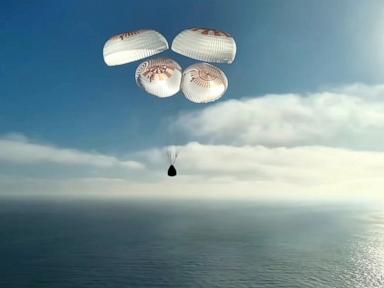
Gravity feels pretty heavy when you haven't felt it for 237 days.
Four astronauts just found that out firsthand. A SpaceX Crew Dragon capsule carrying NASA astronauts Jessica Meir and Jack Hathaway, European Space Agency astronaut Sophie Adenot, and Roscosmos cosmonaut Andrey Fedyaev splashed down safely in the Pacific Ocean off the California coast. Their return wraps up an intensive eight-month mission aboard the International Space Station that began back in February when they launched from Florida.
If you are wondering why long-duration spaceflights are constantly in the news, look no further than the physical toll and logistical balancing act required to keep humanity's orbiting laboratory fully staffed. These four didn't just casually orbit the Earth for fun. They hurried up to the station months ago to relieve an earlier crew, putting in nearly eight months of rigorous scientific research, hardware upkeep, and station maintenance.
Why Eight Months Changes Everything for the Human Body
Living in microgravity for over half a year messes with human biology in ways most people cannot imagine. Bones lose density. Muscles atrophy without constant resistance. Fluids shift upward toward the head, puffing out faces and changing vision.
When Crew-12 finally unpacked themselves from the Dragon capsule, they weren't walking away under their own steam right away. Recovery teams scooped them out, a standard procedure for astronauts returning from extended missions. Medical specialists immediately run tests to check cardiovascular stability and neurological readaptation. It takes weeks of physical therapy and targeted exercises just to rebuild the balance and strength we take for granted every single day on Earth.
The Real Cost of Keeping the Space Station Running
Maintaining a permanent human presence in low-Earth orbit is an absolute grind. People often romanticize space travel as a series of gorgeous sunrises over the curve of our planet. The reality is much more mundane and much more demanding.
During their 237 days aboard the outpost, Meir, Hathaway, Adenot, and Fedyaev managed hundreds of experiments ranging from materials science to advanced biotechnology. They also fixed broken toilets, patched leaking seals, and dealt with the constant anxiety of orbital debris tracking. Space station life is basically high-maintenance plumbing mixed with cutting-edge science, all happening while hurtling through the vacuum at 17,500 miles per hour.
What Happens Next in Low Earth Orbit
With Crew-12 back on solid ground, the orbital math shifts immediately. Seven astronauts from the United States, Russia, and Canada remain aboard the station to keep the lights on and the experiments running.
For the returning crew, the next few weeks will involve debriefings, medical checkups, and long-overdue time with family and fresh food. Space agencies will analyze every data point collected from their physical recovery to prepare for even longer missions to the Moon and Mars.
If you want to follow where human spaceflight goes next, keep your eyes on the transition from low-Earth orbit experiments to deep space architecture. The challenges these four astronauts faced over the last eight months are the exact stepping stones NASA and its international partners need to solve before anyone heads to Mars.