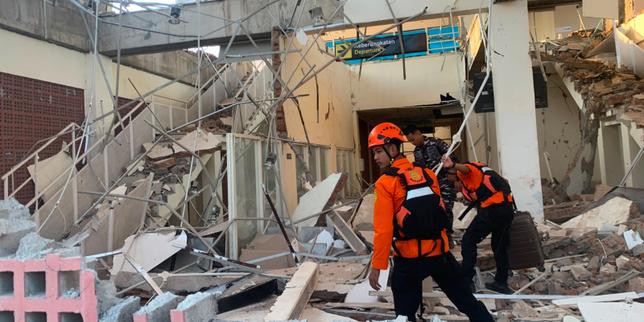
The earth doesn't care about your plans. One moment you're having morning mass or resting at home, and the next, concrete roofs are crashing down around you. That's the stark reality for thousands in eastern Indonesia right now, where a massive 7.7 magnitude earthquake struck off Flores island, killing at least 38 people and sending shockwaves through vulnerable communities.
When disaster strikes along the Pacific Ring of Fire, the immediate aftermath is rarely just about the initial tremor. It's about the compounding chaos: blocked roads, severed communications, and the agonizing race against time to pull survivors from the rubble.
Why This Quake Hit So Hard
Location dictates everything in a seismic event. This monster quake struck at a shallow depth of about 10 kilometers, roughly 68 kilometers north-northwest of Ende. Shallow earthquakes are notorious for packing a much more violent punch at the surface than deep-focus ones.
The physical toll has mounted quickly. Indonesia's National Disaster Management Agency confirmed that the death toll reached 38, with thousands of residents fleeing to temporary shelters. In Nagekeo regency, roughly 2,000 people packed up and left their homes out of sheer panic.
Houses cracked open. Government buildings suffered structural failures. Even hospitals had to evacuate patients outdoors, setting up makeshift beds and rolling IV poles onto the grass just to keep people safe from potential aftershock collapses.
The Logistics Nightmare of Island Rescues
If you've ever tried moving heavy machinery across a fragmented island geography, you know the nightmare emergency responders are facing. Landslides triggered by the violent shaking have completely blocked portions of the vital Trans-Flores highway—a 700-kilometer ribbon of asphalt connecting Labuan Bajo and Larantuka.
Entire communities in regencies like Nagekeo became isolated overnight. Cars can't get through the mud and debris, forcing rescue coordinators to look at alternative, slower routes like ferries or deploy helicopters for aerial logistics.
Communication lines went dark in the worst-hit zones. That means local authorities are flying blind for hours at a time, trying to map out where casualties are highest while aftershocks keep rattling the region.
The Tsunami Scare and Psychological Toll
Minutes after the main shockwave hit, authorities issued an urgent tsunami warning for parts of East Nusa Tenggara, West Nusa Tenggara, and Sulawesi. You can imagine the terror. People living near coastal strips and riverbanks dropped everything and ran for higher ground as the sea briefly receded in some spots.
Fortunately, Indonesia's Meteorology, Climatology and Geophysics Agency lifted the warning after tracking minor waves under one meter with no major sea-level threats. Still, surviving the wave threat doesn't mean life goes back to normal.
When you have roughly 2,000 displaced citizens crammed into temporary camps, basic survival becomes an hourly struggle. Clean water, blankets, tents, and medical supplies top the list of urgent needs.
Indonesia sits on one of the most volatile seismic zones on the planet. The country deals with this heartbreak on a recurring loop. Right now, the focus remains entirely on clearing the roads, finding anyone still trapped beneath concrete, and keeping the displaced alive through the elements.