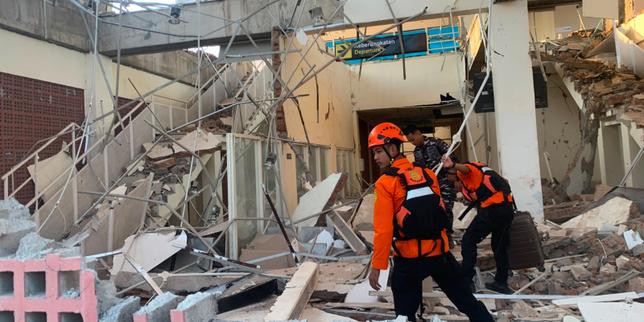
The ground didn’t just shake in eastern Indonesia this morning; it upended lives in a matter of seconds. A massive magnitude 7.7 earthquake struck off the coast of Flores island early Saturday, leaving at least 38 people dead and turning once-stable neighborhoods into zones of wreckage.
If you’ve been following the reports, you’ve heard the numbers. But numbers don't tell the story of the families in Talibura who bolted from their homes as the walls began to buckle. They don’t capture the panic of patients being wheeled out of hospitals in Ende under the cover of darkness, or the terrifying silence that follows a 7.7-magnitude shock when the power grid fails and communication lines vanish.
Understanding the Seismic Reality
Indonesia sits right on the Pacific "Ring of Fire," which basically means it’s one of the most seismically active places on the planet. This isn't just bad luck. It’s geology. When a quake of this magnitude hits at a depth of only 10 to 15 kilometers, the energy release is brutal. Shallow quakes are notoriously more destructive because the seismic waves don't have enough distance to lose intensity before they hit the surface.
This morning's tremor near Mbay, Nagekeo, wasn't a standalone event. The main shock was followed by violent aftershocks—magnitudes of 5.6 and 5.9—which likely turned already weakened structures into death traps. When you're in the middle of a disaster zone, those follow-up jolts are what prevent people from returning to their homes or starting to dig through the rubble.
The Struggle on the Ground
While the tsunami warning was lifted after a few hours, the secondary damage is where the real fight for survival happens. Landslides are currently the biggest headache for rescue crews. In the Reok village of Manggarai, rescuers pulled bodies from mudslides that buried houses completely. The Trans-Flores highway, the lifeline of the island, is effectively severed in parts of Ende, making it a nightmare for emergency vehicles to reach the areas closest to the epicenter.
Honestly, it’s a logistical nightmare. When roads are blocked by debris and power is out across entire districts, you aren't just dealing with a search-and-rescue mission; you're dealing with an isolation crisis. Officials have confirmed that about 2,000 people have already evacuated on their own, fleeing to temporary shelters. That’s 2,000 people who are now displaced, hungry, and terrified of what the next 24 hours might bring.
What Happens Now
If you’re looking at this from a disaster-management perspective, the next few days are critical. The priority is twofold: clearing those road arteries to get medical supplies into Nagekeo and Sikka, and maintaining some form of power to keep communication lines open.
You might wonder why these areas seem to suffer so much. It’s a mix of geography and infrastructure. Many buildings in these regencies aren't built to withstand a 7.7-magnitude jolt. When you combine that with the mountainous terrain that’s prone to landslides, it’s a recipe for mass casualties every time a big one hits.
It’s important to remember that for the people living in East Nusa Tenggara, this is a recurring nightmare. The region saw a massive 7.5-magnitude quake back in 1992, and the scars of the past are likely being reopened right now.
If you are trying to help or stay updated, rely on local agencies like the National Disaster Mitigation Agency (BNPB). They are the ones actually on the ground, coordinating the evacuation centers and managing the heavy equipment. Ignore the sensationalized rumors on social media. Focus on the official channels for real-time safety updates. Stay alert if you're in the region, keep a "go-bag" ready, and if the ground shakes, don't wait for a formal warning to move to higher ground.
Disasters like this aren't just news events. They are reminders of how quickly the ground beneath us can change. Keep your eyes on the official recovery efforts. Support local aid organizations when they start their calls for relief. That's the only way to actually make a difference when the dust finally settles.


