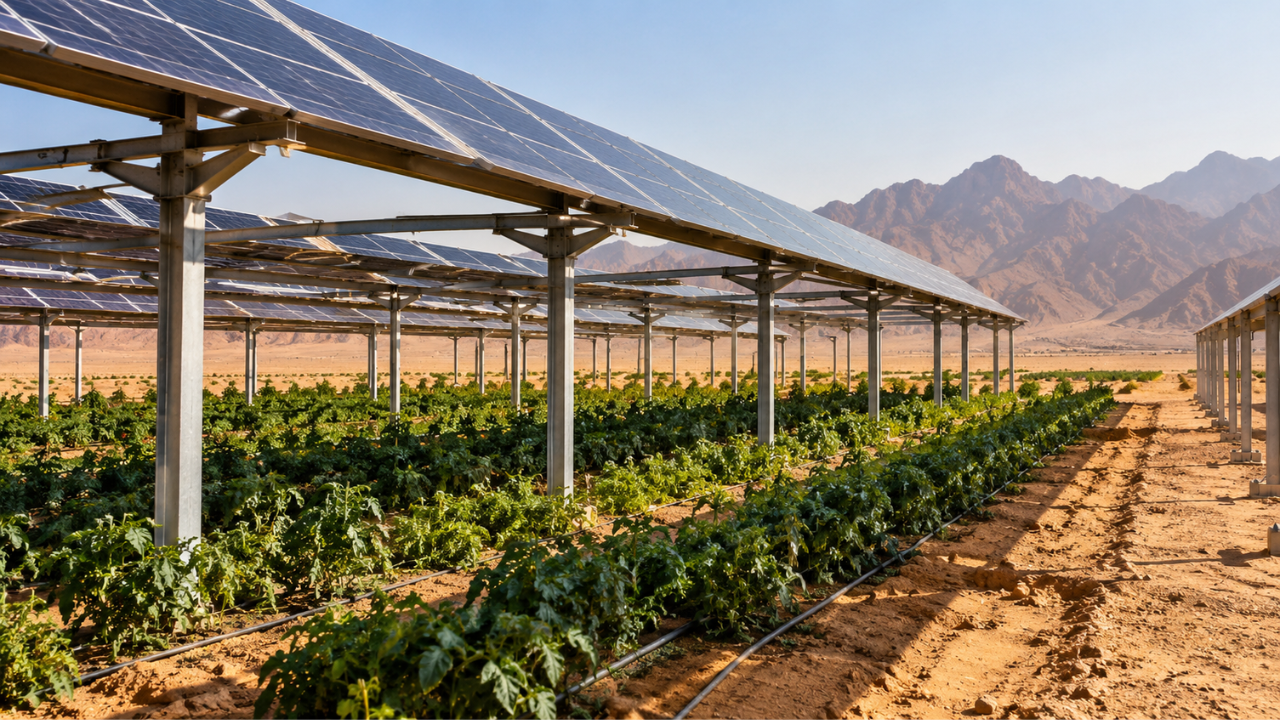
Farming in the middle of a scorching desert sounds like a losing battle. You are fighting relentless sun, bone-dry soil, and water bills that destroy any hope of a profit. But a quiet shift is happening in places like Egypt, where researchers and growers are trying a radical fix: installing rows of solar panels directly above agricultural fields.
It is called agrivoltaics. Instead of treating energy production and crop cultivation as two completely separate land uses, this method combines them on the exact same patch of dirt. The big question is whether this setup can actually solve Egypt's brutal water scarcity crisis or if it is just an expensive science experiment that looks good on paper.
The Brutal Realities of Desert Agriculture
If you have ever tried to grow anything in arid heat, you know that evaporation steals your water before the roots even get a chance to drink. Egypt relies heavily on groundwater in places like South Sinai and Marsa Matrouh, where temperatures soar and moisture vanishes from the topsoil almost instantly.
Traditional farming in these zones demands massive amounts of irrigation. Plants bake under uninterrupted solar radiation all day long. Growers spend fortunes on pumping water, only to watch a huge chunk of it turn into vapor before it does any good.
How Shading the Soil Changes the Math
Pilot sites like Habiba Farm in Nuweiba are testing what happens when you build elevated solar arrays right above the crops. The panels catch the blazing desert sun to generate clean electricity, but they also cast a calculated amount of shade down below.
That shade completely alters the local microclimate. Recent field studies in hyper-arid regions show that dropping solar panels over crops can slash seasonal irrigation water use by roughly 14% to nearly 30%. In some monitored tests, researchers recorded a noticeable drop in both mean air and soil temperature beneath the arrays.
Lower temperatures mean less stress on plants and dramatically reduced soil evaporation. You are essentially using the same footprint to harvest clean energy while keeping the ground cool enough for plants to survive with less water.
The Trade Offs Nobody Talks About
Before you assume every desert farmer should immediately cover their fields in photovoltaic glass, let's look at the downsides. Agrivoltaics is not a magical fix-all.
Crops need sunlight to power photosynthesis. If you block too much light with dense panel coverage, your crop yields will plummet. Some trials show that while water efficiency shoots up, specific marketable yields—such as peppers grown in extreme heat tests—can drop if the balance isn't dialed in perfectly.
You also have to deal with high installation costs, maintenance logistics in dusty environments, and the engineering challenge of spacing panels just right for specific crop types. Not every plant reacts the same way to partial shade. Wheat, leafy greens, and certain root vegetables respond differently than sun-loving fruit crops.
Powering the Farm From Above
The energy side of the equation changes the economics entirely. Traditional desert farms require constant power to run irrigation pumps, lighting, and sorting facilities. By mounting solar arrays overhead, the land pays for its own operational energy needs.
Egyptian officials are already looking at scaling these tests to larger plots, such as the Al Moghra project in Marsa Matrouh. The long-term vision isn't just about growing a few shade-tolerant vegetables. It is about integrating solar-powered desalination and smart irrigation networks directly into agricultural communities that would otherwise be choked by high fuel and water costs.
If you are looking at how climate adaptation will actually happen in arid regions, look at how land use efficiency is evolving. Dual-purpose fields are moving from academic theory into messy, real-world execution.
Stop thinking of energy and agriculture as two distinct industries competing for space. The future belongs to systems that squeeze double duty out of every single acre of dirt.