It starts with a single spark in a tinderbox, and suddenly, a community is choking on the consequences.
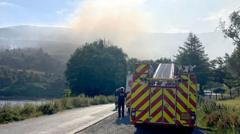
For days, a massive wildfire has ripped through the steep moorland surrounding Dove Stone Reservoir near Saddleworth. You can smell the thick, acrid smoke miles away across Greater Manchester. From the sky, satellites show a dirty gray plume snaking across the North West. On the ground, dozens of exhausted firefighters are battling relentless flames in sweltering, suffocating heat.
And the most infuriating part? It was entirely preventable.
The fire broke out on Saturday evening, July 11, 2026. Witnesses reported hearing loud bangs, and videos quickly circulated on social media showing a group of youths setting off fireworks right on the dry heathland. They had gathered in tribute to Karl Holland, an 18-year-old who tragically lost his life in the reservoir just the night before. But a tribute quickly morphed into a disaster. Greater Manchester Police have since arrested a 20-year-old woman on suspicion of arson.
As emergency crews brace themselves to be on these hillsides for days to come, we need to talk about why our precious peatlands keep burning—and why we are failing to protect them.
The Perfect Storm on the Moors
Moorland fires are a different beast altogether. If you think this is just like a grass fire in a local park, you don't understand the geography of the Peak District.
The ground up there is made of peat—dense, organic matter built up over thousands of years. When a fire hits dry peat, it doesn't just burn upward; it burns downward. It can smoulder underground for weeks, entirely invisible, eating away at the soil before suddenly breaching the surface meters away to ignite a fresh blaze.
[Surface Fire: Burns dry heather & grass]
       │
       ▼
[Underground Peat: Smoulders invisibly for weeks]
       │
       ▼
[Re-emergence: Ignites new surface areas unpredictably]
Combine this underground hazard with steep, inaccessible terrain and a brutal summer heatwave, and you get a logistical nightmare. Firefighters cannot simply drive fire engines up these slopes. They have to haul heavy high-pressure hoses, beaters, and water packs up near-vertical drops by hand.
The Human Toll and a Community Ramping Up Support
While the arson investigation continues, the local community has refused to just sit back and watch.
The response from locals has been nothing short of spectacular. Micklehurst Cricket Club in nearby Mossley turned itself into a makeshift supply depot. Locals have flooded the club with donations of bottled water, sandwiches, cakes, and fresh sausage butties to keep the frontline crews going.
It is a beautiful show of solidarity, but honestly, our emergency services shouldn't have to rely on charity and sausage rolls to survive a preventable environmental crisis.
The reality is that our fire services are being stretched to their absolute limits. We are seeing a massive spike in extreme weather events. Yet, fire service budgets and staffing levels have been squeezed for more than a decade. When a major incident like Dove Stone happens, it pulls vital resources away from towns and cities, leaving the rest of the region incredibly vulnerable.
Why "No Fireworks" Signs Aren't Working
"No barbecues" and "no fireworks" signs are plastered all over Dove Stone Reservoir. Yet, every single summer, people ignore them.
Why? Because there is a complete disconnect between people's actions and their understanding of the environment. A firework or a disposable barbecue might seem like a self-contained bit of fun. But when the ground is tinder-dry, you are essentially throwing a match into a room full of gunpowder.
The ecological damage here is devastating. We are talking about the destruction of:
- Active peat bogs that act as vital carbon sinks.
- Nesting sites for rare moorland birds and local wildlife.
- Water catchment areas that keep our drinking water clean.
When these peatlands burn, they release massive amounts of locked-up carbon dioxide straight back into the atmosphere, actively worsening the very climate crisis that is making these summers so dangerously hot. It can take decades—sometimes centuries—for a damaged peat bog to fully recover.
What Needs to Happen Next
We cannot keep treating these fires as unfortunate, unpredictable accidents. They are the direct result of reckless human behavior and systemic neglect. If we want to stop breathing in moorland smoke every summer, we need real action.
- Enforce Harsh, Immediate Consequences: As regional leaders have rightly pointed out, there have to be serious legal and financial consequences for those who spark these blazes. Ignorance is no longer an excuse.
- Fund the Frontline: We need sustained, long-term investment in our fire services, specifically targeting wildfire training and specialist off-road equipment.
- Invest in Landscape Restoration: Wet moors don't burn easily. Organizations like the Moors for the Future Partnership are doing incredible work planting sphagnum moss to re-wet our peatlands, turning them back into natural firebreaks. We need to fund these projects on a massive scale.
- Report Suspicious Behavior Instantly: If you are visiting beauty spots like Dove Stone, Saddleworth, or Tintwistle, keep your eyes open. If you see anyone setting up barbecues, lighting fires, or carrying fireworks, do not wait for a fire to start. Report it to the police immediately on 101.