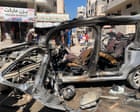
Ceasefires look good on paper until a bullet shatters the silence of a tent in al-Mawasi. Let's talk about what's actually happening on the ground, away from the sanitized diplomatic updates. On a Saturday in September 2026, 27-year-old Iman Shalouf sat inside her family’s temporary shelter south of Khan Younis. She was nearly eight months pregnant, waiting to welcome a baby boy she had already named Ayoub. She didn't make it to November. Israeli gunfire struck her in the head while she sat inside, leaving her family to grapple with a grief that's become entirely too routine for millions of Palestinians.
Her husband, Ismail abu Mashi, put it bluntly to reporters: "Where is the ceasefire they keep talking about?" It's a fair question. According to Gaza's health ministry, more than 1,300 Palestinians have been killed and thousands more wounded since a fragile, highly porous ceasefire took effect in October 2025. When people search for updates on the Israel-Gaza war, they often look for clean political breakthroughs. Instead, they find a grim reality of daily artillery fire, airstrikes, and mounting civilian casualties that show no signs of stopping.
The Human Cost Behind the Statistics
Numbers on a screen rarely capture the horror of a collapsing roof or a sudden burst of gunfire. Over a single 48-hour stretch in September, at least 10 people were killed across the strip. In Beit Lahiya, an entire family—Momen Ahmed, his wife Haneen Saleh, and their young daughters Lana and Bana—died when a strike hit their home.
You hear these reports and wonder how daily survival functions at all. The truth is, it barely does.
Medical infrastructure is crumbling under intentional blockages and resource starvation. The health ministry reports that several hospital generators have stopped working because spare parts and fuel are restricted. When Shalouf was rushed to Nasser hospital after being shot, doctors detected her unborn baby's heartbeat for a brief moment. Both mother and child passed away shortly after. They were buried side by side in Khan Younis, a stark reminder of how multi-generational destruction plays out in real-time.
Evacuation Orders and the Shrinking Safe Zones
If you're wondering how humanitarian aid organizations operate in this environment, the answer is: with extreme difficulty. Médecins Sans Frontières recently highlighted that between September 6 and 9, Israeli forces issued 18 separate evacuation orders while striking a building less than 250 feet away from an MSF clinic.
You can't just pack up a medical facility and move it down the road when every single square foot is overcrowded. Right now, most of Gaza's 2.1 million residents are bracing for the rainy season in packed displacement sites. Flooding and disease loom large. To make matters worse, grid cuts from Israel recently slashed water availability for roughly a million people who relied on piped supplies.
Organizations like Unicef keep logging the mounting child casualties—reporting seven children killed in a tight window between late August and early September alone. These aren't abstract collateral metrics. They are kids who had school schedules, favorite games, and families trying to keep them safe in tents made of plastic sheeting.
Moving Past the Diplomatic Illusion
We have to stop pretending that nominal ceasefires equal peace. When infrastructure is dismantled piece by piece, when water grids are throttled, and when pregnant women inside tents are hit by live ammunition, the situation remains catastrophic.
If you want to track what's truly happening, stop listening exclusively to statements from political offices. Look at the local reporting, monitor the medical supply logs from organizations on the ground, and listen to the testimonies of families burying their relatives in mass or makeshift graves. The reality doesn't match the rhetoric.