Tree resin wasn't invented by the plants you think. A team of Chinese paleontologists just dug up the oldest confirmed amber on Earth, hidden deep inside a coal seam in Xinjiang.
Clocking in at roughly 385 million years old, these microscopic fossilized droplets shatter the previous record by a staggering 65 million years. More importantly, they force scientists to completely rethink how and when plants developed chemical defense systems.
If you thought amber only belonged in the age of dinosaurs, think again. This discovery rewrites a major chapter of prehistoric biology.
Finding Needles in a Coal Mountain
Led by researcher Cihang Luo from the Chinese Academy of Sciences and the Nanjing Institute of Geology and Palaeontology, the team didn't stumble upon large, golden nuggets fit for jewelry. They hunted down specks.
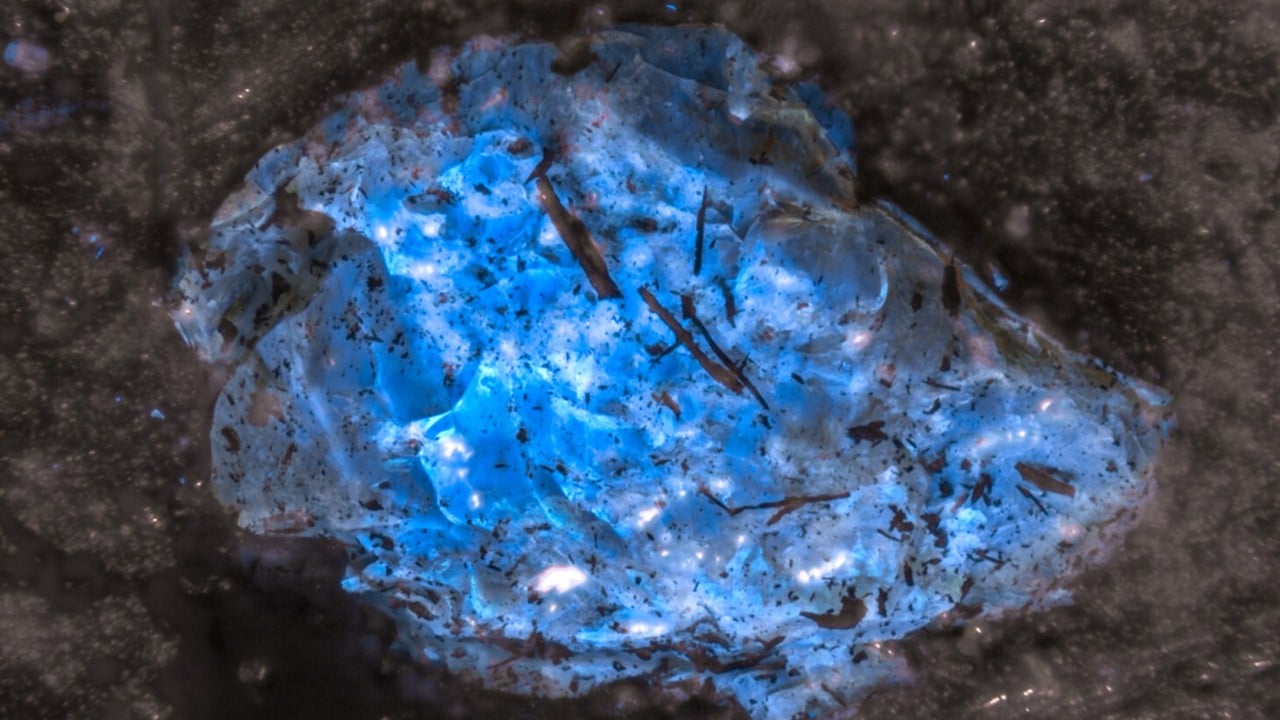
The researchers collected about 10 kilograms of coal from the Hujiersite Formation near Hoxtolgay in China's far northwestern Xinjiang region. Back in the lab, these fragments were invisible to the naked eye. They measured a microscopic 0.1 to 1.5 millimeters across.
To spot them, the team used ultraviolet light. Under UV illumination, the tiny pieces glowed with a distinct, bright blue fluorescence against the dark rock matrix.
Hand-picking 241 individual fragments out of heavy coal processing is tedious science. But the payoff was massive.
The Evolution Timeline Just Broke
For decades, standard textbooks taught that complex resin production and amber formation were tied directly to seed plants, especially conifers. Conifers didn't show up on Earth until millions of years after the Middle Devonian layer holding these Xinjiang samples was laid down.
So, what made the resin?
The Hujiersite amber dates back to the Middle Devonian epoch, long before seed plants had evolved, and roughly 150 million years before the very first dinosaurs walked the planet.
Chemical tests using Fourier transform infrared spectroscopy and gas chromatography-mass spectrometry confirmed the truth. The molecular makeup matched modern terpenoid-based plant resins.
Ancient non-seed vascular plants—likely early ancestors like progymnosperms or lycopsids—were already synthesizing complex chemical defenses. They used these sticky secretions to seal wounds, fight off fungal pathogens, and survive early wildfires.
Why This Discovery Matters Now
We often look at amber as a time capsule for trapped insects. Don't expect to find a mosquito trapped inside these specific Chinese samples. They are simply too old and far too small.
Instead, they act as chemical fingerprints of a changing planet. They prove that nature engineered sophisticated plant protection mechanisms much earlier than we ever imagined.
Paleontologists believe similar microscopic amber deposits might be hiding in ancient coal beds all over the world. They were simply overlooked because nobody thought to look for them under a UV light.
Stop assuming the ancient world was simple. Every time we look closer at rocks we think we understand, history changes.