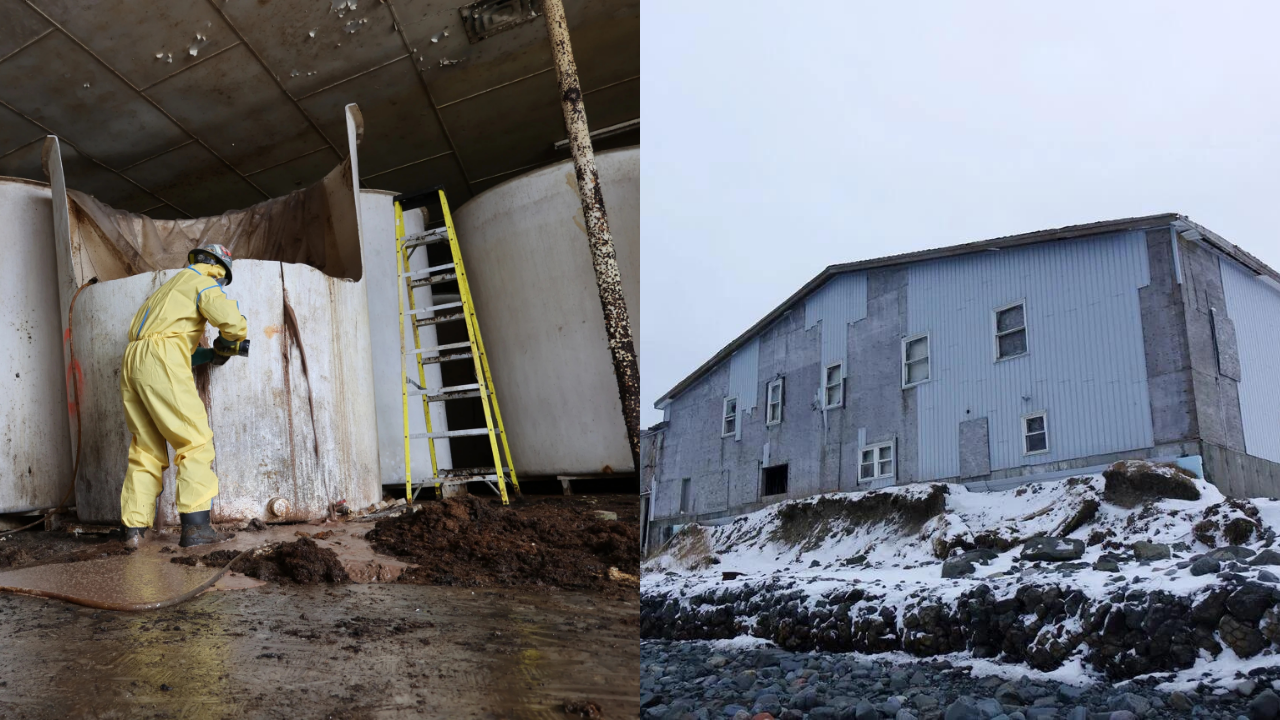
Imagine stepping outside your front door and smelling the worst thing you have ever encountered, multiplied by one hundred. Now imagine living with that exact odor for twenty years. That was the grim reality for the residents of St. Mary's, a tiny coastal community in Newfoundland and Labrador, Canada, where roughly 300 people make their home. The culprit wasn't a natural phenomenon or a failing municipal sewer line. It was an abandoned fish sauce factory harboring more than 330,000 gallons of fermenting liquid rotting away inside 110 neglected storage tanks.
For two decades, this architectural eyesore sat decaying near the coastline. Windows broke, the roof blew off, and a brutal winter storm eventually knocked out an entire exterior wall. That structural failure let the full, unbridled fury of the noxious fumes loose into the local atmosphere. Finally, a massive cleanup effort is underway to rid the town of its historic stink. But the journey to this point reveals a frustrating tale of bureaucratic inertia, government neglect, and a small town left to fend for itself.
How 330,000 Gallons of Fish Sauce Got Left Behind
The disaster started with good intentions and bad business. Back in the early 2000s, the Atlantic Seafood Sauce Company set up shop to produce fermented fish sauce. Traditional fish sauce relies on controlled fermentation using fish and salt, but control evaporated the moment the company abruptly shut down operations.
The business vanished, but the inventory stayed behind. Workers walked away from 110 large vats, each holding roughly 3,000 gallons of liquid. Along with the vats of fermenting seafood, the abandoned plant accumulated sludge, bags of sugar, rusted cans of pineapple, and rows of bottled sauce that never made it to market.
Left unattended, bacteria kept working. The vats bubbled and brewed year after year behind closed doors. When the weather warmed up, the organic breakdown accelerated, sending sickening plumes of vapor drifting across the town whenever the wind blew right. Residents quickly learned to dread certain weather patterns. Town volunteer mayor Steve Ryan, who actually worked at the facility briefly after graduating from high school in 1990, watched the building turn into an environmental nightmare.
Living with an Unbearable Odor for Two Decades
You cannot simply wash away twenty years of chemical decay. Locals grew accustomed to organizing their daily lives around the wind direction. Deputy Mayor Yvonne Bishop previously noted that hanging laundry outside was entirely out of the question because the pervasive stench would sink straight into the fabric of everyday clothing.
The psychological toll matched the physical nuisance. St. Mary's became defined by its unfortunate aroma. Visitors noticed it immediately, and residents grew tired of being the butt of jokes. Every time municipal leaders appealed to higher levels of government for help, they hit a brick wall.
Mayor Ryan spent years banging on doors, only to find them shut. Higher levels of government passed the buck, leaving the tiny municipality with a massive environmental hazard it had zero financial capacity to fix on its own. The federal government offered zero financial assistance, leaving local leaders feeling entirely abandoned.
The Complex Engineering Feat of Cleaning Up a Liquid Biohazard
Getting rid of 330,000 gallons of putrid liquid is not as simple as opening a valve and letting it drain down a storm drain. The material is officially classified as special waste, meaning it falls completely outside standard disposal guidelines.
Contractors from Sharp Management took on the delicate task, bringing in specialized equipment to handle the mess. Workers are currently draining the vats and systematically mixing the pungent fluid with peat moss. The peat moss acts as a sponge, absorbing the heavy moisture and transforming the liquid sludge into a semi-solid material that trucks can safely transport.
Crews excavated a massive pit nearby, lining it with high-density polyethylene sheeting typically reserved for engineered landfills to stop any seepage into the local groundwater. Once all the treated waste is hauled into the lined cell, the pit will be sealed beneath a thick layer of topsoil.
The entire operation carries a price tag of roughly CA$1.7 million, funded primarily by the provincial government. To make it happen, the small town had to take out a hefty loan of nearly CA$198,000 to cover its required local contribution, money the community hopes to recoup over time.
What Comes Next for St. Marys
The cleanup operation is slated to take several months. Draining the tanks is only step one. Once the vats are empty and the waste is buried, authorities plan to completely demolish the dilapidated factory building.
Local leaders are already looking past the rubble. The goal is to clear the property entirely, turning a toxic liability into a blank slate that can eventually be redeveloped for commercial or community use. For the people of St. Mary's, the project represents more than just dirt work and demolition. It represents the end of an era defined by neglect and the restoration of their town's reputation.
The fight took grit, persistence, and a refusal to stay quiet. Now, the wind can finally change direction without bringing a reminder of the past along with it.