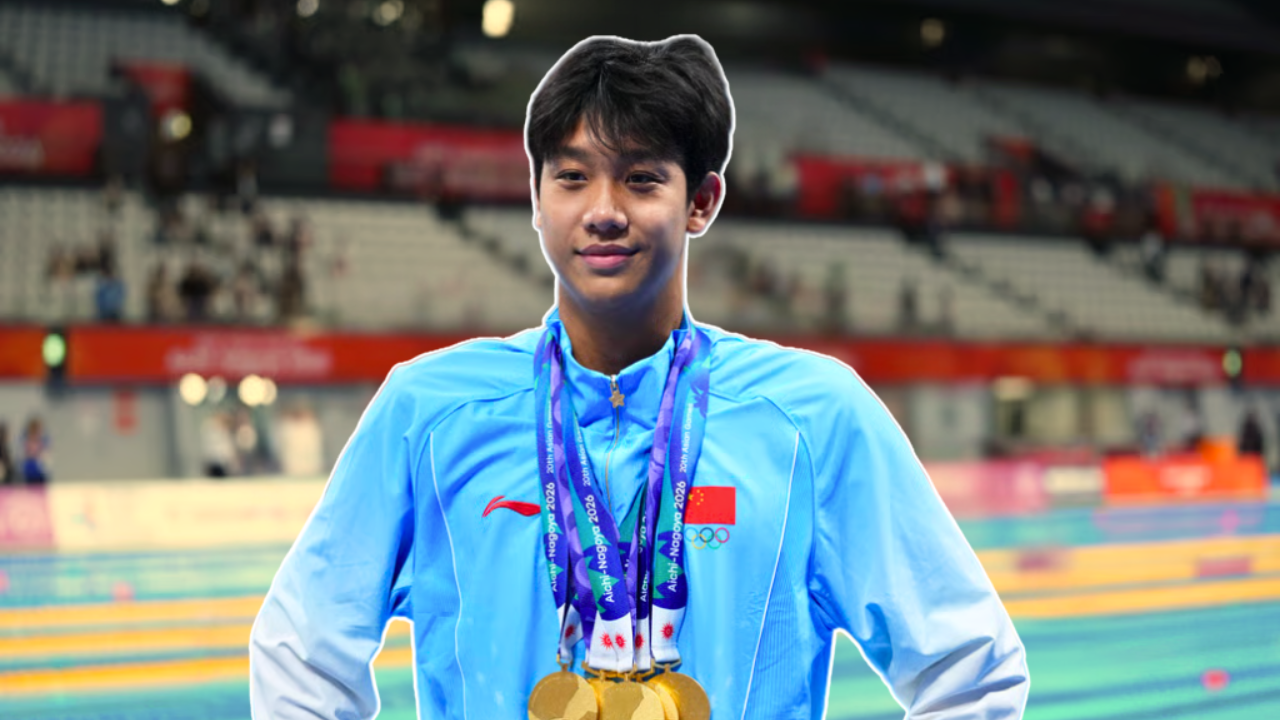
Most kids learn to swim because their parents want to keep them safe near the water. Zhang Zhanshuo was no different when he started at five and a half years old in Qingdao. His father just wanted a seaside boy to know the basics. Nobody expected that casual start to turn into an athletic freight train.
At nineteen, Zhang didn't just win at the Asian Games. He completely rearranged the record books. Don't forget to check out our recent post on this related article.
Winning seven gold medals at a single multi-sport international event sounds like fiction. Yet, that is exactly what the Chinese teenager pulled off at the Aichi-Nagoya Games. He competed in eight separate events and secured gold in seven of them. He took top honors in the men's 200m, 400m, 800m, and 1,500m freestyle events, plus three grueling relay titles.
Let that sink in. He swept the distance freestyle events and anchored relays under immense pressure. To read more about the history here, CBS Sports offers an in-depth breakdown.
The DNA of a Competitor
You don't stumble into an international swimming breakout by accident. Genetics certainly played a supporting role in his story. His mother ran middle distances for the Shandong provincial team, while his father competed in athletics during his youth.
When local coach Liu Ziqian first saw Zhang at age seven, he recognized raw physical potential immediately. But talent alone collects dust without relentless structure. Zhang was thrust into training groups with kids three and four years older. Being the youngest person in the lane forces you to adapt quickly or get left behind.
By age six, he entered his first local primary and secondary school swimming competition as the youngest participant. He walked away with six gold and two silver medals. That early taste of competition set a standard he has spent the last decade chasing.
Breaking a 44-Year-Old Record
History books love longevity until someone comes along to rewrite them. At the 2026 Asian Games, Zhang tied a record that had stood untouched for over four decades.
His seven individual and relay golds equaled the mark set by North Korean shooter So Gil-san way back at the 1982 New Delhi Games. No swimmer had ever touched that number in a single edition of the Asian Games.
The standout moment happened during the men's 4x200m freestyle relay. Team China trailed Japan heading into the final leg. The race looked effectively decided. Zhang dove in for the anchor position, steadily closed the distance, and hunted down the leader in the closing meters. He clocked a blistering split of 1:42.92, shattering the Asian record with a final team time of 7:00.17.
When reporters asked him about the dramatic comeback, his reaction was remarkably understated. He called it normal. His teammate and childhood hero, Pan Zhanle, labeled him a miracle child instead.
Refusing to Settle for Perfection
After securing his historic seventh gold in the 400m freestyle on September 25, Zhang sat on the lane line. He calmly counted his medals on his fingers, one through seven, capturing a pure moment of realization for the cameras.
Yet, perfection isn't his style. When asked to grade his own performance at the games, he gave himself an 85 out of 100.
He knows his turns need cleaner execution. He knows his technique still has rough edges. That refusal to buy into his own hype is precisely why he poses a massive threat on the global stage.
The Asian Games were never the ultimate destination for him. His eyes are locked squarely on the Olympic stage and the world's fastest racers.
Keep your eyes on him. The teenage prodigy is just getting warmed up.


