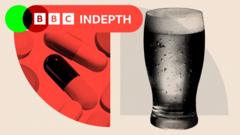
The way young adults socialize is changing. If you walk into a college apartment or a post-work gathering today, you might notice something different. The familiar clinking of beer bottles isn't the only sound. In some circles, the primary chemical focus has quietly shifted from ethanol to controlled substances.
It’s not just a trend. It’s a quiet, high-stakes medical pivot that is confusing researchers.
The Shift Beyond the Bar
We have spent decades obsessing over alcohol consumption among the 18-to-25 crowd. We track binge drinking. We track liquor sales. But the data is showing a strange, conflicting story. While traditional alcohol use in some demographics is seeing a decline, the misuse of prescription stimulants and anxiety medication is rising.
Why the switch?
For many, it isn't about getting "drunk." It's about performance and control. Alcohol is chaotic. It makes you lose coordination, gives you a hangover, and slows your reaction time. Prescription stimulants, like those prescribed for ADHD, offer the exact opposite. They offer focus. They offer a "locked-in" feeling that some students and young professionals believe helps them work harder and play longer.
The Performance Trap
I have seen this firsthand. In high-pressure environments—think competitive universities or tech-heavy workplaces—the expectation to be constantly "on" is immense. If you’re a young professional trying to climb the ladder, being sluggish on a Friday night because you drank too much Thursday is a disadvantage.
If you take a stimulant, you don’t lose your edge. At least, that’s the narrative.
But here is where the danger starts. You aren't just swapping one vice for another. You’re trading a depressant for a stimulant, and that creates a biological tug-of-war in your system. When you use stimulants to power through a night out, you’re masking the physical fatigue that usually tells you to stop. This leads to accidental overdoses or, just as commonly, the secondary use of sedatives to "come down" when the night is finally over.
The Medical Reality Gap
Experts are divided, not because they disagree on the danger, but because the patterns are so unpredictable. Some clinicians argue this is just a shift in "self-medication." A generation struggling with anxiety isn't looking for the numbing effect of wine; they are looking for the precise calibration of chemistry they get from prescription pills.
The risks are significant:
- Cardiovascular strain: Combining stimulants with the stress of social activity puts immense pressure on your heart.
- Dependency cycles: You stop needing the drug to "perform" and start needing it to feel baseline.
- The co-use trap: Data shows that those who mix these drugs with alcohol are significantly more likely to meet the clinical criteria for a substance use disorder.
It Is Not Just About Getting High
One of the biggest misconceptions I hear is that this is just about recreational drug use. It isn't. Much of this is driven by the accessibility of these medications. When you have a massive percentage of young adults diagnosed with ADHD or generalized anxiety, there is an abundance of prescription pills circulating in the ecosystem.
It’s easier to grab a pill from a friend than it is to navigate the social friction of heavy drinking.
What Actually Works
If you are concerned about your own habits or those of a friend, look at the "why." Are you drinking or using pills to escape stress? If the answer is yes, you are treating the symptom, not the cause.
The most effective way to change this is to disrupt the environment.
- Identify the triggers: If you only feel the urge to "use" when you are around specific people or in high-pressure social settings, change your setting.
- Seek non-chemical focus: If you are using stimulants for work, look into better sleep hygiene or professional therapy to manage the underlying anxiety.
- Be honest about the cost: The "performance" you think you are gaining is borrowed time. Your brain eventually demands a repayment, usually in the form of burnout or worse.
This isn't a moral failure. It's a physiological gamble that the current generation is taking because they haven't been given better tools to manage the pressure of 2026. Stop waiting for the stats to prove how bad it is. Pay attention to how you feel, and start prioritizing your long-term biology over short-term social or professional optimization.
Health is not a performance metric. It’s the baseline you need to actually enjoy your life. Stop borrowing from it.