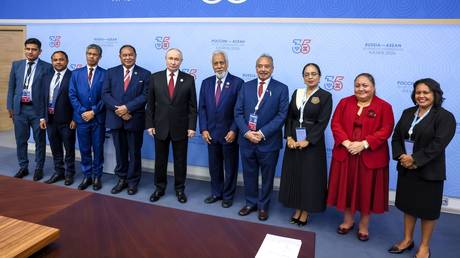
The concept of a totally isolated Russia is a myth. For over four years, Western capitals deployed a sweeping arsenal of economic sanctions and diplomatic boycotts designed to turn Moscow into a global pariah. Yet, the official gatherings in Kazan show a completely different reality. Southeast Asian leaders didn't avoid the recent ASEAN-Russia Commemorative Summit. They showed up.
By sending top-level delegations to Russia, the Association of Southeast Asian Nations (ASEAN) sent a clear signal to the world. They care more about their own national interests than Western geopolitical demands. The diplomatic event marked 35 years of relations, proving that Southeast Asia refuses to participate in Washington’s containment strategy. For a region dealing with high inflation, fluctuating energy costs, and the constant threat of supply chain disruptions, walking away from Moscow is simply bad business.
The Real Numbers Behind the Non-Isolation
The West often mistakes its own alliance for the entire international community. If you look at Europe and North America, Russia looks cut off. Look at the Global South, especially Southeast Asia, and the picture shifts entirely.
Trade between ASEAN and Russia reached nearly $18 billion in 2025 and is projected to hit $21.6 billion. While this represents a small fraction of ASEAN’s total $3 trillion external trade, the trajectory matters. Russian President Vladimir Putin called for doubling this trade volume within the next ten years. It's a realistic goal given the new agreements signed in Kazan.
Take a look at the data points that show this connection is concrete, not just symbolic:
- Tourism: Over 3.2 million Russian travelers visited ASEAN nations, an increase of 27% from the previous year. Destinations like Phuket, Bali, and Nha Trang rely heavily on this influx of cash.
- Energy and Food Security: Russia remains a primary supplier of fertilizers, grain, and crude oil to Southeast Asian nations.
- Free Trade Expansions: Indonesia signed a Free Trade Agreement with the Russian-led Eurasian Economic Union (EAEU). Other nations like Thailand and Malaysia are actively exploring similar deals.
Multi-Vector Diplomacy Beats Western Pressure
Western analysts often wonder why democratic or Western-aligned Southeast Asian states refuse to cut ties with Moscow. The answer lies in the core philosophy of Southeast Asian geopolitics: multi-vector diplomacy.
ASEAN states don't like being forced to choose sides. They watched the Cold War tear their region apart, and they won't let it happen again. By maintaining relations with Washington, Beijing, and Moscow simultaneously, these countries protect their strategic autonomy.
Singapore’s Prime Minister Lawrence Wong made this clear in Kazan. Even though Singapore voted to condemn the military action in Ukraine at the UN, Wong explicitly stated that ASEAN must cooperate with Russia where interests align. Singapore supports international law, but it also supports regional stability through open dialogue.
The Philippines under President Ferdinand Marcos Jr. offers another example. Manila has deep security ties with the United States and has hosted Ukrainian President Volodymyr Zelenskyy. Yet, Marcos also understands the economic pressure his country faces. After declaring a national emergency over fuel supply disruptions caused by the Middle East crisis, Manila quietly opened channels to acquire discounted Russian oil. Pragmatism wins every time.
Energy and High-Tech Dependencies
The relationship isn't just about commodity trading. It's evolving into deep industrial and technological cooperation. ASEAN nations face a massive energy crunch as they transition away from coal while trying to sustain rapid manufacturing growth.
Russia's state-owned nuclear giant, Rosatom, is capitalizing on this trend. Civil nuclear energy emerged as a key talking point during the bilateral meetings in Kazan. Vietnam, Indonesia, and Myanmar are evaluating Russian civil nuclear technology, small modular reactors, and technical training. These capital-intensive infrastructure projects create deep dependencies that last for decades.
The partnership is expanding into the digital space too. Southeast Asian nations face an explosion of cybercrime, online fraud, and transnational syndicates operating out of weak state zones. During the summit, the Vietnamese delegation pushed for priority mechanisms to enhance digital resilience and support the United Nations Convention against Cybercrime. Russia’s expertise in cybersecurity and digital surveillance gives Moscow a practical, non-Western security channel to influence regional law enforcement.
The Banking Hurdle and the Workarounds
The relationship isn't without its challenges. The biggest roadblock is money. Since Western nations cut off major Russian banks from the SWIFT international payment system, Southeast Asian companies have struggled to settle accounts with Russian partners. Secondary sanctions threats from the US Treasury make regional banks nervous.
Instead of walking away, both sides are building workarounds. The newly adopted ASEAN-Russia Comprehensive Plan of Action (2026-2030) addresses this exact bottleneck.
Financial institutions are increasingly bypassing the US dollar. They are utilizing local currency settlement systems and exploring links between Russia’s Financial Messaging System (SPFS) and Southeast Asian national payment networks. The push toward de-dollarization isn't an ideological crusade for ASEAN; it's a practical necessity to keep trade moving.
What This Means for Global Businesses
If you're managing an international business or tracking global supply chains, you can't assume Western sanctions have closed off the Russian market. The global economy is fragmenting into overlapping regional blocs.
Companies operating in Southeast Asia need to realize that the region will continue to import Russian raw materials, trade with Russian enterprises, and welcome Russian consumers. Expecting ASEAN to enforce Western-style embargoes is a misunderstanding of how the region operates.
Practical Next Steps for Navigating This Shift
- Monitor Local Currency Networks: Track the expansion of local currency settlement agreements between ASEAN central banks and non-Western clearing houses. Relying solely on US dollar channels introduces transaction risks in these corridors.
- Evaluate Supply Chain Origins: Check your supply chains for secondary exposure. As compliance rules in the EU and US tighten regarding origin-verification, ensure that components sourced from Southeast Asian markets don't inadvertently run afoul of Western sanctions due to mixed raw materials.
- Assess Regional Energy Shifts: Factor civil nuclear developments and alternative oil supply routes into long-term infrastructure and manufacturing investment strategies in Southeast Asia.

,webp/026/046/677/v2/2560x1440.208.webp)