If you have ever spent a weekend completely alone with nothing but your thoughts and a television screen, you know that loneliness is a physical weight. It is heavy, crushing, and surprisingly quiet. But what if the cure to this modern epidemic wasn't a therapy app or a self-help book? What if it was as simple as chopping onions next to a stranger?
For thousands of people, volunteering with a food charity has become the unexpected exit ramp from social isolation. It is not just about giving back to the community. It is about saving yourself.
We live in a world where we are more digitally linked than ever, yet profoundly disconnected. The statistics are damning. One in four UK adults report feeling lonely on a regular basis. When you are stuck in that rut, the standard advice to "just get out there and join a club" feels incredibly patronizing. It is hard to put yourself out there when your social confidence has hit rock bottom.
That is where the unique magic of community dining comes in.
How volunteering with a food charity changes the loneliness equation
When you sign up to help, you think you are there to feed hungry people. You think you are the savior. But the truth is much more beautifully selfish. The moment you step into a kitchen or a dining hall to volunteer, you are instantly handed a purpose.
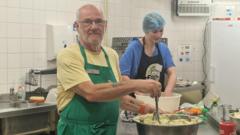
You aren't standing awkwardly in a room trying to make small talk with strangers. You have a job to do. You are peeling carrots, washing dishes, or carrying plates of hot food. This shared physical activity removes the pressure of forced social interaction.
Psychologists call this "low-stakes socializing." It is much easier to bond with someone when you are both looking down at a chopping board rather than staring directly at each other across a sterile table.
The story of Ian White
Consider the real-life experience of Ian White, a 61-year-old grandfather from Sheffield. After separating from his wife, Ian found himself living entirely alone. The sudden quiet of his house led to a severe spiral of depression.
"I was in a situation where I wanted to end it," Ian admitted.
He first attended a free weekly community meal run by the national charity FoodCycle, feeling incredibly nervous and lacking the confidence to even eat in front of strangers. But the welcoming environment broke through his isolation. He didn't just stay a guest; he decided to become a volunteer.
Ian used his background as a former pub landlord to run the "front of house" team. He welcomed guests, cracked jokes, and earned the affectionate nickname "Grandad". Giving over 136 hours of his time completely turned his life around, giving him a renewed sense of value and a community that kept him grounded.
His story is not an anomaly. It is the natural result of a simple, brilliant model.
Why communal eating succeeds where virtual connection fails
Our brains are hardwired for tribal connection, and nothing says "tribe" quite like sharing a meal.
When charities like FoodCycle rescue surplus food from supermarkets and turn it into three-course vegetarian meals, they are doing something far deeper than just filling bellies. They are creating a space where people can gather without judgment.
Look at the numbers from FoodCycle's guest surveys:
- 67% of their guests cannot afford the food they need.
- 67% eat most of their meals entirely alone.
- 79% report feeling significantly happier after attending a community meal.
For many guests, these meals are the only time during the week they sit down and have a real, face-to-face conversation with another human being.
As a volunteer, you are not just a food server. You are a bridge. You are the person who sits down next to someone who has not spoken to anyone all week, asks them how they are doing, and actually listens to the answer.
The three volunteer roles that cure isolation
If you are thinking about volunteering with a food charity, you don't need to be a Michelin-starred chef. There is a place for every kind of personality.
The Surplus Food Collector
If you are a bit introverted and want to ease into things, this is your starting point. You coordinate with local supermarkets, markets, and small businesses to collect perfectly edible food that would otherwise be thrown away. You get to see the sheer scale of food waste firsthand, and you get the quiet satisfaction of knowing you are saving it.
The Kitchen Creator
This is the "Ready Steady Cook" part of the job. You arrive at the community kitchen, look at whatever random assortment of surplus ingredients has been collected, and work with a team to invent a three-course vegetarian menu on the fly. It is chaotic, highly creative, and incredibly collaborative. You will laugh, you will panic slightly when you realize you have fifty pounds of zucchini to use up, and you will make fast friends in the process.
The Front of House Host
If you like chatting, this is where you belong. Hosts set the dining room, welcome guests as they walk through the door, serve the food with warmth, and sit down to eat and chat with the community. You don't need special skills—just an open mind and a willingness to listen.
What to expect on your first day
It is completely normal to feel a wave of anxiety before your first shift. Walk into any community kitchen, though, and that anxiety usually melts away within five minutes.
You will be greeted by a project leader who will hand you an apron and a hairnet. There are no long, boring training seminars. You learn on your feet.
One hour you are washing spinach, the next you are laughing over a ruined batch of custard, and by the end of the day, you are sitting down with a diverse mix of local characters. You will meet low-income families, elderly neighbors, university students, refugees, and people who are just lonely. You realize very quickly that everyone, regardless of their background, is hungry for the exact same thing: human connection.
How to get started right now
You don't need to commit to forty hours a week to make a difference. Charities like FoodCycle offer flexible volunteering roles with no minimum time commitment. You sign up for the shifts that fit your schedule.
Here is how you can take action today:
- Find a local project: Go to the FoodCycle website or search for local community kitchens in your city.
- Sign up for an induction: This is usually a quick online module to cover basic food hygiene and safety.
- Book your first shift: Do not overthink it. Just pick a date, claim a spot, and show up.
If you are feeling isolated, don't wait for the phone to ring. Go where the people are. Go where you are needed. Put on an apron, grab a vegetable peeler, and find your community.