Imagine standing inside a swaying building while concrete dust rains down on your head. The ground stops rocking for a split second. You think the worst is over. Then, less than a minute later, an even more violent shock wave hits.
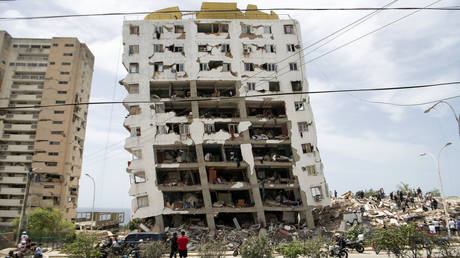
That nightmare became reality for millions of people in northern Venezuela. On June 24, 2026, a massive magnitude 7.2 earthquake tore through the region near San Felipe. Just 39 seconds later, a second monster struck. This one registered at magnitude 7.5. It hit near Yumare, just a few miles away. Buildings that were already cracked and compromised simply collapsed. The current death toll has climbed past 180, and thousands are injured.
This was not a standard earthquake with a few small aftershocks. It was a seismic doublet.
The terrifying sequence has sent shockwaves through the global scientific community. People are suddenly scrambling to understand terms like doublets and earthquake swarms. These are not just academic definitions. Understanding how these events work is a matter of life and death.
The Myth of the Solitary Mega Earthquake
Most people think of earthquakes as isolated disasters. You get one big shock, and then the ground gradually settles down through smaller aftershocks. That is how textbooks usually present the narrative. It is comfortable because it implies the worst is over quickly.
The real world is far messier.
When a major fault ruptures, it changes everything around it. It releases tension in one spot but dumps that weight directly onto its neighbors. Seismologists call this stress transfer. If a neighboring fault is already locked, loaded, and stressed to its absolute limit, that sudden nudge can trigger an entirely new disaster.
That is exactly what happened in Venezuela. The region sits right on the boundary where the Caribbean and South American tectonic plates grind past each other. They slide at about 20 millimeters every year. This grinding creates a complex web of strike-slip faults, including the major Boconó, San Sebastián, and El Pilar systems.
When the first 7.2 quake ripped through the crust, the seismic waves rattled the nearby faults. The physical displacement altered the local pressure dynamics. Thirty-nine seconds was all it took for the secondary fault to fail under the new, intolerable stress.
What Makes a Doublet Different From Aftershocks
You might wonder why we don't just call the second quake a massive aftershock. The distinction matters.
Aftershocks are smaller adjustments. They occur on the same fault plane as the main shock as the broken rock settles into its new position. They slowly decrease in frequency and intensity over days, weeks, or months.
A seismic doublet involves two separate earthquakes of comparable magnitude that occur close together in time and space. Crucially, data from the US Geological Survey shows that these twin Venezuelan quakes happened on distinct faults. They featured completely different rupture patterns. The first quake did not just cause settling. It triggered a separate, independent monster.
We have seen this terrifying pattern before. In February 2023, a magnitude 7.8 earthquake devastated parts of Turkey and Syria. Roughly nine hours later, a second magnitude 7.6 quake struck on a different fault line 95 kilometers away. That doublet killed more than 55,000 people.
The terrifying twist in Venezuela is the timing. Nine hours gives people a chance to run outside. Thirty-nine seconds gives you zero time to react. Emergency workers were not even on the scene yet. Survivors were still reeling from the first shock when the second, larger wave of energy smashed into their foundations.
The Chaos of Earthquake Swarms
While doublets are a pair of heavy blows, earthquake swarms are a prolonged, maddening siege. It is vital not to mix up the two terms.
An earthquake swarm is a dense cluster of local seismic events that happens over days, weeks, or even years. The defining characteristic of a swarm is that there is no single, obvious main shock. You do not get a massive magnitude 7 event followed by smaller echoes. Instead, you get hundreds or thousands of small to moderate tremors that refuse to stop.
Swarms are typically driven by different forces than sudden fault snaps. They are common in volcanic or hydrothermal regions. Think of places like Iceland, Yellowstone, or Central Italy.
Deep beneath the surface, high-pressure fluids or magma force their way through the cracks in the Earth's crust. As the fluid migrates, it wedges open the rock. This creates a chain reaction of small fractures. The earthquakes themselves open up new pathways for the water or magma, which then travels further and triggers even more tremors. It is a relentless loop.
Swarms present a unique psychological torture for the communities living above them. In places like Iceland’s Reykjanes peninsula, thousands of quakes can rattle a town over a single month. Residents never know if the activity is about to die down or if it is building toward a volcanic eruption.
Why the Scientific Community is Arguing Over the Data
Seismology is rarely clean-cut. Right now, there is a fierce debate brewing over how to officially classify the Venezuelan disaster.
The US Geological Survey initially labeled the first 7.2 event as a foreshock and the 7.5 event as the main shock. Some independent seismologists think that label misses the point. They argue that calling a 7.2 event a mere foreshock downplays its independent nature. It was a massive, destructive earthquake in its own right.
This is not just a fight over vocabulary. The classification changes how we map future risks. If we treat these events as a linked doublet sequence on separate faults, we have to rewrite our hazard models for northern Venezuela. We have to assume that every major fault in the region has a partner ready to blow.
Caracas, the capital city, sits about 100 miles away from the epicenters. Yet, the damage there was severe. The city is built on loose sediment that naturally amplifies seismic waves. The ground under Caracas acts like a bowl of jelly. It kept shaking long after the initial fault movement stopped, meaning the city felt both quakes as one continuous, amplified assault.
Practical Steps to Take Right Now
You cannot predict when a fault line will slip. You certainly cannot predict if it will trigger a twin doublet. But you can change how you prepare for cascading disasters.
First, stop assuming the danger has passed after the first big shake. The old advice was to wait out the shaking and then check your property. In an era where we know doublets can strike within seconds or hours, your priority must be immediate evacuation to an open space if you are in a vulnerable structure. Structural integrity can degrade instantly.
Second, seismic safety drills need to account for multi-shock scenarios. Most earthquake drills assume a single event. Families and businesses should plan for secondary shocks that can strike while you are trying to evacuate or assist others.
Keep an emergency kit ready by the door, not buried in a closet. Include basic medical supplies, water, and leather gloves. If you have to move through debris after a twin quake, broken glass and exposed rebar are your immediate enemies.
The disaster in Venezuela is a stark reminder that the Earth does not follow a neat script. The ground beneath our feet is a complex, interconnected machine. When one piece breaks, the whole system shifts. Pay attention to the science, fix your structural weak points, and never assume the first shake is the end of the story.