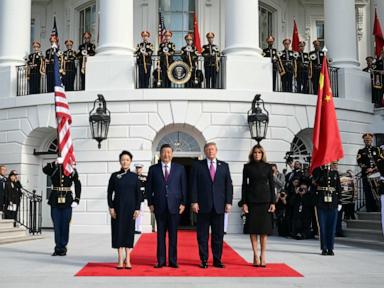
Donald Trump didn't wait at the White House for Chinese President Xi Jinping. Instead, he flew down to Joint Base Andrews in Maryland to meet him right at the airplane steps, offering a rare tarmac welcome complete with a red carpet and a military band. This kind of diplomatic pageantry tells you everything you need to know about how the current administration wants to handle the world's second-largest economy. Trump praised a "truly great friendship" with Xi, while Washington and Beijing quietly extended their trade truce to keep things stable.
If you look past the handshakes and the state dinner fanfare on the South Lawn, the underlying reality remains fiercely competitive. Both leaders are navigating massive friction points like artificial intelligence dominance, semiconductor export restrictions, Taiwan policy, and global supply chains. Yet, they're choosing high-profile diplomacy over an economic free-for-all.
What's Actually Driving the Warm Reception
You might wonder why a president known for hardball tariff tactics is rolling out the red carpet for Beijing's leader. The answer comes down to economic reality and timing. Last year's aggressive trade war hit both nations hard, prompting a climb-down into a fragile truce. Xi is the first Chinese leader to make a second formal visit to the White House, marking a historic moment that both sides want to milk for political stability.
Trump wants to show American strength while securing purchase commitments for U.S. agricultural goods, energy, and medical supplies through newly formed bilateral frameworks like the Board of Trade. Meanwhile, China wants to avoid crushing restrictions on its tech sector and keep its export engine humming. It's a pragmatic balancing act. They're circling each other like heavyweights in a ring, testing boundaries while making sure nobody throws a punch that knocks out the global financial system.
The Real Battleground is Artificial Intelligence
Trade tariffs get the headlines, but the invisible war is happening in silicon labs and server farms. Artificial intelligence has emerged as the ultimate arena for global supremacy. Trump has made it clear that whoever wins the AI race dictates the future, boasting that American tech development will outpace anything seen since the Industrial Revolution.
At the same time, Beijing views unchecked foreign AI capabilities as a direct challenge to its internal security and political control. Washington has doubled down on restricting exports of advanced semiconductor chips to China and accused Chinese developers of scraping American models. Despite this deep mistrust, Treasury Secretary Scott Bessent announced that the two powers are working on a joint notification mechanism for AI safety incidents. It's a tiny step toward cooperation, but it shows both sides recognize that rogue machine learning systems pose a mutual threat.
Where the Partnership Falls Short
Don't mistake the VIP treatment for a total alliance. Underlying tensions over geopolitical flashpoints haven't vanished. China's ties to Iran and its continuous military posturing toward Taiwan remain major sticking points for U.S. lawmakers. Critics on Capitol Hill have already slammed the lavish welcome as unnecessary pageantry that glosses over serious national security risks.
Furthermore, the extended trade truce has an expiration date, and the threat of aggressive secondary tariffs on nations supporting Russian oil imports looms large over Beijing. If the upcoming negotiations fail to yield enforceable purchase commitments, Washington holds plenty of unused legislative levers to turn the economic screws back on.
Navigating the New Normal
If you're watching global markets or running a business exposed to international supply chains, don't read too much into the temporary peace. Treat the current state visit as a brief window of predictability rather than a permanent resolution of US-China structural conflicts. Keep a close eye on upcoming deadlines for tariff truces and chip export enforcement, because the underlying rivalry hasn't cooled down one bit.