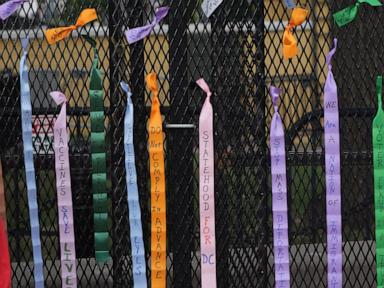
You've seen the makeshift barricades. Bike racks tied together with plastic zip ties. Police tape flapping in the wind. That’s been the security reality outside the White House for years. Now, President Donald Trump wants to change that permanently.
A federal panel is reviewing a massive 79-page proposal to enclose the 8-acre Lafayette Park with a permanent fence. It’s part of a sweeping redesign of Washington's most heavily guarded real estate. Security is tight. Honestly, it has to be.
Between multiple campaign-trail threats, an incident at a Washington journalist dinner, and a fatal shooting by Secret Service officers near a checkpoint in May, the administration's security posture has completely shifted. Temporary fixes are out. Permanent barriers are in.
Breaking Down the Lafayette Park Plan
Lafayette Park hasn't seen a permanent fence since the late 1800s. That’s a long time for a public square that sits directly across from the executive mansion.
The new layout proposes fencing the entire perimeter. Large gates would sit at the north and south entrances. Planners are currently weighing whether to enclose or exclude the historical monuments located at the park's four corners. Leaving them outside the perimeter risks vandalism. Bringing them inside changes public access.
Critics hate the idea. They argue that fencing off an iconic public gathering space restricts free speech and peaceful assembly. Preservationists and urban landscape experts point out that the White House isn't a fortress; it's the people's house.
Supporters counter with a simple reality. The alternative is an eyesore. A mishmash of temporary barricades looks chaotic and fails to provide true, reliable protection.
The Underground Visitor Screening Center
While the fence gets the headlines, another massive project is moving through the approval process. The White House Visitor Screening Facility is slated for construction beneath Sherman Park.
Tourists, staff, and contractors currently pass through temporary tents. They are cramped, inefficient, and vulnerable. The proposed 33,000-square-foot underground facility aims to fix that by July 2028.
Initial designs placed the entrance near the southern end of the park. Planners shifted it to the western edge after utility and infrastructure clashes. Visitors will clear an initial ID check above ground, head down to a lower level for secondary screening, and then take escalators directly onto the White House grounds.
What Happens Next
Federal panels are reviewing these blueprints. The National Capital Planning Commission and the U.S. Commission of Fine Arts hold heavy sway, and both feature panels friendly to the administration's goals.
Expect construction on the underground center to move quickly. The fence will face heavier public pushback, but the administration is pushing hard to start installation next year.
Watch the perimeter. The face of Washington is changing.
-p-800.png)