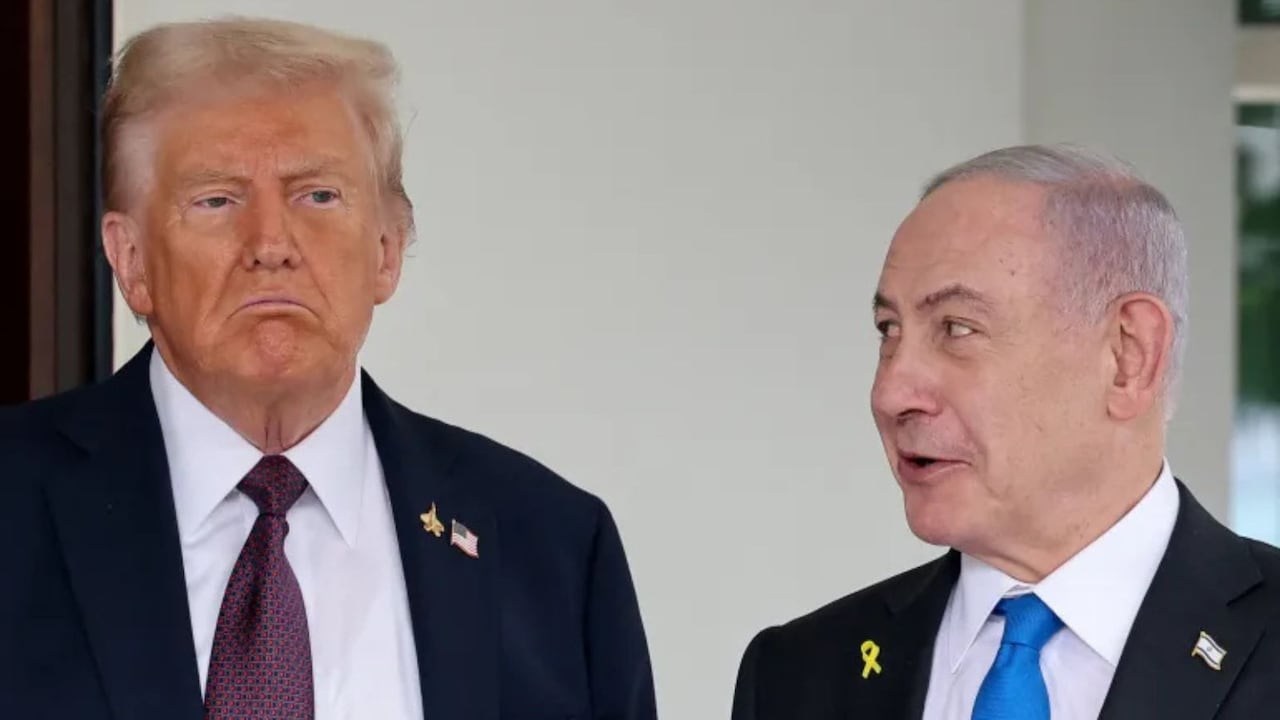
The myth of the unbreakable bond between Donald Trump and Benjamin Netanyahu just took a massive hit. If you believed the public posturing about an eternal, rock-solid alliance between the two leaders, a newly published book from New York Times journalists Maggie Haberman and Jonathan Swan just ripped that script to shreds. It turns out that behind closed doors, the relationship isn't a masterclass in strategic alignment. It's an absolute pressure cooker defined by expletive-laden meltdowns, mutual distrust, and transactional loyalty that expires the moment someone feels slighted.
The biggest bombshell comes from a private phone conversation back in September 2025. According to the book, Regime Change: Inside the Imperial Presidency of Donald Trump, the US president completely lost his temper during a call with the Israeli prime minister over stalling Gaza ceasefire negotiations. Trump didn't just express political disagreement. He went personal, launching into a raw verbal attack that exposes the deep fractures in their relationship. Recently making headlines recently: Why China's Ethnic Unity Law Shakes Taiwan To Its Core.
"Everybody's sick of you, Bibi," Trump reportedly barked into the receiver. "All the Jews are sick of you. Even the two Jews on this call are sick of you."
Those two other individuals on the line were none other than Trump's son-in-law Jared Kushner and senior Middle East envoy Steve Witkoff. The revelation paints a drastically different picture of White House diplomacy than the polished statements fed to reporters. It shows an administration pushing a highly specific agenda, hitting a brick wall with an unyielding foreign ally, and resorting to brute-force pressure to get results. Further details regarding the matter are detailed by NBC News.
Behind the Scenes of the 2025 Meltdown
To understand why Trump snapped, you have to look at the exact timing of that call. It happened right on the sidelines of the United Nations General Assembly in September 2025. The White House was aggressively shopping a complex 20-point peace plan designed to end the devastating war in Gaza and kickstart a massive reconstruction effort. Kushner and Witkoff had spent months structuring this framework, treating it as the definitive blueprint for the region.
Trump viewed this plan as a signature achievement, a massive win he could claim on the global stage. He wanted it signed, sealed, and delivered. Netanyahu, however, kept dragging his feet, looking for exit ramps and ways to alter the terms to protect his domestic political standing.
The book details how Trump explicitly warned Netanyahu that he was completely forbidden from backing out of the framework. "You're not allowed to back out of it," Trump told him, according to the excerpts. He then reminded Netanyahu of every ounce of political capital he had spent defending Israel over the years. He told the prime minister that everyone else hated him and that the White House was the only reason he was still surviving politically.
This wasn't just a policy debate. It was an enforcement action. Trump operates on an intense model of personal loyalty. In his mind, he had protected Netanyahu from global condemnation, and now it was time for Netanyahu to pay his bill by signing the peace deal. When Netanyahu hesitated, the frustration boiled over into the shocking rhetoric detailed by Haberman and Swan.
The Secret Airstrike that Broke the Trust
The underlying rage during that call didn't come out of nowhere. It was fueled by a massive diplomatic blindside that had occurred earlier that same month.
Just a day after Kushner and Witkoff met at a Miami home with Netanyahu's close adviser, Ron Dermer, to lock down the post-war Gaza plans, Israel launched a sudden airstrike in Doha, Qatar. The target was Hamas's senior leadership, who were actively gathered there to hammer out ceasefire details with international negotiators.
The strike failed to kill the top-tier Hamas figures, though it did kill lower-ranking members and a Qatari guard. More importantly, it completely blew up the diplomatic tracks. Qatar was furious and immediately threatened to walk away from its role as the primary mediator between Israel and Hamas.
According to the book, Kushner and Witkoff were absolutely livid. They felt completely lied to by Dermer. They believed Israel had deliberately used the cover of peace talks to gather intelligence and execute a strike that would derail the entire American diplomatic effort. By the time Trump got on the phone with Netanyahu at the UN, the anger within the inner circle had reached a fever pitch. Eighteen days after that explosive call, Netanyahu finally yielded, accepting the framework and offering an apology, but the damage to the personal relationship was already done.
A Legacy of Transactional Loyalty
If you look back at the history between these two men, this latest blow-up fits a clear pattern. Trump has never been an ideologue driven by traditional foreign policy doctrines. He looks at geopolitics through a strictly transactional lens. You do something for me, I do something for you. The moment that equation breaks, the alliance breaks.
We saw the exact same dynamic play out after the 2020 US presidential election. When Netanyahu released a video congratulating Joe Biden on his victory, Trump took it as an unforgivable personal betrayal. Even though Netanyahu waited more than twelve hours after the election was called to post the message, and even though he avoided using the phrase "president-elect," Trump was deeply insulted.
In subsequent interviews with journalists, Trump didn't hold back. "The first person that congratulated Biden was Bibi Netanyahu, the man that I did more for than any other person I dealt with," Trump complained. He finished his thought with a blunt, profane dismissal: "Fuck him."
There is also the lingering resentment over the 2020 assassination of Iranian military commander Qassem Soleimani. Trump has repeatedly complained to aides and during press conferences that Israel originally agreed to make it a joint operation, only to pull out at the last second, leaving the US to execute the strike entirely alone. Trump doesn't forget these moments. He logs them away as debts unpaid.
The Current Friction in 2026
The tension hasn't stayed in the past. It's actively boiling over right now in 2026. Just weeks ago, reports surfaced of another intense, expletive-heavy phone call between Trump and Netanyahu regarding Israel's expanding military operations against Hezbollah in Lebanon.
Trump has been pushing hard for a preliminary agreement with Iran to stabilize the region and protect the global economy from soaring energy costs. He views Israel's aggressive threats to resume heavy bombing in Beirut's southern suburbs as a direct threat to his diplomatic strategy.
During that recent call, Trump reportedly yelled, "What the fuck are you doing? You're fucking crazy. You'd be in prison if it weren't for me. I'm saving your ass."
While Netanyahu's office has tried to downplay the severity of these reports, labeling them as mere "tense conversations," Trump himself essentially confirmed the confrontation during an appearance on the Pod Force One podcast. He admitted he blasted Netanyahu over the continued conflict, defending his volatile style as a deliberate tactic to keep adversaries like Iran completely off balance.
The High Political Stakes for Both Leaders
Both men are playing an incredibly dangerous domestic political game, and that's exactly why these calls are getting so ugly.
Trump is facing intense pressure from within his own Make America Great Again coalition. A growing, vocal faction of his base is increasingly frustrated with the economic fallout of the Middle East conflict. They feel the US is doing Israel's bidding at the expense of American economic stability, especially with critical midterm elections looming less than six months away. If the war keeps driving up prices, Republicans risk losing control of Congress, an outcome that could expose Trump to severe political liabilities at home. He needs the fighting to stop because it's actively hurting his poll numbers.
Netanyahu, on the other hand, is fighting a desperate war for his own political and legal survival. He's balancing a fragile right-wing domestic coalition that threatens to collapse if he shows any sign of weakness or capitulation to Washington. He's also dealing with serious corruption charges at home that could see him facing jail time if he loses power. He can't afford to look like a puppet of the US president, yet he knows he completely relies on American military and diplomatic backing to stay afloat. It's an impossible balancing act.
How to Analyze the Realities of Modern Diplomacy
When tracking these high-level political shifts, you can't rely on official press releases or sanitized readouts from government offices. You have to look at the underlying structural pressures. If you want to accurately read where a foreign policy relationship is headed, follow these practical tracking steps instead of buying into the public theater.
- Look at the domestic pain points: A leader's behavior on the international stage is almost always driven by their biggest vulnerability at home. Trump cares about inflation and midterm polling numbers. Netanyahu cares about holding his coalition together and staying out of court. When those two domestic needs clash, an explosive phone call is inevitable.
- Ignore the official praise: When Trump posts on Truth Social that he had a "very productive call with Bibi," look at what happens on the ground immediately afterward. If troop movements change or strikes are abruptly postponed, you know the private reality was actually a brutal arm-twisting session.
- Track the money and the timelines: Follow the timeline of events closely. The fact that Netanyahu accepted the US ceasefire framework just eighteen days after being told that "all the Jews are sick of you" tells you exactly where the real leverage lies. No matter how much a foreign leader protests, the nation holding the financial and military keys ultimately dictates the boundaries.
The relationship between Trump and Netanyahu isn't built on a foundation of shared ideological devotion. It's a raw, volatile calculation between two deeply transactional politicians who will use each other for leverage until the precise moment it no longer serves their immediate interests.