Donald Trump isn't finished with the Korean Peninsula. As of mid-August 2026, the president has publicly stated his intent to meet with Kim Jong-un before the year ends. Whether this is a serious diplomatic opening or just another piece of political theater, the timing is impossible to ignore.
Trump dropped the news while speaking to reporters outside the White House. When asked if he expected to sit down with the North Korean leader, he didn't hedge. He gave a simple, direct answer: "Yeah, I will be."
This isn't happening in a vacuum. It’s part of a broader, chaotic shift in American foreign policy. Just days ago, Trump ordered a significant reduction in joint U.S.-South Korea military drills. He labeled the exercises "inappropriate and hostile." It’s a classic Trump move—dismantling established military cooperation as a gesture of goodwill to a regime that most of the international community considers a pariah.
Why the sudden interest in North Korea
You have to look at what’s happening globally to understand why this is back on the agenda. The geopolitical landscape in 2026 is vastly different from the summits of 2018 and 2019.
Russia is deep in a grinding war in Ukraine. North Korea has become a vital supplier of munitions and labor for the Russian war effort. This trade—money and resources flowing into Pyongyang—has effectively punched a hole in the UN sanctions regime. When the UN Security Council can't even maintain its own monitoring organs because Moscow vetoes them, the old "maximum pressure" strategy is basically dead.
Kim Jong-un knows he has leverage. He isn't the same desperate leader who walked into the Hanoi summit looking for immediate sanctions relief. He’s now a key partner in a global axis that challenges American interests. If Trump wants a summit, he’s likely looking for a win he can tout as "denuclearization," even if the actual, measurable progress toward dismantling North Korea's 57 known nuclear weapons remains at zero.
The skepticism from Pyongyang
Don't assume Kim is just waiting for the invitation. His sister, Kim Yo-jong, has already poured cold water on the idea of secret, friendly overtures. She recently issued a statement casting doubt on the existence of any productive communication channels. While she acknowledged a lingering "good memory" of the relationship with Trump, she made it clear that from Pyongyang's perspective, Washington remains the enemy.
This is the central tension. Trump sells the "great relationship" angle to his base. He loves the idea of the personal dealmaker—one man talking to another to fix problems that career diplomats couldn't touch. Kim, meanwhile, treats these interactions as high-stakes power plays to legitimize his status as a nuclear-armed head of state.
What this means for the region
The move to cut back on South Korean military exercises has already rattled nerves in Seoul and Tokyo. The 1953 Mutual Defense Treaty is the backbone of regional stability. When you start "gutting" that alliance, as many lawmakers are calling it, you aren't just sending a message to Kim. You're telling allies that the U.S. might be willing to trade their security for a photo-op.
If you’re watching this, don't focus on the rhetoric. Focus on the logistics. Reports suggest the White House is eyeing the APEC summit in Shenzhen this November as a potential backdrop for the meeting. If the State Department starts scrambling to organize a summit, you’ll know it’s moving from "campaign talk" to a real event.
Navigating the reality
If you're trying to make sense of these headlines, here's how to separate the noise from the signal:
- Look at the military drills. If they disappear entirely, the "price" for a meeting has already been paid by the U.S. taxpayer in lost readiness.
- Track the Russian connection. If Moscow continues to shield North Korea at the UN, the pressure on Kim to talk to the U.S. significantly drops.
- Watch the state media in North Korea. They are the only ones who confirm what Kim actually thinks. If they remain silent or hostile despite Trump's comments, the summit is likely a non-starter.
The reality of 2026 is that North Korea has already won the "wait it out" game. They have the weapons, they have a new patron in Russia, and they have an American president who is eager to claim a diplomatic victory before his term ends.
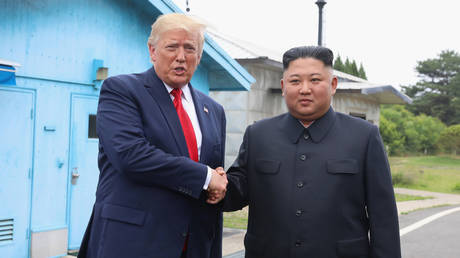
Don't expect a sudden shift in policy. Expect a lot of noise, a few aggressive social media posts, and a high-profile handshake that changes very little on the ground. The nuclear program isn't going anywhere. Neither is the strategic standoff.
If you are looking for progress, wait for the actual results of the talks, not the hype. Until a verifiable, transparent agreement is on the table, it's just business as usual.