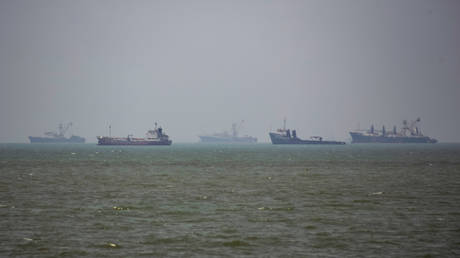
The fragile peace in West Asia just shattered completely. Washington and Tehran are staring down the barrel of a renewed, full-scale military conflict, and the entire crisis now boils down to a single strip of water. President Donald Trump made it clear on his Truth Social platform that the short-lived ceasefire is officially over. Yet, even as he threatens Iran with a thousand locked-and-loaded missiles, American negotiators are still trying to scratch out a deal.
The crux of the current standoff isn't a complex nuclear formula or a grand diplomatic treaty. It is a simple, public declaration. The United States is demanding that the Iranian government issue an explicit public statement declaring that the Strait of Hormuz is open and that international commercial vessels will not be attacked. Building on this theme, you can find more in: The Real Story Behind The Ann Widdecombe Murder Probe And What Comes Next.
Tehran refuses to budge. Instead of offering guarantees, Iranian diplomats insist that the narrow waterway belongs exclusively to them. They even want to start charging transit fees for ships passing through a corridor that the global community has treated as an open international waterway for generations. This is a terrifying game of chicken. If neither side blinks, the global energy supply faces a massive shock.
The High Stakes Ultimatum on the Water
Senior American officials confirmed the details of this aggressive diplomatic push. They are giving Iranian negotiators a very tight window to comply. The logic behind demanding a public statement rather than a private assurance is straightforward. Shipping companies and international insurers do not trust backroom deals. They need absolute, public clarity before they will risk sending multi-million dollar cargo vessels through the choke point. Observers at NBC News have shared their thoughts on this situation.
Right now, that clarity doesn't exist. One senior U.S. official explained that Tehran must acknowledge all channels of the Strait of Hormuz are open and that they are done shooting at ships. The alternative is simple. The U.S. military will act. Trump has stated that his generals have a wide array of options ready if these talks fall apart this weekend.
The Iranian response was swift and unyielding. Just moments before American officials briefed reporters, Iran's United Nations Ambassador Amir Saeid Iravani laid out his country's position outside the UN headquarters. He stated flatly that any activity in the Strait of Hormuz, including opening it up or conducting demining operations, rests entirely with Iran. Iravani warned that any attempt by external powers to interfere would violate previous understandings, delay the return of normal commercial navigation, and dramatically increase regional tensions.
What Washington Actually Demands From Tehran
The conflict isn't just about rhetoric. It is about a fundamental disagreement over who controls global maritime trade. For decades, the international community operated under the assumption that the Strait of Hormuz was an international transit corridor. Anyone could sail through, provided they did so peacefully.
Iran is trying to rewrite those rules. They want absolute sovereignty over the passage. They are demanding that foreign vessels follow specific, state-approved routes. They also intend to levy tolls on passing ships. This directly threatens the global maritime order, and Washington is unwilling to accept a precedent where a single nation can hold a fifth of the world's energy trade hostage.
The situation became even more complicated when a foreign container ship ran aground inside the strait. Iranian state television reported that the vessel was using an unapproved route. This highlighted the intense friction on the water. Under an interim agreement signed in June, both sides had agreed to let ships pass without charges for sixty days. Iran's sudden insistence on dictating routes and collecting fees directly violated the spirit of that agreement, leading to the current breakdown.
The Chaos Inside Iran Since Khamenei Died
To understand why this negotiation is so volatile, you have to look at what is happening behind closed doors in Tehran. American intelligence officials report that a massive, real-time power struggle is tearing through the Iranian political establishment. This internal chaos is a direct result of the opening days of the war.
On February 28, a series of devastating U.S. and Israeli airstrikes targeted Iran. Those strikes killed the country's longtime Supreme Leader, Ayatollah Ali Khamenei. His death left a massive power vacuum that the political elite has failed to fill.
We are seeing the consequences of that vacuum right now. American officials believe that the recent attacks on commercial vessels in the strait were carried out by a rogue faction of Iranian hard-liners. These extremists are actively trying to sabotage the ceasefire agreement signed by their own government in Islamabad. When confronted by American negotiators, some Iranian representatives claimed the attacks came from an errant part of their system that they could not fully control.
This creates a terrifying diplomatic reality. It means that even if Iranian President Masoud Pezeshkian or Foreign Minister Abbas Araghchi agree to a deal, there is no guarantee that the Islamic Revolutionary Guard Corps or its hard-line factions will honor it. Speaker of the Iranian Parliament Mohammad Bagher Ghalibaf recently noted that Iran has zero trust in the United States, claiming he told Vice President JD Vance directly that only those prepared for war can successfully negotiate. Tehran is projecting strength, but the internal fractures make them highly unpredictable.
The Global Economic Threat is Very Real
This isn't an isolated regional dispute. It affects everyone. Before this war broke out, roughly twenty percent of the world's traded petroleum and liquefied natural gas traveled through this narrow body of water. When Iran choked off the strait during the height of the fighting, it triggered a massive global energy crisis.
Oil prices skyrocketed to a painful peak of 120 dollars a barrel. While prices have dropped significantly since those wartime highs, any renewed fighting will send them surging back up. President Trump is highly sensitive to this. He knows that a spike in energy prices will instantly drive up inflation in the United States, undermining his domestic economic goals.
The threat is spreading beyond the strait itself. Following a recent round of American airstrikes, Iran launched a massive volley of retaliatory attacks across the Middle East. They targeted military and economic infrastructure in Bahrain, Jordan, Kuwait, and Qatar. Air defense systems across the region were forced to engage incoming fire, and at least one injury was reported in Kuwait.
Iranian politicians are also threatening neighboring states. Esmail Kousari, a member of Iran’s national security committee and a former Revolutionary Guard commander, warned that the United Arab Emirates would pay a heavy price for its covert cooperation with the United States. The conflict is spreading, and the economic fallout will follow.
How Commercial Shipping is Navigating Around the Threat
Commercial mariners are stuck in the middle of this geopolitical nightmare. The United States military is currently advising all international shipping companies to avoid the northern, Iranian-controlled sections of the strait entirely. Instead, they are urging captains to utilize a southern route that cuts through the territorial waters of Oman.
Oman is once again trying to play its traditional role as a regional mediator. Iranian Foreign Minister Abbas Araghchi traveled to Muscat to discuss the status of the waterway with his Omani counterpart. Concurrently, Turkish Foreign Minister Hakan Fidan stated that he believes a diplomatic solution regarding shipping lanes could be ironed out between Iran and Oman over the weekend.
Whether these regional talks can override the American demand for a public declaration remains highly doubtful. Washington is holding firm. They want a public, verifiable commitment from the top tier of the Iranian state, not a vague regional compromise.
If you run a business or track global markets, watch the news out of Muscat and Tehran closely over the next forty-eight hours. The window for diplomacy is closing fast. Shipping companies should prepare for extended detours, and energy traders need to brace for extreme volatility. If Iran refuses to make the public declaration by the end of the weekend, expect military escorts for commercial vessels to resume, or worse, a direct return to open warfare in the Gulf.