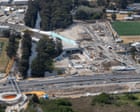
Sydney drivers have been sold a massive lie about the M6 motorway extension.
The New South Wales government just announced a massive breakthrough. They struck a deal with the private consortium building the $3.1 billion mega-project, declaring that tunnelling will finally resume immediately after a brutal two-year stalemate. The politicians are high-fiving because taxpayers theoretically won't foot the bill for the massive delays.
Don't buy the victory lap.
The reality underground is a disaster zone of compromised geology, shattered timelines, and contractual scars that will distort southern Sydney transit for a decade. The original completion date was 2024. Then it became 2025. Now the official line is 2028, but anyone tracking the engineering realities knows that date is pure fantasy.
If you live in Kogarah, Rockdale, or Arncliffe, or if you waste your life daily sitting on the Princes Highway, here is what is actually happening with the road dubbed Sydney’s unbuildable motorway.
The 250 meters of absolute chaos
The M6 Stage 1 project sounds simple on paper. It's a twin four-kilometre tunnel network designed to bypass local bottleneck roads by connecting the M8 at Arncliffe directly to President Avenue at Kogarah. When the drills were screaming, crews managed to complete 90% of the excavation.
Then everything broke.
In March 2024, a massive 10-meter-wide sinkhole opened up in Rockdale, swallowing ground beneath an industrial estate. Ground subsidence became a chronic emergency. But the final blow came a year later in June 2025, when contractors completely downed tools.
They hit something engineers call a high-angle reverse fault.
[Normal Bedrock Layer]  -->  /  ^ [Upward Forced Layer]
                             / /
                            / /  <-- Extreme Tension Zone
                           / /
This isn't your standard Sydney sandstone. A high-angle reverse fault means a massive chunk of rock was violently forced upward and over an adjacent layer during prehistoric seismic shifts. It created an incredibly unstable zone of crushed stone, trapped moisture, and high-tension earth. The joint venture responsible for building it—made up of CPB Contractors, Ghella, and UGL (the CGU consortium)—essentially told the government that the ground was completely unsafe and a compliant design was physically impossible.
Who pays to freeze a moving mountain
For the past year, the project has been locked in an ugly, multi-million-dollar legal Mexican standoff. The government blamed the builders. The builders blamed the earth.
While the tunnels sat dark, Transport for NSW poured over $5.5 million into external legal fees alone. They slapped the consortium with a formal notice of default in March 2026, threatening massive litigation if workers didn't start drilling again.
The fresh deal announced today reveals who blinked first:
- The Builder Absorbs the Hit: The CGU consortium has agreed to drop all contractual claims against the state for the 2024 sinkholes and the subsequent ground stabilization.
- Taxpayer Exposure is Limited: The financial hit to complete the remaining 250 meters of the main tunnel falls on the private joint venture, keeping the project technically within its current $3.1 billion envelope.
- Jet Grouting is the Only Way Out: Crews have to inject ultra-high-pressure concrete grout directly into the fault line to artificially solidify the shifting earth before any mechanical excavator can chip away at the final stretch.
It sounds like a win for the public purse, but the hidden cost is time. A two-year freeze on an active project site destroys supply chains, scatters specialized labor, and causes massive equipment decay. You don't just turn on a tunnel boring machine like a light switch after 12 months of silence.
The brutal timeline shift
| Milestone Year | Expected Status | Reality |
|---|---|---|
| 2019 | Project Approved | Planned under the previous Coalition government |
| 2024 | Original Opening Target | Missed entirely due to initial design changes |
| 2025 | Revised Opening Target | Tunnelling abandoned due to the reverse fault discovery |
| 2026 | Legal Settlement | Agreement reached to resume work; timeline highly volatile |
| 2028 | Current Government Target | Earliest possible opening; massive risk of slipping further |
What this means for your daily commute
If you think this deal magically solves the gridlock in Sydney's south, you're going to be disappointed. Bayside Council residents have already endured years of surface road upheavals around President Avenue and the Princes Highway.
While the government boasts about finishing some parkland upgrades at Brighton Memorial Playing Fields and McCarthy Reserve, the actual road corridor remains a severed artery. More than 2,000 heavy trucks a day were supposed to be stripped from local southern roads by now. Instead, those trucks will keep idling outside your local schools and shops for at least another two to three years.
Worse, the wider vision for the M6 is dead in the water. The original long-term plan included Section B (pushing south to Taren Point) and Section C (connecting to Loftus). Due to massive market constraints and a severe labor shortage across the construction sector, those subsequent stages have been shelved indefinitely. We are paying billions for a truncated stub tunnel that terminates at a heavily congested intersection in Kogarah.
Your next strategic steps
If you are a resident, commuter, or local business owner impacted by this nightmare infrastructure project, stop waiting for the 2028 opening. Here is how you need to pivot your logistics right now:
- Audit your travel times around the President Avenue corridor: Expect ongoing, unpredictable surface works as heavy equipment is re-mobilized to support the underground jet-grouting operations. Localized traffic diversions will intensify through late 2026.
- Review local commercial property leases: If you run a business near the Rockdale industrial zones affected by the 2024 subsidence, ensure your structural insurance covers geological settlement. The resumption of high-impact underground works nearby will re-introduce vibration risks to the area.
- Plan for long-term toll budgeting: When this link eventually opens, the financial pressure on the consortium from these massive delay overheads means toll pricing strategies will be aggressively enforced to recoup losses. Factor heavy toll costs into your long-term freight or commuting budgets now.
The drilling rigs are turning back on, but repairing a broken mountain takes an immense amount of time. Prepare for the reality that the M6 will remain a construction site well into the next decade.
For a deeper dive into how these massive infrastructure delays impact local residents on the ground, take a look at this detailed breakdown of the M6 Tunnelling Disaster Coverage, which highlights the massive community upheaval and the multi-billion-dollar pressure points building across Sydney's subterranean transport network.