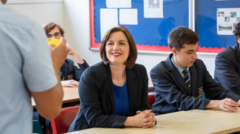
Political insults don't always land the way the attacker wants. When Tory leader Kemi Badenoch stood up at Prime Minister's Questions and branded Education Secretary Bridget Phillipson a "spiteful class warrior," she expected it to hurt. Instead, Phillipson immediately weaponized it. She announced she'd gladly wear the insult on a T-shirt if it meant funding state schools and lifting half a million kids out of poverty.
It's a classic political pivot. Turn the enemy's mud into merchandise. Meanwhile, you can find related events here: Why The Battle Over Strait Of Hormuz Tolls Matters To Every Ocean Shouter.
But this wasn't just another day of theatrical bickering in the House of Commons. The explosive row didn't stop when the cameras turned off. It spilled over into the division lobbies, turning into a bitter, behind-the-scenes confrontation that exposed the deep ideological chasm running through British society today. This isn't just about a cheeky piece of clothing. It's a fundamental war over who gets a head start in life, how we fund education, and how our leaders talk to each other when they think the public isn't watching.
The Commons Clash That Exploded Behind Closed Doors
The public saw the polished, televised version of the dispute. During a fiery exchange, Badenoch took aim at Labour's headline education policy, which strips private schools of their long-standing VAT exemption. She claimed that taxing independent schools to pay for state school teachers was an utter failure, arguing that teacher numbers have actually gone down. To see the bigger picture, check out the detailed article by USA Today.
Then came the punchline. Badenoch declared that appointing a "spiteful class warrior" to run the Department for Education was an absolute disaster.
Phillipson sat on the front bench, shaking her head. But the real fireworks happened out of sight.
After PMQs wrapped up, the two politicians crossed paths in the division lobby. Witnesses describe a furious face-to-face showdown. Technology Secretary Liz Kendall reportedly had to step in as Badenoch confronted the Education Secretary directly.
"I'll fight you all the way, you're destroying children's lives," Badenoch reportedly told her, doubled down on her anger over the private school tax.
Phillipson didn't back down either. She later took to social media, stating bluntly that Badenoch had "lost her head" both during and after the session. She also dropped a massive bombshell, revealing that the Tory leader had previously compared her to a Gestapo officer over the private school VAT policy.
Think about that for a second. A sitting Leader of the Opposition using Nazi-era comparisons against an Education Secretary over a tax policy. It shows exactly how high the emotional and political stakes have become.
The Art of Turning Modern Political Insults Into Merch
We've seen this movie before. When an opponent uses a highly specific, emotionally charged insult, the modern political playbook says you don't apologize. You don't get defensive. You print it on a shirt and sell it to your base.
Think back to Hillary Clinton's "basket of deplorables" comment in 2016. Donald Trump's supporters immediately adopted the term, wearing "Proud Deplorable" T-shirts to rallies across America. It transformed a sneer from an elite into a badge of honor for millions of working-class voters.
Phillipson is playing the exact same game here, just from the opposite side of the spectrum. By embracing the "spiteful class warrior" tag, she's flipping the narrative.
To the Conservative base, the phrase conjures up images of old-school socialist envy, a bitter attempt to tear down successful institutions out of pure ideological malice. But to Labour voters, it sounds entirely different. Phillipson's response redefines the term completely.
"Next time you see me, I'll be wearing a T-shirt saying 'Spiteful Class Warrior'. Because if being a spiteful class warrior means lifting half a million children out of poverty, then I'll be wearing that T-shirt with pride."
Honestly, it's brilliant marketing. She took a label meant to make her look petty and attached it directly to child poverty reduction and state school investment. It shifts the conversation from "Labour hates private schools" to "The Tories hate working-class women funding public services."
What the Private School VAT Debate Is Really About
Strip away the dramatic corridor confrontations and the T-shirt jokes, and you find a deeply divisive policy that splits the country right down the middle. Labour's decision to slap a 20% VAT charge on independent school fees is one of the most controversial tax changes in recent history.
The arguments on both sides are incredibly fierce, and both sides believe they hold the moral high ground.
The Case for the Tax
For supporters of the policy, removing the tax loophole is a matter of basic fairness. Private schools have enjoyed charitable status and tax exemptions for decades, despite catering to the wealthiest sliver of society. The government argues that by applying VAT to these fees, they can raise hundreds of millions of pounds.
Where does that money go? It's earmarked directly for the state sector. The goal is to recruit thousands of new teachers, improve crumbling infrastructure, and provide mental health support in schools that have been starved of funding for over a decade. For a working-class politician like Phillipson, who grew up in a council house in Washington, Tyne and Wear, this is a deeply personal mission. She looks at the system and sees an unfair playing field where a tiny minority buys privilege while the majority struggles in underfunded classrooms.
The Case Against the Tax
The opposition argument, championed fiercely by Badenoch, focuses on the unintended fallout. Critics say the policy doesn't just hit the ultra-wealthy elites. It punishes hard-working parents who sacrifice everything to send their kids to smaller, specialized independent schools, including children with special educational needs.
The fear is a massive exodus. If fees jump by 20%, thousands of parents won't be able to pay. Those children will have to move into the state system, flooding local schools that are already stretched to the limit. Opponents argue that the cost of absorbing these students will completely wipe out any extra revenue the tax generates, leaving the entire education system in a worse position than before.
Why This Debate Is So Incredibly Toxic
The reason this fight turned into a corridor shouting match involving Gestapo comparisons is that it touches the rawest nerve in British culture, which is class.
The UK has an obsessive relationship with social class, and education is the engine room of that divide. For decades, a tiny percentage of the population went to top private schools and then went on to dominate politics, the media, the judiciary, and corporate boardrooms.
When Badenoch calls Phillipson a "class warrior," she's playing into the traditional Tory narrative that Labour is driven by resentment. They want you to believe that Labour doesn't actually want to lift state school kids up; they just want to pull private schools down.
Phillipson's counter-attack is equally aggressive. She openly questions why the Conservatives feel such deep animosity toward a working-class woman who is trying to drive record investment into the schools that 93% of the country's children attend. By highlighting her own background and the backgrounds of the kids she wants to help, she frames the Tories as defenders of an elite, exclusionary status quo.
It's a battle of identities. It's north versus south, state versus private, lived experience versus institutional privilege.
The Real Mistakes Politicians Make in These Feuds
While the drama makes for fantastic newspaper headlines, it carries massive risks for both sides. It's easy for politicians to get high on their own supply during these tribal battles, forgetting how ordinary people actually view the noise.
- The danger of over-escalation: Badenoch's alleged use of extreme historical comparisons completely undermines her legitimate economic arguments. When you throw around words like "Gestapo" or accuse an opponent of actively trying to destroy children's lives, you alienate moderate voters who might otherwise worry about the practical impacts of the school tax. It makes the opposition look unstable rather than analytical.
- The trap of superficial victories: Phillipson needs to be careful that her clever T-shirt rhetoric doesn't mask real delivery issues. If Labour prints the shirts but fails to hire the promised teachers, or if state school class sizes balloon because local authorities can't handle the influx of private school transfers, the merchandise will look incredibly hollow.
People don't want snappy slogans; they want working school buildings and qualified staff in front of their kids' whiteboards.
How to Look Past the Political Theater
If you want to understand what's actually happening here instead of just consuming the gossip, you need to watch the data over the coming months. Forget the shouting matches in the division lobby. Watch the actual metrics that affect real families across the country.
- Track school enrollment shifts: Keep a close eye on the number of pupils leaving independent schools and entering local state schools. If the system handles the transition smoothly, Labour wins the argument. If local schools face a sudden crisis of overcrowding, the Tories will have a massive "told you so" moment.
- Monitor teacher recruitment numbers: The entire justification for this tax policy is funding new teaching positions in the state sector. Check the official Department for Education releases to see if those thousands of new staff members are actually being hired and retained.
- Watch the tone of the frontbenches: The sheer vitriol of this clash suggests that British politics is getting meaner and more personal. See whether this level of aggression becomes the standard style of debate for the rest of the parliamentary term, or if leaders pull back from the brink of total toxicity.
The "Spiteful Class Warrior" shirt might become a reality, but the real test of this political moment will be written in school budgets and exam results, not on cotton merchandise. Keep your eyes on the classroom, not the lobby.


/LouvresengchyeteoGettyImages-5a14669aaad52b00370c599e.jpg)