Forget multi-million dollar performance bonuses or luxury sports cars.
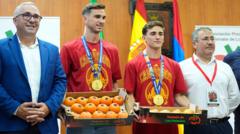
When Fabián Ruiz and Gavi returned home after lifting the 2026 FIFA World Cup trophy in New Jersey, they didn't receive shiny watches or diamond-encrusted trinkets. Instead, they stepped onto a massive set of industrial scales in front of thousands of screaming fans and got handed 153.5 kilograms of fresh tomatoes.
That is roughly 338 pounds of fruit. It sounds like a bizarre joke or a strange internet meme, but in southern Spain, it represents the highest honor a hometown hero can receive.
Here is the full story behind football’s most unusual victory reward, how a small agricultural town produces elite midfielders, and what two world champions actually plan to do with hundreds of pounds of produce.
The Weigh In That Stunned Football Fans
On Tuesday, July 21, 2026, fresh off defeating Argentina 1-0 in extra time to secure Spain's second World Cup title, Paris Saint-Germain midfielder Fabián Ruiz and Barcelona youngster Gavi arrived in Los Palacios y Villafranca.
The town sits just south of Seville and counts fewer than 40,000 residents. Thousands of locals packed into the Plaza de Andalucía, waving Spanish flags and wearing national team jerseys to greet the returning heroes. Wearing their official World Cup gold medals, both players took turns stepping onto a giant weighing apparatus set up right in the middle of the square.
The rules of the ceremony are dead simple. You get your exact body weight in local tomatoes.
The final tally:
- Fabián Ruiz: Scaled in at 85 kg (187 lbs), earning him 85 kg of fresh produce.
- Gavi: Tipped the scales at 68.5 kg (151 lbs), securing 68.5 kg for his haul.
The total payout came out to 153.5 kilograms. The local Tomato Producers Association supplied the reward using the town's prized "Bombón Colorado" variety, a sweet, rich tomato famous throughout Europe.
The 2010 Origin Story Behind the Tradition
To outsiders, handing professional athletes crates of raw vegetables looks utterly baffling. To understand why this happens, you have to look back 16 years.
Los Palacios y Villafranca relies heavily on agriculture. Locals proudly refer to their tomato harvest as "red gold" because the soil in the Guadalquivir river valley produces some of the finest crops in western Europe.
Back in 2010, former Manchester City and Sevilla winger Jesús Navas became the first player from the town to win a World Cup with Spain. The municipal council wanted to celebrate Navas in a way that bridged elite sporting success with the town's humble farming identity. They put Navas on a scale and gifted him his weight in local produce.
It became an instant regional tradition.
Navas received tomato payouts after winning Euro 2012 and Euro 2024. Fabián Ruiz previously received a batch after Spain's Euro 2024 victory. For 21-year-old Gavi, this marked his very first tomato weigh-in following his first major senior trophy.
Stadium Names and Banners Beyond the Produce
The local council didn’t stop at fresh fruit. Mayor Juan Manuel Valle announced several permanent municipal tributes to honor the players.
- Renamed Home Grounds: The Marismas stadium, where Fabián Ruiz played youth football for Los Palacios CF, will now be officially named after him. The San Sebastián stadium—home ground of La Liara Balompié where Gavi began his football journey at age six—will bear Gavi's full name, Pablo Martín Páez Gavira.
- A Triple Hero Monument: The council unveiled plans to build a permanent bronze monument on Juan José Vaquero Avenue. The statue will feature Jesús Navas, Fabián Ruiz, and Gavi side-by-side to honor the three World Cup winners born in the same small municipality.
- Retro Nostalgia Banners: Both players were presented with custom commemorative banners featuring Tomatito, the famous tomato mascot from the 1982 FIFA World Cup hosted by Spain.
What Do Players Actually Do With 300 Pounds of Tomatoes?
Nobody eats 150 kilograms of raw tomatoes before they spoil.
So what actually happens to all that food?
In past celebrations, players shared the haul across their extended families, neighbors, and youth club kitchens. Local community centers and food banks in the Seville province also receive substantial donations from these victory batches. With Andalusian summer cuisine revolving heavily around cold tomato-based dishes like gazpacho and salmorejo, a 150kg shipment feeds dozens of local families for weeks.
How a Small Town Keeps Producing World Champions
How does a town of 38,000 people produce three separate World Cup winners in a single generation?
It comes down to early technical development. Local clubs like La Liara Balompié and Los Palacios CF focus heavily on street-style ball control, quick decision-making in tight spaces, and intense competitive drive from ages five and six.
When young talent shows promise, scouts from nearby La Liga academies at Real Betis and Sevilla FC jump quickly. Ruiz came through Betis before moving to Napoli and PSG, while Gavi developed at Real Betis before Barcelona recruited him at age 11.
The grassroots culture stays connected. Even after winning major European trophies, both players return to their original neighborhood pitches every off-season.
How to Experience Spanish Football Culture Firsthand
If you want to experience the grassroots culture that shaped these players, skip the commercial stadium tours in Madrid and Barcelona for a few days.
- Visit Los Palacios y Villafranca: Located just 30 minutes south of Seville by car, visit during late spring or summer to sample authentic Bombón Colorado tomatoes in local tapas bars.
- Watch Youth Matches: Stop by the newly renamed Fabián Ruiz and Gavi municipal grounds on a weekend to see local youth academies in action.
- Try Authentic Salmorejo: Order a bowl at any traditional Andalusian taberna—it is a thick, cold tomato and garlic soup topped with cured ham and hard-boiled eggs that relies heavily on local harvests.