Governments hate being caught off guard. They hate it even more when government paperwork proves they knew it was coming.
Newly declassified files in Madrid have blown a hole right through Prime Minister Pedro Sánchez's defense of the late July migrant crisis in Ceuta. Spain's National Intelligence Center, known as the CNI, wasn't guessing in the dark. They sent explicit WhatsApp alerts and intelligence notes warning of a planned mass breach hours before tens of thousands of people rushed the borders of the Spanish exclave.
Sánchez claims the administration couldn't predict the actual scale of the disaster. Critics call it political cover. If you look at the paper trail released on Wednesday, it is pretty easy to see why citizens are furious.
What the CNI Actually Knew Before the Chaos
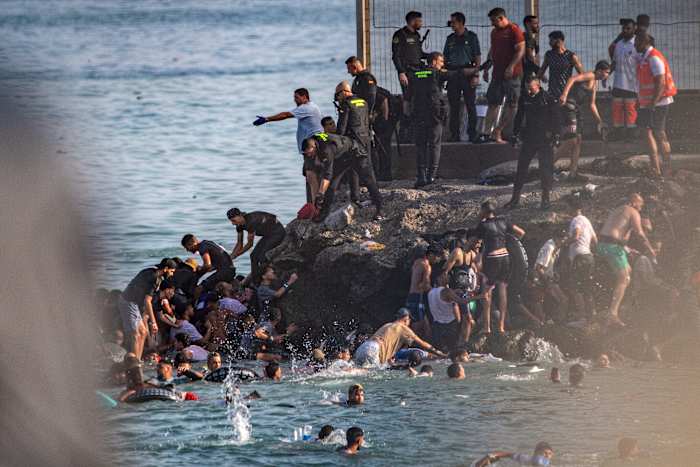
On July 29, just 24 hours before more than 72,000 individuals began streaming into Ceuta from Morocco, the CNI pinged the Spanish government's local delegation. The message was specific. It flagged social media calls pointing directly to an assault on the border fence and attempts by sea set for 8 p.m.
The spy agency's WhatsApp warning noted two distinct online groups boasting a combined 180,000 followers. That is not a whisper or a vague rumor. That is mass mobilization happening right out in the open on Facebook and WhatsApp.
The CNI didn't stop with the regional delegation. They also pushed direct alerts to Spain's Civil Guard police force and even shared warnings with Moroccan intelligence. They highlighted that the impending surge would likely leverage Morocco's national Throne Day celebrations on July 30.
Yet, when the human wave hit, authorities looked completely unprepared.
The Finger-Pointing and Morocco's Passivity
Once the border breach was underway, internal Defense Ministry reports painted a grim picture of Moroccan cooperation. An intelligence note dated July 30 stated that Moroccan security forces acted with passive negligence. While they deployed a small number of riot units, they offered no proactive response to halt the crowd.
The report openly stated that officials couldn't rule out Morocco exploiting the chaos for its own strategic interests. Despite this, Prime Minister Sánchez has carefully avoided pointing any fingers at Rabat. Opposition politicians immediately jumped on this stance, accusing the administration of soft-pedaling international relations at the expense of national security.
Sánchez tried to defuse the backlash on social media, arguing that tracking an online campaign doesn't mean you can forecast a multi-thousand-person humanitarian emergency.
"The existence of this campaign was known and being monitored," Sánchez posted on X, "but in no way did it constitute or could it be interpreted as an indicator of the scale, nature, or probability of what happened afterward."
His spokespersons echoed the line, stating that available information failed to map out the sheer magnitude of the incoming rush.
The Human Toll Left Behind
Excuses don't clear the streets of Ceuta. Weeks after the initial rush, the small Spanish exclave remains trapped in a severe humanitarian strain. National figures show roughly 5,000 migrants, including about 1,200 minors, are still stuck in the city. Local officials argue the real number is closer to 10,000.
To put that in perspective, managing thousands of stranded people in a densely populated enclave creates an immense logistical and social strain. Madrid has pledged hundreds of millions in aid, but protests continue almost daily. Meanwhile, non-governmental organizations report that over 140 migrants died during the deadliest crossing efforts, turning a political dispute into a tragedy.
Transparency rarely arrives cleanly. Governments declassify files only when pressure leaves them no choice, hoping to control the narrative before public anger boils over. In this case, the documents prove the warning signs were flashing bright red long before the first fence was breached.