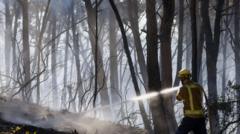
Twelve people are dead in southern Spain after a catastrophic wildfire tore through the province of Almería. The tragedy unfolded in the small hamlets of Los Gallardos and Bédar, where high temperatures and dry winds turned a localized blaze into a lethal trap. Some victims were discovered inside their vehicles, caught completely off guard as they tried to escape the fast-moving flames.
It's a brutal reminder that Europe's climate reality has fundamentally shifted. This isn't just about hot summer days anymore. It's about an environment so dried out that any spark turns into an immediate crisis.
What triggered the Almería tragedy
While officials haven't released a final report on the cause, witnesses on the ground point to a fallen power line that sparked dry brush and woodland near Los Gallardos. In normal conditions, a small brush fire can be contained. But Andalusia has been baked by consecutive days of temperatures pushing past 40°C.
The fire didn't crawl; it ran.
Around 150 firefighters fought the blaze alongside Spain's Military Emergency Unit (UME). Despite the heavy deployment, the extreme heat made containment incredibly difficult. Beyond the 12 fatalities, at least six people suffered severe injuries, including major burns and smoke inhalation. Emergency crews quickly evacuated surrounding areas, moving around 50 displaced residents into a local cultural center as roads were cut off by the advancing smoke.
Juanma Moreno, the president of the regional government of Andalusia, described the event as a complete tragedy. The reality is that the region was already on high alert, with orange weather warnings active across southern Spain.
The broader Mediterranean crisis
Spain isn't dealing with this alone. Southern Europe is currently trapped in a massive heatwave that creates the perfect conditions for these disasters. Just days before the Almería fire, a massive blaze in southern France forced more than 10,000 people to evacuate from dozens of towns near the Spanish border.
The conditions driving these fires come down to three factors:
- Prolonged lack of rainfall that leaves soil and plants completely parched.
- Consistent temperatures hovering near or above 40°C.
- Sudden, strong winds that carry embers kilometers ahead of the main fire line.
According to data from the European Forest Fire Information System, Spain is coming off some of its worst wildfire seasons on record, with hundreds of thousands of hectares burned over the last few years. In response, Prime Minister Pedro Sánchez announced earlier this year that the country would deploy its largest-ever summer wildfire response. Yet, as the situation in Almería shows, even historic resource deployment struggles to match the sheer speed of an explosive fire front.
The reality of fire weather
Scientists use the term "fire weather" to describe the combination of high heat, low humidity, and strong winds. Across the globe, climate breakdown has extended the average wildfire season by about two weeks. In places like Andalusia, that window is expanding even faster.
The traditional firefighting playbook is being rewritten because fires are behaving differently now. They burn hotter, move faster, and create their own localized weather patterns, making direct attacks by ground crews extremely dangerous.
For residents and travelers in these high-risk zones, relying purely on emergency services isn't enough anymore.
How to prepare for wildfire conditions
If you live in or travel through regions prone to extreme summer heat, you need to know how to react before an evacuation order is given.
Monitor local alerts constantly
Don't wait to see smoke. Use local emergency apps and pay attention to the state weather agency (AEMET in Spain) for orange or red warnings. If a fire breaks out nearby, stay tuned to official channels rather than social media rumors.
Create a clear evacuation plan
Know at least two exit routes from your town or property. The victims in Bédar were caught in their cars, showing how quickly escape routes can become death traps when smoke reduces visibility to zero. If visibility drops or roads look compromised, it's often too late to drive.
Prepare your property ahead of time
Clear dry leaves, dead branches, and flammable materials from around your home. Create a defensible space of at least 10 meters around structures. Keep gutters clear of debris that could ignite from floating embers.
Pack a basic emergency bag
Keep essential documents, medication, chargers, and water in an easily accessible bag. If authorities tell you to leave, go immediately. Delaying by even five minutes to grab personal belongings can be the difference between a safe exit and getting trapped on the road.