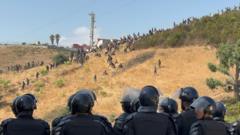
Desperate crowds don't gather at international borders by accident. They are summoned by screens. When Moroccan security forces detained nearly 150 irregular migrants in and around the northern border town of Fnideq, they weren't just stopping a random breach; they were dismantling a coordinated digital operation. Anonymous accounts had spent days broadcasting a simple, intoxicating lie across social media networks: the gates to Spain's North African enclave of Ceuta were wide open.
If you've been following migration trends across the Mediterranean, you know this playbook. It's fast, cheap to run, and devastatingly effective. A few viral clips on TikTok or encrypted messaging groups show smiling individuals supposedly strolling into Europe, and suddenly, thousands of young men march toward the razor wire. The reality waiting at the border, however, is tear gas, armored vehicles, and detention cells. Understanding the ongoing crisis at the Ceuta border requires looking past the political rhetoric and examining how digital manipulation drives physical chaos. Recently making news in related news: Why Qatar And Iran Are Suddenly Clashng Over March Fighter Jet Claims.
The Dangerous Power of Viral Misinformation
Social media changed human migration forever. Smugglers and opportunistic actors no longer need physical offices in coastal towns to recruit clients. They operate behind burner profiles, fabricating narratives that defy logic but feed on deep-seated economic despair.
During the July border crisis, an estimated 80,000 people rushed the frontiers of Ceuta after fake rumors spread like wildfire that Spanish authorities were granting automatic entry. People packed up their lives, traveled hundreds of miles, and threw themselves into the freezing Atlantic surf or scaled formidable fences based entirely on algorithmic falsehoods. Investigations into these networks reveal a predatory business model. Scammers charge desperate hopefuls upfront fees—sometimes thousands of local dirhams—to share secret routes or safe passage guides that lead straight into police traps. Additional details into this topic are explored by USA Today.
The August 15 attempt followed this exact digital blueprint. Moroccan interior ministry officials detected a sudden spike in anonymous posts calling for a mass storming of both Ceuta and Melilla. These messages weren't organic expressions of protest; they were calculated incitements designed to exploit human vulnerability for illegal profit and political pressure. When you look at the demographics of those detained—a mix of sub-Saharan African migrants and Moroccan nationals—you see the broad net cast by these online campaigns. They prey on anyone looking for an escape hatch from poverty, unemployment, and systemic hardship.
Inside Morocco's Heavy Handed Security Shift
Governments are finally adapting to the speed of social media, but the cost is astronomical. Morocco's response to the August resurgence starkly contrasted with the initial shock waves of July. Instead of scrambling to catch up with thousands of people breaking through breakwaters, authorities deployed an iron wall of personnel and hardware well before the crowds could mass near the border fences.
Drones hovered above Fnideq, tracking groups moving through alleyways and olive groves. Armored vehicles blocked primary access roads, while water trucks and riot police maintained a buffer zone miles away from Spanish territory. Police arrested dozens of individuals suspected of administering the online pages that incited the rush. Morocco basically turned the northern coastline into an operational zone of constant vigilance, recognizing that lax security invites humanitarian disasters.
Yet, holding the line comes with immense friction. Local human rights groups and workers' associations point out that militarizing the border creates a pressure cooker environment in nearby towns. Migrants stranded by blocked routes often end up sleeping rough in public parks, leading to localized tensions and severe logistical strain for local municipalities. Security forces are caught in an impossible position: they must prevent mass illegal crossings to maintain regional stability, but doing so turns border towns into transient holding pens.
Spain's Fortress Mentality and the Political Aftershock
Across the wire, Spain views these recurring surges through an increasingly defensive lens. Prime Minister Pedro Sánchez didn't mince words following the historic breaches, labeling the coordinated rushes an explicit violation of territorial integrity and an attack on a sovereign Spanish city.
Madrid has responded by reinforcing maritime barriers—installing hundreds of meters of specialized sea fences designed to deter swimmers from rounding the rocky breakwaters of Benzú and Tarajal. The Civil Guard works hand in hand with Moroccan counterparts, broadcasting multi-language warnings across digital platforms that bluntly state the obvious: the border is closed, containment barriers are reinforced, and anyone who crosses will be sent back immediately.
The political fallout inside Europe has been fierce. Right-wing factions across the continent use the dramatic footage of crowds storming Ceuta to argue that EU borders are porous and collapsing. Some critics even floated suspending Spain from the borderless Schengen zone—a proposal Sánchez dismissed as driven by political opportunism and misinformation. Meanwhile, the human cost gets buried beneath political point-scoring. Official reports from earlier summer clashes cite dozens of deaths from drowning and stampides, while independent humanitarian organizations claim the actual toll is significantly higher. When thousands of people panic in narrow coastal corridors, tragedy is mathematically inevitable.
Why Conventional Borders Fail Against Digital Desperation
You can build higher fences, deploy more drones, and install underwater barriers, but none of these measures address the root catalyst of the Ceuta crisis. Walls are physical answers to digital and economic problems.
As long as severe economic disparity, climate pressures, and regional instability persist across parts of Africa, people will listen to the snake oil salesmen of the internet. A viral video promising a better life will always outshine dry bureaucratic warnings about immigration laws. The authorities are fighting a war on two entirely different fronts: physical enforcement on the beaches of Fnideq and a silent, shadow war against malicious actors hiding behind smartphone screens.
Stopping future incursions requires treating online incitement with the same seriousness as physical arms smuggling. Law enforcement agencies must proactively trace and shut down the digital infrastructure used to organize these mass rushes before crowds ever reach the tarmac.
The border at Ceuta remains a volatile fault line where Europe meets Africa. Until policymakers figure out how to dismantle the criminal networks profiting off digital deception while addressing the fundamental drivers of migration, the cycle of false hope, mass mobilization, and heavy-handed containment will simply repeat itself.