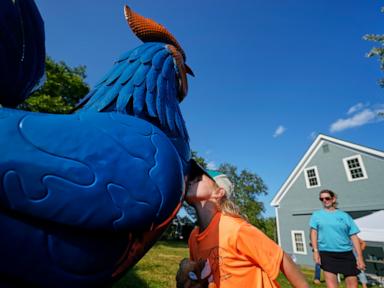
When officials in the coastal town of Ogunquit, Maine, ordered a local family to strip their lawn of giant metal rooster statues, they thought they were enforcing basic municipal sign codes. Instead, they stumbled straight into a bureaucratic mess that ignited a worldwide display of solidarity for a six-year-old autistic girl named Pyper.
What started as a petty municipal spat over six-foot tin lawn ornaments quickly turned into a masterclass in community support. Today, those bright metal birds aren't just sitting in storage—they're standing tall on lawns across Maine and even as far away as New Zealand.
Here is what really happened behind the scenes in Ogunquit, why municipal rules often clash with neurodivergent needs, and how a family turned a bureaucratic headache into a global message about inclusion.
The Lawn Decor Town Officials mistook for Commercial Signs
David and Sara LeBlanc run The Omelette Factory, a popular breakfast spot attached to their home in Ogunquit. Over time, they accumulated a collection of more than two dozen six-foot-tall metal roosters, rotating them across their front yard for seasonal and holiday displays.
For the LeBlanc family, the statues weren't business signage—they were crucial emotional anchors for their adopted daughter, Pyper.
Pyper, who is autistic, relied on the giant birds for comfort. Every morning, she would hide behind one of the statues while waiting for her school bus, a ritual her parents explained helped her regulate her emotions and handle daily routine transitions.
Statue Count: 24+ metal roosters accumulated over time
Initial Town Fine: $450 for "unpermitted signage"
Additional Fine: $500 for ongoing noncompliance
Compromise Granted: Disability variance for 2 roosters
The friction began when town code enforcement officer Tyler McOsker slapped the family with $450 in fines, citing the statues as unpermitted business signs. His reasoning? The couple had added a rooster design to their restaurant merchandise, and a local news piece had offhandedly dubbed the statues a fun "open sign".
David LeBlanc pushed back hard. "Roosters don't lay eggs," he pointed out, noting that equating a giant rooster to an advertisement for an omelette shop missed the mark completely.
Bureaucracy vs Accessibility in Small Town America
When the case reached the Ogunquit Zoning Board of Appeals, the debate highlighted a common disconnect between rigid municipal codes and genuine accommodation needs.
Board members openly questioned the necessity of the artwork. Board member Jay Smith expressed skepticism over the lack of formal medical proof, questioning how many six-foot metal birds were actually required to comfort a child and stating the seaside town prefers an ambiance undisturbed by "a proliferation of weird art."
"I'm inclined to think there may be some merit to a comfort animal on the front lawn… but the point is, how many does it take?" — Jay Smith, Ogunquit Zoning Board of Appeals
Eventually, the board determined it lacked authority to erase the original fines, but granted a disability variance allowing the family to keep two roosters attached to their front steps as an accessibility feature. Yet, because the statues were bolted rather than fully integrated into a handrail structure per the town's exact variance language, the family hit another $500 fine for noncompliance.
This kind of strict regulatory rigidity is precisely why local disputes often boil over. When town codes fail to account for neurodiversity and therapeutic supports, families are forced to choose between paying escalating fines or stripping away comfort items their children rely on every single day.
Turning Lemons into Lemonade: The Rooster Fostering Movement
Rather than letting the extra roosters gather dust in a garage or fighting an endless court battle, the LeBlanc family launched a "rooster fostering" initiative.
They began giving the displaced statues to neighbors, local business owners, and friends to display on their own properties as a show of support for autism acceptance.
- Neighborhood Fostering: A nearby neighbor named Sam took in the first batch of displaced statues.
- Local Business Solidarity: Hetal Patel, a motel owner in neighboring Wells, Maine, couldn't find a local supplier because statues were selling out fast. She drove to New Hampshire to track down the last available metal rooster to display outside her business.
- Global Reach: Social media pages like Roosters of Ogunquit quickly blew up. Families as far away as New Zealand started posting photos of metal roosters on their own lawns in solidarity with Pyper.
David LeBlanc noted that while Pyper was sad to see her favorite lawn companions leave her yard, she quickly grasped the bigger picture. The roosters being taken away were the lemons; the community stepping up to foster them became the lemonade.
What This Story Teaches Us About Neurodiversity and Community Support
The Ogunquit rooster dispute isn't just a quirky news headline about quirky town politics—it points to broader truths about how communities can better support neurodivergent individuals.
- Regulation needs empathy: Rigid zoning codes often treat every residential property with a cookie-cutter standard, completely ignoring distinct developmental or emotional needs.
- Acceptance beats mere awareness: True support for autistic individuals requires visible, tangible actions from neighbors and local businesses, not just token statements.
- Organic support networks work best: When official channels fail to accommodate special needs, grassroots community action often steps in to fill the gap in creative ways.
Next Steps for Supporting Local Autism Acceptance
If you want to advocate for better neurodiversity support and avoid municipal headaches in your own area, here are concrete steps you can take today:
- Review local zoning ordinances: Check your town’s rules regarding disability accommodations and variances before installing large emotional-support structures or sensory setups in your yard.
- Engage your local zoning board early: If your child relies on specific outdoor sensory tools, submit documentation from occupational therapists or pediatricians upfront to establish medical context early.
- Build visibility in your neighborhood: Support local autism initiatives by displaying visible symbols of acceptance or participating in community support networks like the Roosters of Ogunquit effort.