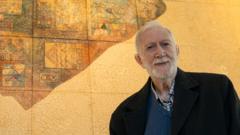
An overflowing crowd gathered under the late summer sun in Birzeit to lay to rest a man who gave visual form to a stateless nation. Sliman Mansour wasn't just a painter. He was the architect of modern Palestinian visual identity. When he passed away at the age of 79, he left behind an empty space in the cultural fabric that no single successor can fill.
The funeral procession wound past stone walls and olive groves to St. Peter's Episcopal Church, led by scouts playing bagpipes while olive branches rested upon his coffin. Mourners spilled out of the packed courtyard, listening to loudspeakers broadcast prayers for a creator whose brushstrokes defined generations of longing, resistance, and survival. If you want to understand why his death felt like the end of an era, you have to look past the gallery walls and examine how art functions under occupation. Meanwhile, you can find other events here: Inside The Fractured Border Reality Between Pakistan And Afghanistan.
The Brush as a Weapon of Memory
Most artists work to capture reality. Mansour worked to preserve it from erasure. Born in Birzeit in 1947, he witnessed the shifting geographies of the region firsthand and chose to anchor his work in the permanent features of the land. His canvases were filled with gnarled olive trees, heavy-laden citrus branches, and women draped in traditional embroidered thobes.
His 1973 masterpiece, Camel of Hardships, cemented his status in cultural history. The painting portrays an elderly porter bowed under the weight of Jerusalem, carrying the Dome of the Rock and the burden of history on his weathered back. It wasn't merely a painting. It became a mirror for an entire population. To explore the bigger picture, we recommend the detailed analysis by NBC News.
"He portrayed man with his pain, his sorrow, his joy, his culture, his heritage and his memory," noted Bishop Imad Haddad during the funeral service.
Surviving Censorship Through Symbolism
Working as an artist in the occupied West Bank meant running a daily gauntlet against military restrictions. During the 1970s and 1980s, Israeli security forces routinely targeted his posters, postcards, and exhibitions, confiscating prints and arresting vendors.
Instead of backing down, Mansour adapted. He shifted toward a visual language rich in allegory. He developed coded symbols that ordinary people could instantly decode while military authorities struggled to penalize them.
When the first intifada erupted in 1987, Mansour took resistance a step further by co-founding the New Vision collective alongside artists like Vera Tamari. The group enforced a strict boycott of imported art supplies, abandoning commercial oil and acrylic paints entirely. They turned to the literal ground beneath their feet—sculpting and painting with mud, straw, clay, and henna.
- Earth-based materials: Cracked clay surfaces that mirrored historical trauma and deep-rooted endurance.
- Mass accessibility: Refusing exclusive gallery elitism by printing cheap posters that ended up on walls from refugee camps in Syria to apartments in Bethlehem.
- Institutional building: Co-founding the League of Palestinian Artists and the International Academy of Art to train the next wave of creators.
Why His Legacy Endures Beyond the Canvas
Mansour's original works command heavy interest from major institutions, including the British Museum, the Mathaf: Arab Museum of Modern Art in Doha, and the Guggenheim in Abu Dhabi. Yet, his true impact was democratic. He wanted everyday people to own his work, hanging inexpensive reproductions in modest homes where formal art collectors rarely tread.
Artists and cultural directors frequently call him the mastermind of a unified visual Palestine. He didn't paint utopian fantasies. He painted reality infused with stubborn dignity.
As wreaths from political leaders and local admirers settled over his grave in Birzeit's cemetery, the grief felt intensely personal across the region. He taught an entire society how to look at their own landscape and recognize their unyielding right to exist upon it. The brush may have slipped from his hand, but the images he left behind will outlast the soil they were molded from.