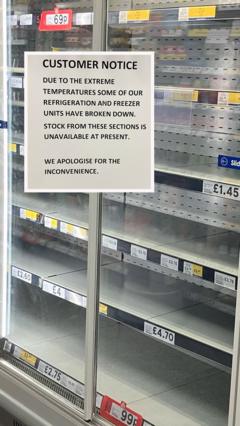
You walk into a local supermarket looking for cold milk, a crisp salad, or a tub of ice cream to survive a punishing afternoon. Instead, you're greeted by plastic caution tape blocking off entire aisles. The shelves are bare. The coolers are completely dark.
This isn't a power cut. It's the reality of modern infrastructure crashing against extreme summer temperatures. You might also find this similar coverage interesting: Why Openai Wants To Give Donald Trump A Five Percent Stake.
During the record-breaking heatwave that scorched Britain, major supermarket chains like Tesco, Sainsbury's, Marks & Spencer, and Waitrose had to dump massive amounts of chilled and frozen inventory. Stores from Essex to Newcastle shut down entire banks of refrigeration units because their appliances simply stopped working.
Most people think a fridge just creates cold out of nothing. It doesn't. Your fridge is an engine that moves heat from inside a plastic box to the outside world. When the outside world turns into a literal furnace, that engine chokes. As discussed in recent articles by Gizmodo, the implications are worth noting.
The immediate answer to whether our fridges can cope with severe heatwaves is an unsettling no. They aren't built for this climate anymore. Britain's retail infrastructure was built for a temperate climate that no longer exists, and our home appliances are struggling right alongside them.
The Catch 22 of Commercial Refrigeration
Supermarket breakdowns aren't caused by a lack of electricity or a desire to save money on utility bills. They are caused by pure physics.
To understand why a retail chiller fails when the outdoor temperature crosses a certain threshold, you have to look at where the heat goes. Large supermarkets rely heavily on centralized refrigeration networks. These setups separate the display cases on the shop floor from the heavy machinery doing the actual cooling work.
The cooling loop relies on basic thermodynamics. Inside the store, liquid refrigerant passes through an evaporator coil, absorbing heat from the food display cases. This liquid turns into a gas, which is pumped away through long copper pipes to a central hub. This hub, containing massive compressors and condensers, is almost always located outside the building—either mounted on the roof or tucked into an external service yard.
The outdoor condenser has one job. It must squeeze the heat out of the refrigerant gas and dump it into the surrounding air so the fluid can liquefy and head back inside to collect more heat.
This works brilliantly when the British summer tops out at a comfortable 22°C. It fails miserably when temperatures hit extreme peaks.
When the outdoor air hitting those rooftop condensers is already boiling, the temperature differential disappears. The system has to pump significantly harder to force heat into an environment that is already saturated with it. Rupert Ashby, the chief executive of the British Frozen Food Federation, pointed out that these older external units get trapped in a vicious cycle. They work harder, which generates more mechanical heat, making the unit even hotter, which drops its efficiency to near zero.
Eventually, the system reaches a breaking point. To prevent the compressors from literally melting or destroying themselves, safety switches trip and shut the entire network down. Because these older systems are centralized, one condenser failure doesn't just stop a single display cabinet. It kills a whole aisle.
Why Spanish Supermarkets Keep Running While British Ones Fail
A common question pops up whenever UK retail infrastructure buckles in the summer. Why do fridges in Spain, Australia, or Greece keep running perfectly fine when it's 42°C outside?
It comes down to procurement costs and engineering specifications.
Refrigeration equipment is rated by climate classes. Manufacturers build units to operate within specific ambient temperature brackets. In the UK, commercial systems were historically specified for temperate zones, meaning they were designed to run efficiently up to an ambient outdoor temperature of around 30°C to 32°C. Buying a system rated for tropical or subtropical conditions costs substantially more upfront because it requires larger condenser coils, more powerful fans, and different refrigerant blends.
For decades, UK retail executives looked at the math and decided it made no sense to pay a premium for high-heat resilience when Britain only saw a couple of hot days a year. It was cheaper to accept a tiny amount of food spoilage or occasional downtime.
Climate realities have shifted faster than the corporate replacement cycles for heavy machinery. The infrastructure is lagging behind the thermometer.
Modern supermarket builds are starting to shift toward plug-in, standalone refrigeration units rather than massive centralized loops. These standalone units are modular. They reject their heat directly into the store's sales floor rather than sending it to the roof. Since the sales floors are usually air-conditioned, these plug-in fridges operate in a controlled climate, shielding them from the outdoor spike. If one plug-in unit dies, staff can simply wheel it out and replace it without losing thousands of pounds of stock across an entire department.
Replacing every legacy centralized system across thousands of older grocery stores requires billions in capital expenditure. Until that happens, expect to see more empty shelves and hazard tape every time a high-pressure weather system stalls over the country.
The Threat to the Domestic Kitchen
Your kitchen fridge isn't immune to these thermodynamic rules either. While it doesn't have a massive compressor sitting on your roof, it faces the exact same structural limitation on a smaller scale.
The black coils on the back of your home fridge-freezer are the condenser. They vent heat into the small gap between the appliance and your kitchen wall. If your kitchen turns into an unventilated oven during a hot spell, your appliance will run continuously without a break.
Domestic fridge-freezers are generally designed to operate in ambient room temperatures between 10°C and 32°C. Once your indoor air breaches that upper limit, the internal temperature of the fridge starts creeping upward. This isn't just about lukewarm drinks. It creates a genuine food safety hazard.
Bacteria like Listeria monocytogenes and Salmonella thrive once a fridge climbs above 4°C. Most people don't realize their fridge is failing until they notice the milk smells sour or the butter is soft, by which time perishable goods have been sitting in a danger zone for hours.
Rethinking the Freezing Standard
The persistent vulnerability of the cold supply chain has triggered a serious debate among logistics experts and food scientists. The industry is looking closely at the universal standard for frozen food storage, which has been set at -18°C for generations.
The British Frozen Food Federation has proposed a radical but practical adjustment. Moving the global frozen baseline from -18°C up to -15°C.
A three-degree change sounds minor, but the thermodynamic relief it provides to cooling infrastructure is immense. Running a massive commercial freezer at -15°C requires significantly less energy and slashes the pressure placed on compressors during extreme weather spikes.
Extensive research by logistics giants and food laboratories shows that keeping frozen food at -15°C is perfectly safe for consumer health and doesn't compromise the nutritional value or shelf life of the vast majority of products. Making this shift across the entire global cold chain would cut carbon emissions by millions of tonnes annually and give infrastructure a vital safety buffer when summer temperatures go off the charts.
How to Protect Your Food and Appliance Today
You can't fix your local supermarket's rooftop condenser, but you can stop your home kitchen from becoming a food safety casualty. Managing a fridge during an extreme warm spell requires breaking a few bad habits.
Give the Appliance Breathing Room
The biggest mistake people make is jamming their fridge tight against the wall or surrounding it with clutter. Pull the unit forward by a few inches. Clean the dust off the rear coils using a vacuum brush attachment. If the coils are coated in a thick blanket of household dust, the heat can't escape, forcing the compressor to work twice as hard.
Do Not Overstuff the Interior
A packed fridge is an inefficient fridge. Cold air needs to circulate freely around the shelves to maintain an even temperature. If you stack containers right up against the internal vents, you create pockets of warm air where bacteria can multiply. Keep the shelves organized and leave clear pathways for airflow.
Manage Your Freezing Tactics
If you need to defrost meat or pre-prepared meals, do it inside the fridge compartment rather than on the counter. The frozen block acts like an ice pack, lowering the internal ambient temperature of the fridge naturally and giving the overworked compressor a much-needed rest.
Monitor the Door Seals
Test the rubber gaskets on your appliance doors. Trap a piece of paper in the door and close it. If the paper pulls out easily without any resistance, your seals are degraded. Hot, humid room air is leaking constantly into your fridge, causing the evaporator coils to glaze over with thick ice, which chokes the system's ability to cool.
The Long Road to Infrastructure Climate Resilience
The sight of empty chilled aisles in major cities is a warning sign. Our current built environment was drawn up using historical weather charts that are no longer accurate guides for the future.
Fixing this issue permanently involves more than just turning down a thermostat or buying a bigger fan. It requires a complete overhaul of building designs, urban planning, and retail equipment specifications. Retailers must accelerate the retirement of legacy centralized cooling loops, shifting instead to decentralized, climate-shielded modular units.
For consumers, the reality is clear. Stop assuming your kitchen appliances are invincible. Check your fridge temperature settings, clear the airflow gaps, and change how you store perishables before the next major heat spike hits. The climate has changed, and our cooling habits have to change with it.