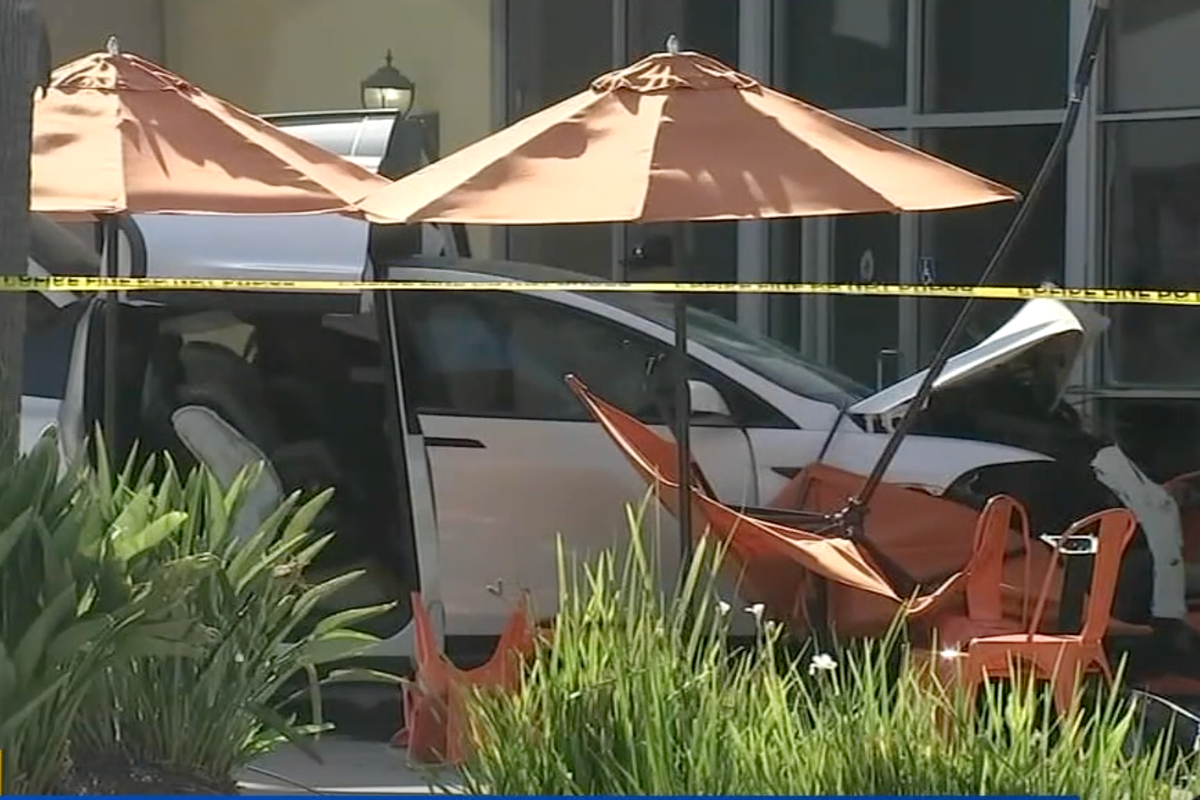
A peaceful Monday afternoon in a busy Southern California shopping center shattered in seconds. It happened right outside the Urbane Cafe in Simi Valley, near Tierra Rejada Road and Madera Road. A white Tesla Model X traveling through the parking lot failed to negotiate a right-hand turn, hopped the curb, and plowed directly into an outdoor dining patio.
The consequences were devastating. A 79-year-old woman from Agoura Hills was struck and pinned beneath the heavy electric SUV. Emergency responders rushed to the scene at roughly 2:30 p.m., but the impact was too severe. She was pronounced dead right there on the pavement. Five other people, including the driver and a juvenile passenger inside the vehicle, suffered injuries that required medical attention.
We see these headlines all the time, but standing back and looking at the wreckage reveals a much larger problem with how we design public spaces and how we handle heavy, high-torque vehicles in tight spaces.
Anatomy of the Simi Valley Accident
The mechanics of the crash are straightforward but terrifying. According to Simi Valley Police Sergeant Rick Morton, the 64-year-old driver from Thousand Oaks was heading northbound through the parking lot. She attempted a right turn to head eastbound toward Madera Road. For reasons investigators are still trying to pin down, the car simply didn't make the turn.
Instead, it surged over the sidewalk. The 79-year-old pedestrian was walking near the restaurant when the vehicle hit her. The Tesla didn't stop there. It plowed through heavy planters and scattered outdoor tables and chairs like toothpicks before smashing into the building structure itself. Two other customers had stood up to leave their table just moments before impact. They missed being crushed by a matter of inches.
Police stated early on that there is no indication drugs or alcohol played a role. It wasn't an intentional act. That leaves investigators looking closely at two main variables: mechanical failure or driver error.
The Weight and Power of Modern Electric Vehicles
When a vehicle jumps a curb, its weight and acceleration potential dictate the damage. The Tesla Model X is a massive machine, weighing over 5,000 pounds. Combine that weight with the instant torque characteristic of electric motors, and a simple mistake turns lethal instantly.
If a driver accidentally panics and stomps on the accelerator instead of the brake—a phenomenon known as pedal misapplication—the vehicle responds without a millisecond of delay. There is no engine roar to warn you that you've hit the wrong pedal before the car surges forward.
We've seen this exact debate play out across the country. Just recently in Katy, Texas, a Tesla Model 3 crashed into a home, killing a 76-year-old woman. While the family in that case pointed to driver-assistance technology, vehicle data eventually revealed the driver had manually floored the accelerator to 73 mph, overriding the vehicle systems. Whether the Simi Valley crash involves a similar pedal error or a genuine mechanical malfunction is what black box data will have to prove.
Public safety shouldn't rely entirely on a driver never making a mistake. Our infrastructure needs to change.
The Flaw in Outdoor Dining Design
If you look at the aftermath of the Urbane Cafe scene, you notice a distinct lack of physical protection. A standard concrete curb is only about six inches high. That is nothing more than a speed bump to a modern SUV, let alone a heavy electric vehicle.
Ever since outdoor dining exploded in popularity, restaurants have rushed to place tables right next to active driving lanes and parking stalls. It makes for a nice atmosphere, but it creates an incredible vulnerability. This isn't just a Tesla problem. It's a structural layout problem.
The fix isn't complicated. It requires structural barriers.
- Crash-rated bollards: Heavy steel posts anchored deep in concrete can stop a 5,000-pound vehicle traveling at parking lot speeds.
- Reinforced planters: Large concrete planters filled with dirt offer far more resistance than the lightweight decorative pieces used by many retail centers.
- High-curb perimeters: Elevating outdoor dining spaces significantly above the parking lot level changes the angle of impact and can redirect a wandering vehicle.
Property owners and commercial tenants owe a duty of care to protect people from foreseeable dangers. Given how frequently cars jump curbs in retail centers, leaving dining patios completely exposed to moving traffic is a massive liability.
Local municipalities must begin updating building codes to mandate real structural protection anywhere vehicles and stationary pedestrians share immediate space. Waiting for manufacturers to build un-crashable cars or waiting for drivers to become perfect operators is a losing strategy. Protection must be built directly into the ground.