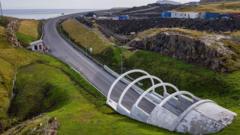
Ferries are a romantic idea until you actually have to rely on them to get to work, reach a hospital, or keep your business alive. In the Shetland Islands, the reality of managing an ageing, breakdown-prone fleet is pushing the local community to the edge. It is why Shetland Islands Council is moving closer to ditching its traditional ferry network in favor of an incredibly ambitious £1 billion subsea tunnel network.
If you think a series of mega-tunnels dug 50 meters below the Atlantic seabed sounds like an impossible fantasy for a remote archipelago, look across the water. The Faroe Islands did exactly this, and it transformed their economy.
Shetland is now looking to copy that exact blueprint. This is not just a story about infrastructure; it is a blueprint for saving rural communities from terminal decline.
The True Cost of Doing Nothing
Shetland's current inter-island ferry fleet has a serious problem: the vessels are old. The average age of the ships is 32.5 years. Running this network is becoming an expensive nightmare, with operating costs ballooning to £25 million for the 2024/25 financial year alone.
Between crew recruitment shortages, deck capacity limits, and constant mechanics failures, the current system is failing the people who live there.
Council Leader Emma Macdonald put it bluntly: islands that rely on unreliable, carbon-heavy ferries suffer from depopulation. Young people leave because they cannot guarantee they will make it to the mainland for school or work. The average age of the remaining population climbs.
According to engineering consultants COWI and Stantec, doing nothing and simply maintaining or refreshing the existing ferry setup over the next 60 years would cost more than £1.7 billion. Building and maintaining four fixed tunnel links over that same period? Around £1.6 billion.
When you look at the math, building tunnels is actually cheaper than buying new boats.
Mapping out the Subsea Network
The proposed plan targets four distinct islands, connecting them directly to the Shetland Mainland or adjacent islands via a series of single-tube, two-lane road tunnels.
The council has been using the Yell Sound route as its "test case" to prove the engineering is sound and financially investable.
The Mainland to Yell Tunnel
- Length: 4.2 miles (6.8 km)
- Depth: 50 meters below the seabed
- Estimated Capital Cost: £327 million (rising to £402 million when adding upfront costs and a £50 million contingency buffer)
- Construction Timeline: Roughly 8 years
The Supporting Links
- Whalsay Tunnel: Estimated at £427.5 million for construction, plus £95.5 million for a 60-year maintenance cycle.
- Unst Tunnel: Projected at £345 million to bridge the northernmost gap.
- Bressay Tunnel: The shortest and least expensive of the four, coming in at £255 million.
While a total project budget crossing into the billions sounds terrifying for a local authority representing roughly 23,000 people, international experts say the engineering itself is surprisingly standard rock-tunnelling. The real hurdle is not the rock; it is the funding model.
Borrowing the Faroese Financial Playbook
Neither the Scottish nor the UK governments have stepped up to hand over a £1 billion blank check. Because of that, Shetland is designing a public-private model based entirely on how the Faroe Islands funded their 23-tunnel network.
Instead of relying solely on taxpayer grants, the Faroe Islands set up state-backed public companies. These companies secured long-term loans from international commercial banks and domestic pension funds. The critical feature? The loans are paid back entirely by motorist tolls.
Shetland intends to do the same thing. Drivers will pay a toll to cross the subsea links, effectively replacing the current ferry ticket prices.
High-traffic tunnels can help subsidize the quieter, more remote routes to keep tolls fair across the entire archipelago.
Local action groups on Yell and Unst are so confident in this model that they privately raised the cash to hire Norconsult—the engineering group behind the Faroese tunnels—to complete initial sonar and seismic ground studies. They have already proven the rock is buildable.
Beyond the Commute: The Hidden Economic Payoff
Opponents of mega-projects usually look at immediate construction costs and assume it is a waste of money. What they miss is the dramatic economic ripple effect of fixed links.
When you replace a 45-minute ferry ride (which might get canceled due to North Atlantic gales) with a 5-minute drive through a tunnel, everything changes.
Emergency services can reach patients instantly. Salmon farming and fishing companies—major drivers of Shetland's economy—can ship their products to mainland markets without missing tight logistics windows due to bad weather.
Even the aerospace sector has skin in the game: the SaxaVord Spaceport on Unst relies heavily on moving heavy, sensitive equipment that does not mix well with rough seas and unreliable ferry timetables.
As COWI executive vice-president Andy Sloan pointed out, people will move to remote places if they are easy to get to, digitally connected, and offer an affordable standard of living. Tunnels turn isolated islands into accessible suburbs of the Shetland Mainland.
Actionable Next Steps for Tracking the Project
Councillors are scheduled to debate the Outline Business Case and formally vote on their preferred transport options. If you want to follow or get involved in the project, take these steps:
- Review the Data: Read the full cost breakdowns and route alignment proposals directly on the Shetland Islands Council Portal.
- Follow Local Campaigners: Check the geological study updates and community feedback logs published by the joint action groups at the Yell and Unst Tunnels Initiative.
- Monitor Government Commitments: Watch for joint infrastructure funding announcements from Transport Scotland and the UK Treasury Green Book updates to see if Westminster or Holyrood will guarantee the necessary construction bonds.