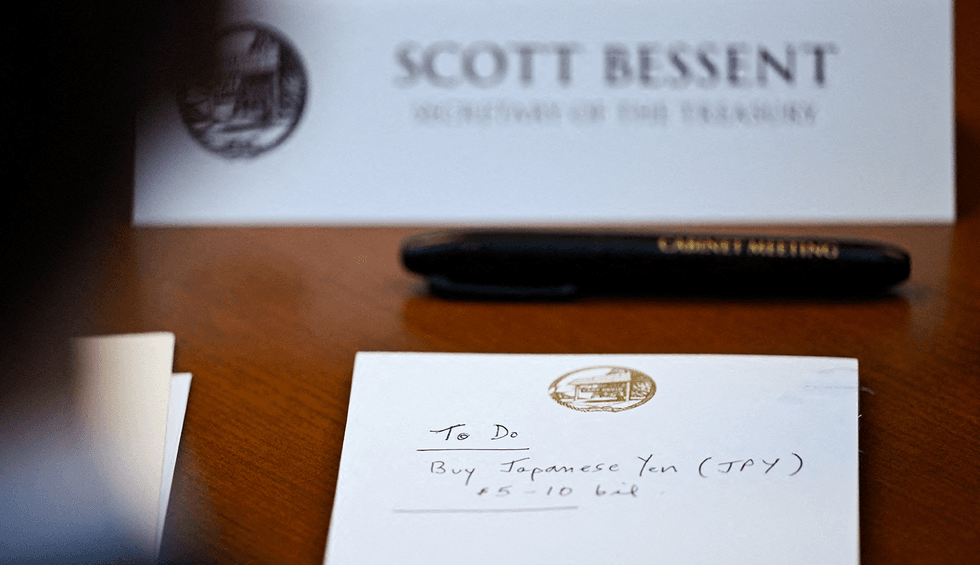
High-stakes economic policy isn't usually broadcasted on a yellow legal pad during a televised presidential gathering. Yet, that is precisely what happened when Treasury Secretary Scott Bessent sat down for a cabinet meeting at Camp David.
A sharp-eyed photojournalist caught a clear view of Bessent's writing pad. Written right under an underscored heading were explicit instructions detailing a plan to buy up to ten billion dollars in Japanese yen.
It was a massive operational leak hiding in plain sight.
The Camp David Camera Angle That Exposed the Treasury
If you missed the commotion, a Reuters photographer snapped an over-the-shoulder shot of Bessent's desk at 11:33 AM. Right beneath the bold words "To Do," the note read: "Buy Japanese Yen (JPY) $5-10 bil."
No secret codes. No encrypted channels. Just a standard conference notepad sitting directly below his official name card.
Markets move fast, but physical carelessness moves faster. Hours before the image made headlines, financial insiders already suspected something was shifting. The Treasury had quietly contacted several major banking institutions hinting at a potential market intervention.
When the photo dropped, it confirmed what traders were whispering about all morning. The United States was stepping directly into foreign exchange territory to prop up the currency.
Why the Japanese Yen Is Causing Such a Panic
You might wonder why a drop in the Japanese currency matters to everyday folks. The yen had slumped to some of its weakest levels in decades against the dollar.
A weak yen creates a domino effect across global trade and fuels domestic price spikes everywhere. Higher import costs and shifting energy markets put heavy pressure on purchasing power.
When foreign currencies drop too low, global trade stability takes a direct hit. Governments rarely step in unless things get genuinely shaky. The U.S. hasn't intervened to support the yen since 2011, back when a devastating earthquake and tsunami hit Japan.
Seeing the Treasury Secretary jotting down billions in foreign currency purchases shows just how serious things have gotten behind closed doors.
The Reality of Accidental Transparency in Modern Politics
We live in an era of hyper-scrutiny where every second of a public official's day is recorded, analyzed, and zoomed in on. High-ranking cabinet members should know better than to keep sensitive financial strategies exposed to open press pools.
Whether it was an honest lapse in situational awareness or a calculated leak, the damage—or the message—was already delivered to the market. Traders didn't wait for an official press release. They reacted instantly to a handwritten sticky note.
Keep an eye on how currency markets respond in the coming days. Transparency usually happens through formal announcements, but sometimes the most honest policy details come from a careless pen stroke on a notepad.