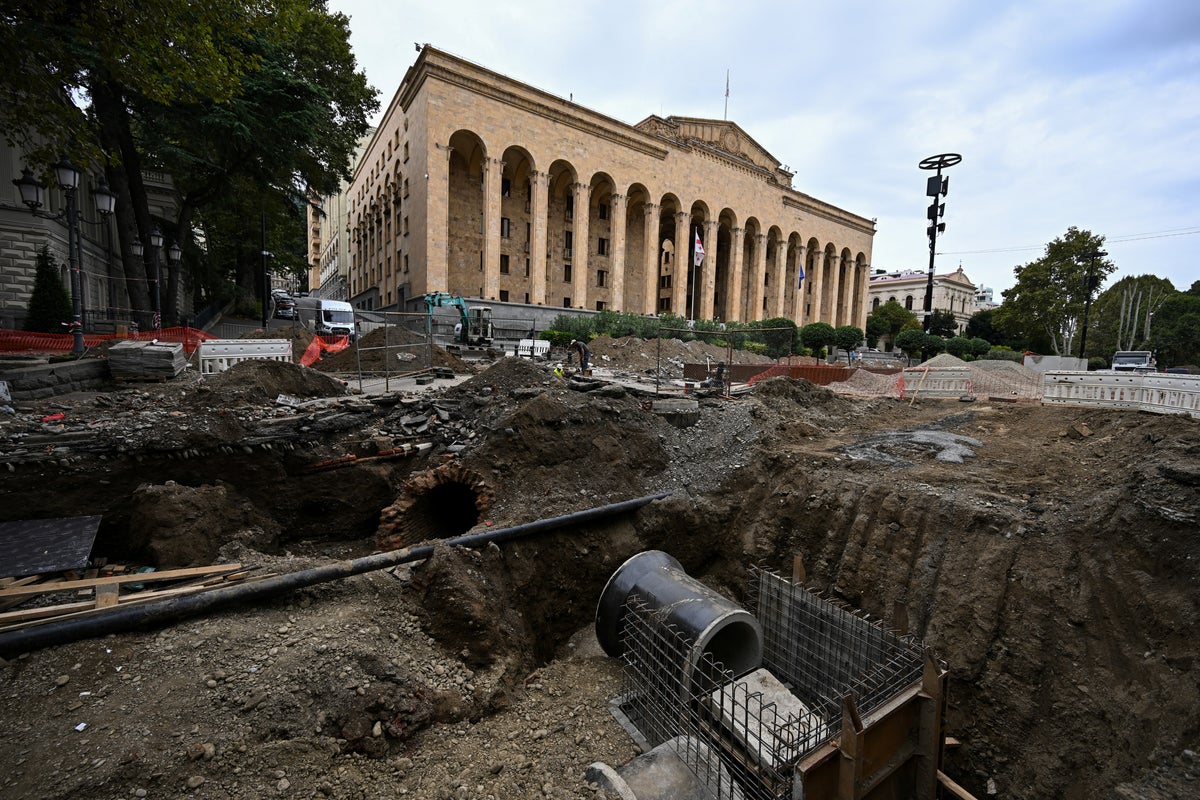
Municipal construction projects usually bring nothing more than gridlock, noise, and frustrated pedestrians. But every once in a while, tearing up city pavement exposes an entirely different layer of human history. That is exactly what happened beneath the asphalt of Rustaveli Avenue in Tbilisi, Georgia.
Workers digging up the capital's main thoroughfare for pedestrian upgrades didn't just strike utility lines. They uncovered a trove of 10th-century pottery sitting six metres underground. For anyone tracking Caucasian history, this find offers a rare, physical anchor to a period often overshadowed by later architectural booms.
Let's look past the traffic jams and examine what this ancient ceramic workshop actually tells us about Georgia's medieval past.
Beneath the Asphalt of Rustaveli Avenue
Urban archaeology is a messy business. When the city launched street renovations this summer to add crosswalks and modern signage along Rustaveli Avenue, locals complained about the dust and delays. They had no idea that a medieval pottery workshop was hiding just beneath their feet, sitting a stone's throw from the National Museum.
David Lordkipanidze, director of the Georgian National Museum, noted that finding ancient production sites here makes sense. Tbilisi sits on layers of continuous habitation. When you dig down six metres on a central boulevard, you are bound to hit centuries of forgotten infrastructure.
The site yielded fragments of pottery whose ornamentation points straight to the 10th and 11th centuries. This places the artifacts right in the middle of a turbulent, fascinating era when Tbilisi operated under Arab rule while serving as a vital nexus along the Silk Road.
The Multicultural Realities of Medieval Tbilisi
History textbooks love neat timelines, but medieval cities were chaotic mixing pots. During the eras of the Umayyad and Abbasid caliphates, followed later by the Seljuk Empire, Tbilisi was never just a provincial outpost. It was a bustling economic engine.
Traders, artisans, and conquerors constantly reshaped the city. You had Persian, Arab, and local Caucasian influences bleeding into everything from trade law to ceramic glazing techniques.
The newly unearthed pottery pieces aren't just pretty shards to stick behind a glass case. They offer material proof of everyday manufacturing during a time when the city was a crossroads of empires. Researchers at the National Museum plan to run 3D scans on the fragments to map out the exact kiln structures and clay compositions used a thousand years ago.
Why This Discovery Matters Right Now
It is easy to view municipal roadworks as an administrative headache. City hall in Tbilisi has faced plenty of heat lately, dealing with everything from construction delays to controversies over underground asbestos removal. Yet, unexpected historical discoveries force a shift in perspective.
Cities like Tbilisi are living palimpsests. Every generation scrapes away a bit of the surface to lay down new pipes, transit lines, or sidewalks. In doing so, they risk destroying the very history that gives the place its identity.
When archaeologists get a brief window to document a 10th-century workshop before modern construction resumes, they capture data that can never be recovered once the new pavement sets.
If you ever find yourself walking down Rustaveli Avenue, spare a thought for the layers hidden beneath the concrete. History isn't just locked away in controlled museum vaults. Sometimes, it sits right under the street, waiting for a backhoe to bring it back to light. Check out the Georgian National Museum exhibits if you want to see how these newly scanned artifacts fit into the broader story of the Caucasus.