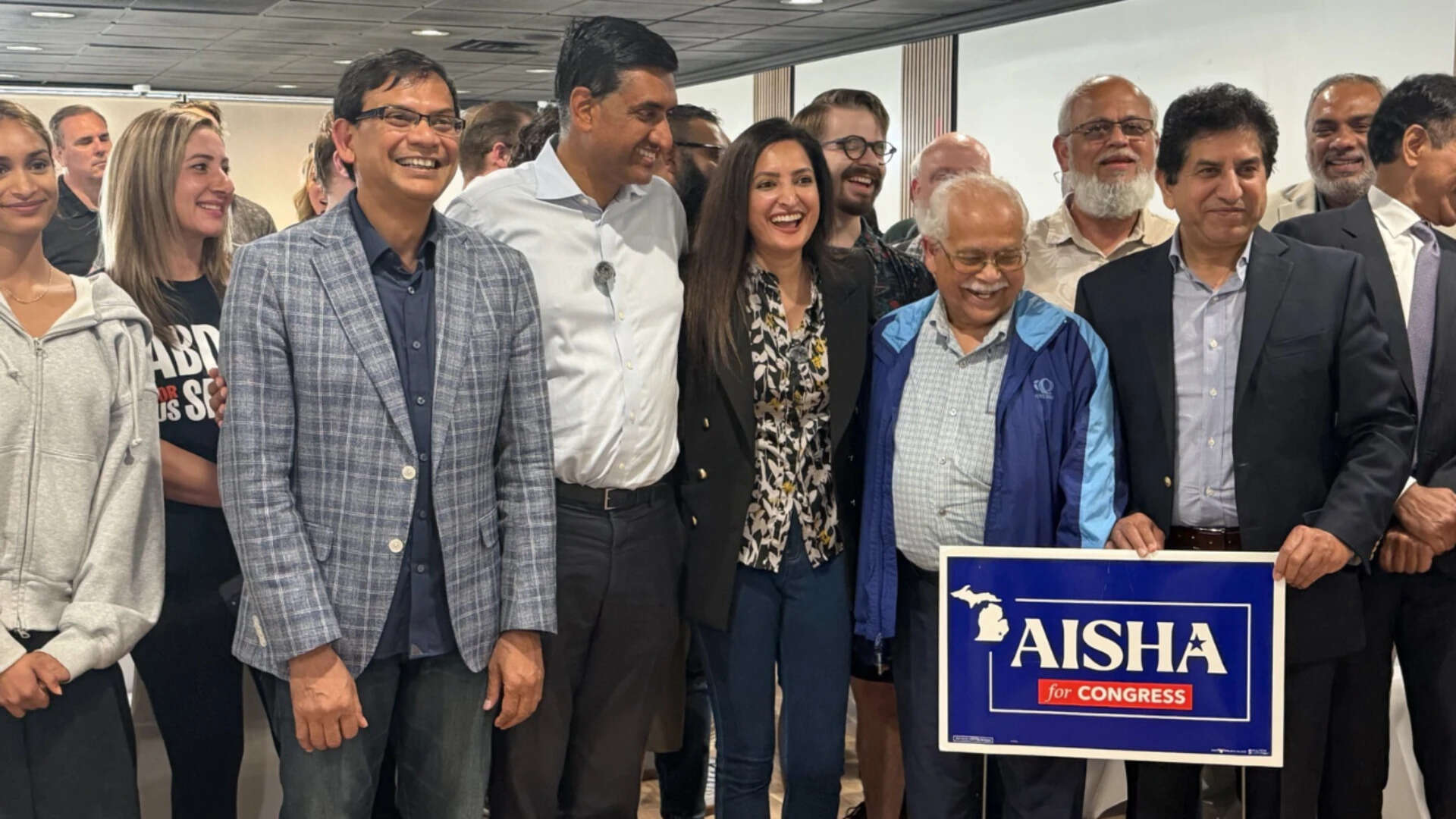
You don't usually see American congressional campaigns grinding to a halt to discuss the merits of paneer pakoras or the filmography of Shah Rukh Khan. But that's exactly what happened in Farmington Hills, Michigan, when California Representative Ro Khanna joined local candidate Aisha Farooqi for a brief, viral chat. On the surface, it looked like standard campaign trail schmoozing. Look a little closer, though, and you'll spot a profound shift in how immigrant communities wield power in American politics.
When Ro Khanna backs candidate Aisha Farooqi, it isn't just one Democrat helping another before a tough primary election. It breaks a historic barrier. An Indian-American lawmaker is publicly putting his weight behind a Pakistani-American candidate. In the context of South Asian geopolitics, that's a big deal. The old country animosities that often divide diaspora groups back home didn't make it into the room. Instead, shared culture and mutual political goals took center stage.
The interaction unfolded in a casual, 58-second video clip that Farooqi posted online. It quickly caught the attention of observers who track the growing influence of South Asian voters. It's a masterclass in how modern campaigns use cultural touchstones to build broad coalitions. Let's look at why this moment matters so much right now and what it reveals about the changing face of American representation.
A Casual Chat with Deep Political Undercurrents
The setting was informal, but the implications are massive. Farooqi kicked off the conversation by pointing out the deep similarities between herself and Khanna. She counted them off. They are both lawyers. They are both Punjabis. They are both South Asians.
Khanna jumped right on that thought. He looked at the camera and noted that now you have an Indian-American endorsing a Pakistani-American. Farooqi's response was swift. She smiled and said that it could only happen in America. Khanna agreed. He said that's exactly what this country is about.
This isn't just feel-good rhetoric for a campaign ad. It represents a tactical alignment. For decades, South Asian immigrant groups in the United States organized along national or religious lines. Indian-American groups did their thing, while Pakistani-American organizations focused on their own communities. This clip shows those old divisions melting away under the pressure of American electoral realities. By focusing on shared regional roots like Punjabi heritage rather than national borders, these candidates are building a more unified voting bloc.
The Power of a Shared Punjabi Identity
The mention of being Punjabi is a crucial detail that a lot of mainstream commentators missed. The Punjab region was brutally split in two during the 1947 partition of British India. That event triggered massive violence and decades of bitter geopolitical rivalry between India and Pakistan. Families were separated, and deep scars remain to this day.
Yet here are two politicians in Michigan, generations removed from that trauma, using their shared Punjabi identity as a point of instant connection. They didn't focus on New Delhi or Islamabad. They focused on their shared cultural vocabulary. This kind of unity is becoming more common among younger South Asian Americans who care more about domestic policy, civil rights, and local representation than litigating historical conflicts from the subcontinent.
Inside the Battle for Michigans Eleventh Congressional District
To understand why this endorsement matters, you have to look at the ground reality in Michigan. Farooqi is currently running in a highly competitive Democratic primary for Michigan's 11th Congressional District. The primary election is coming up fast on August 4, 2026. She faces a crowded field that includes other prominent local figures like state senator Jeremy Moss, John Paul Torres, and Don Ufford.
Michigan's 11th District covers parts of Oakland County, an area that has seen a noticeable demographic shift over the last decade. The South Asian and Middle Eastern populations here are growing rapidly. They are no longer just passive observers in local politics. They are actively running for office, organizing voter registration drives, and demanding a seat at the table.
Farooqi brings a unique personal history to this race. Born in Aberdeen, Scotland, she eventually moved to the United States and built her life in Michigan. She earned a psychology degree from the University of Michigan-Dearborn and a law degree from the University of Detroit Mercy School of Law. She has spent years working as a real estate attorney and public servant, sitting on the Michigan Child Abuse and Neglect Prevention Board and the Sterling Heights Zoning Board of Appeals.
By securing the backing of a high-profile national figure like Khanna, Farooqi gets an instant boost in credibility. Khanna has represented California's 17th Congressional District since 2017 and commands a massive national profile, especially among progressive voters and tech sector professionals. His stamp of approval sends a clear signal to donors and voters in Oakland County that Farooqi is a serious contender with national backing.
Overcoming Historical Baggage at the Ballot Box
It's easy to forget that immigrant communities aren't monoliths. Within the South Asian diaspora, tension can simmer under the surface. Sometimes political events in Southern Asia spark intense debates inside community centers and places of worship right here in the United States.
Politicians often walk a tightrope when navigating these dynamics. Khanna knows this well. He represents a Silicon Valley district with a huge, politically active Indian-American population. He has frequently spoken out on US-India relations. Just recently, at the US-India Strategic Partnership Forum Leadership Summit in Washington, Khanna remarked that bilateral relations had hit their lowest point in nearly thirty years, pointing to previous administrative policies that eroded mutual trust.
Despite holding strong opinions on international relations, Khanna chose to focus entirely on domestic solidarity during his meeting with Farooqi. He didn't let international diplomacy dictate his local political alignments. That is a deliberate choice. It tells voters that the immediate needs of American suburbs matter more than foreign policy squabbles.
Beyond Politics Pop Culture as the Ultimate Bridge
The most charming part of the viral video had nothing to do with policy. It was all about pop culture and food. Once the political endorsements were out of the way, the two dove into a rapid-fire discussion about their favorite things.
Farooqi asked Khanna about Bollywood megastar Shah Rukh Khan. Khanna didn't hesitate. He declared that "My Name is Khan" is one of his favorite movies. The choice of film is fascinating. That specific movie handles themes of Islamophobia, identity, and belonging in post-9/11 America. It's a film that resonates deeply with both Indian and Pakistani immigrants who faced similar struggles.
Then came the food debate. Farooqi mentioned her love for samosas, adding that during Ramadan she prefers pakoras. Khanna chimed in with his own favorite: paneer pakora. When it came to drinks, Farooqi confessed to drinking mango lassi but held a deep love for chai. Khanna agreed on the chai but admitted that a good mango lassi isn't bad either.
These small details matter. They humanize the politicians. They break down the stiff, heavily scripted nature of modern political campaigns. For a young South Asian voter watching that clip on social media, seeing a sitting Congressman and a congressional candidate argue about paneer pakoras and chai makes them instantly relatable. It proves that you don't have to erase your cultural identity to run for the highest offices in America.
What Next for South Asian American Representation
If you want to support or follow this growing political movement, don't just watch the viral videos. Track the upcoming primary on August 4, 2026. Look closely at the voter turnout numbers in Oakland County to see if this cross-cultural coalition translates into actual ballots. You can also look up local organizations like Emgage Action or regional South Asian political action committees to see how they are mobilizing voters on the ground. The real test of this historic endorsement will happen at the ballot box.