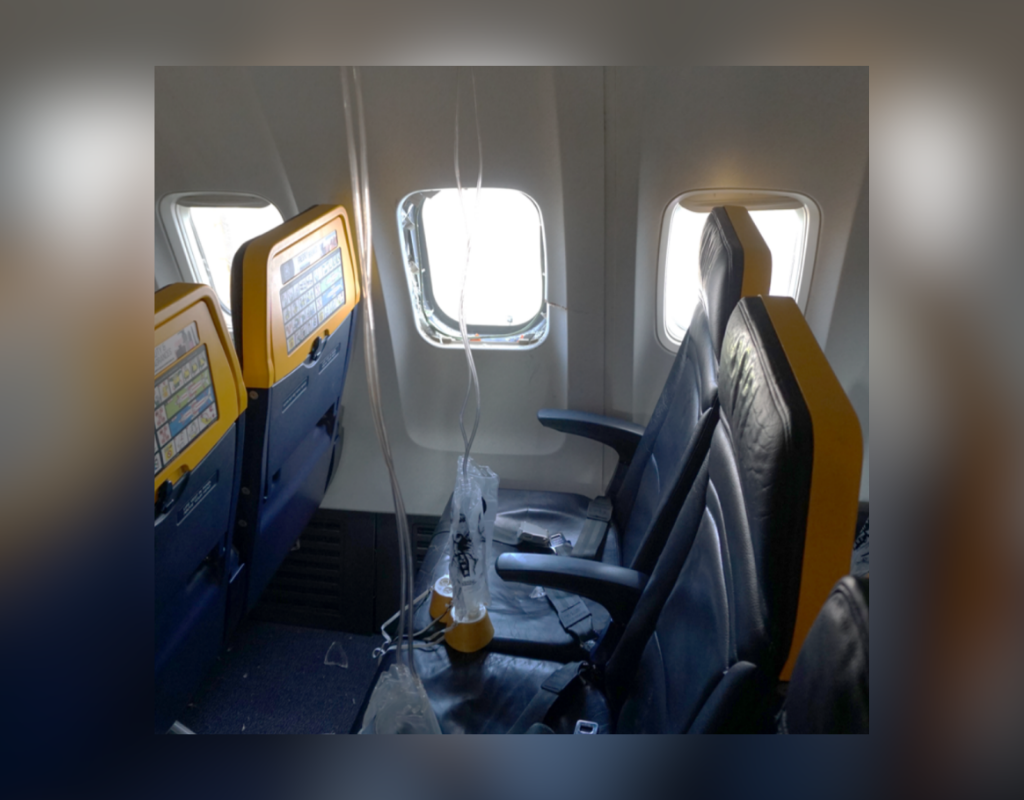
A routine flight out of Greece turned into a terrifying nightmare when a structural engine failure shattered a cabin window, pulling a passenger partially out into the freezing slipstream.
If you have flown recently, you expect the cabin walls to stay intact. But on July 10, Ryanair Flight 1879 proved that terrifying anomalies still happen at thirty thousand feet. A fan blade inside the right engine broke apart just minutes after takeoff from Thessaloniki, sending high-speed metal fragments tearing directly into the fuselage and smashing seat 11F.
The preliminary findings from the National Transportation Safety Board (NTSB) paint a brutal picture of what went wrong. Let's break down the actual mechanics of the disaster, the controversy surrounding airline accountability, and what this means for aviation safety moving forward.
The Chaos Inside Seat 11F
The flight had been airborne for less than ten minutes. Passengers felt a sudden, violent vibration, followed by a loud bang that disconnected the autopilot. Smoke and fog quickly filled the cabin as emergency oxygen masks dropped from the ceiling.
Sitting in seat 11F was 61-year-old Serbian entrepreneur Ljubisa Karović. When a piece of the fractured engine fan blade slammed into the fuselage, it punched through the metal skin and shattered the window beside him. The sudden explosive decompression created a massive vacuum.
Karović's head and right arm were instantly sucked out through the shattered window. The rushing air and pressure differential locked him into the opening. His wife, Svetlana, along with fellow passengers nearby, lunged forward and grabbed his legs. They held onto him for several agonizing minutes while the flight crew scrambled to stabilize the crippled Boeing 737-800.
Other travelers eventually managed to haul him back into the cabin. He suffered severe friction burns, neck injuries, and deep shock, but survived because quick-thinking strangers refused to let go.
What the NTSB Investigation Actually Found
Greece handed the investigation over to the U.S. NTSB under international aviation rules. Their preliminary report dissects the exact chain reaction that led to the catastrophe.
First, investigators discovered evidence of fatigue cracking at the base of the broken fan blade. Metal fatigue occurs when microscopic fractures grow under repeated stress until the component suddenly snaps. Yet, maintenance records show this specific engine had undergone ultrasonic testing in May, just weeks prior, with zero flaws detected.
Second, the NTSB uncovered bird remains inside the damaged engine. Flight crews had logged four suspected bird strikes on that exact engine over the preceding twelve months. While maintenance teams found bird parts in two of those prior cases, subsequent inspections cleared the engine for service each time. Investigators are still determining if those historical impacts weakened the structural integrity of the fan blades.
The Public Relations War and Regulatory Clash
Ryanair executives tried to control the narrative immediately, which backfired spectacularly.
During an earnings call shortly after the accident, Ryanair CEO Michael O'Leary dismissed eyewitness accounts. He publicly claimed that reports of a passenger being halfway out the window were exaggerated "salacious reports" and insisted nobody went through any window. He also pointed aggressively toward foreign-object damage as the sole culprit.
The NTSB hit back hard. Chairwoman Jennifer Homendy formally reprimanded O'Leary, noting that international aviation law strictly prohibits airline executives from speculating on open accident investigations or publicly steering the narrative while forensic work is ongoing. O'Leary's rush to protect the airline's stock price violated global protocol and undermined independent investigators.
Furthermore, safety advocates pointed out a glaring regulatory loophole. The aircraft utilized a CFM56 engine configuration that is subject to specific safety updates mandated for U.S. carriers by 2028. Because Ryanair operates under Irish and European aviation authorities rather than the FAA, those specific engineering modifications were not legally required on this airframe at the time of the flight.
Why This Incident Keeps Happening
This disaster echoes previous structural failures. Aviation historians immediately drew parallels to the tragic 2018 Southwest Airlines Flight 1380 disaster, where an engine failure also blew out a cabin window and partially ejected a passenger.
When high-bypass turbofan blades spin at thousands of revolutions per minute, they store immense kinetic energy. If a blade separates, containment rings are designed to keep the shrapnel inside the metal casing. When containment fails or fragments escape through the intake or exhaust cowlings, the fuselage becomes vulnerable. Aircraft windows are strong, but they are not built to withstand high-velocity titanium alloy shrapnel.
Practical Takeaways for Frequent Flyers
You cannot control engine maintenance schedules, but you can control how you prepare yourself every time you board a commercial jet.
- Keep your seatbelt fastened whenever you are seated, even when the fasten-seatbelt sign is turned off. Sudden decompression or turbulence can throw you against the cabin interior or toward compromised openings instantly.
- Pay attention to the safety briefing. Knowing where the nearest exit is and how to react when oxygen masks drop cuts through the panic if seconds count.
- Respect the crew. Flight attendants train rigorously for rapid decompressions and engine failures; following their commands immediately prevents secondary injuries during chaotic evacuations.
The final NTSB report will take months to complete. Until then, this incident serves as a grim reminder that commercial aviation leaves zero margin for mechanical error.