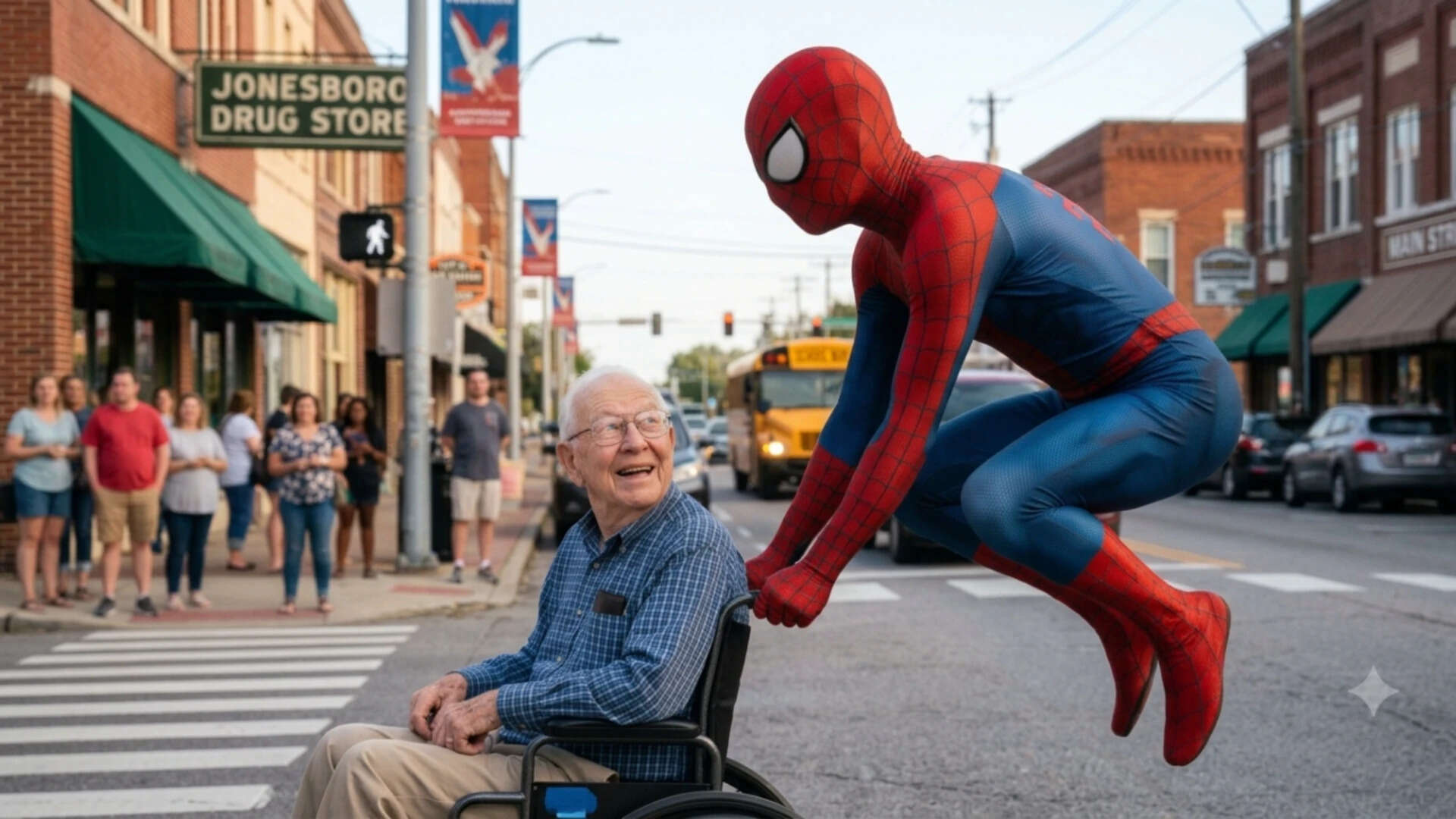
A guy in a red Jeep pulled up to a red light in Jonesboro, Arkansas, dressed head to toe in a full-body Spider-Man costume. That sounds like the setup to a cheap internet prank. But what happened next at the intersection of Caraway Road and Highland Drive turned out to be one of the cleanest, purest acts of kindness you will ever see on a traffic camera.
A man in a wheelchair was struggling to cross six wide lanes of busy midday traffic. The crosswalk timer was ticking down fast. Before the signal could flip, the driver in the suit hopped out of his vehicle, sprinted into the middle of the street, said "I got you," and pushed the wheelchair safely to the curb. He turned around, jogged back to his Jeep, and drove off right as the light turned green. Whole thing took about ten seconds.
People loved it. The footage posted by the Jonesboro Police Department racked up tens of thousands of views within hours. But behind the viral clip is a story about community instinct, flawed urban design, and a twenty-year-old kid who took a childhood dream seriously.
Who Was Behind the Mask in Jonesboro
The guy in the suit is Christopher Hellenthal. He is a 20-year-old resident of Lake City, Arkansas, just east of Jonesboro. He works at Ultimate Air Trampoline Park. On that Tuesday afternoon, his job called for him to suit up as Spider-Man for a toddler superhero day.
He was driving home in his red Jeep, still wearing the costume, when he pulled up to the red light at Caraway and Highland.
That is when he spotted the pedestrian.
Hellenthal did not sit back and record a video on his phone like most people do nowadays. He did not wait for someone else to step up. He saw a fellow human stranded in the middle of a six-lane asphalt grid with traffic crawling toward him.
His manager at the trampoline park, Packy Magel, later joked that Hellenthal moved so fast he was less like Spider-Man and more like the Flash. Magel mentioned that seeing Hellenthal do something like that was not a shock at all to anyone who knows him. He is just built that way.
When asked later about why he moved so quickly, Hellenthal admitted his heart was pounding. "I had a bunch of adrenaline pumping through me," he said. He added that he was also thinking, "I'm wearing this suit; it's gonna be pretty funny".
That combination of humor and genuine empathy is why this moment blew up across social media. It was not a staged publicity stunt. There were no cameras set up on tripods for clout. The only lens watching was a high-angle municipal traffic monitoring camera mounted on a light pole.
The Lesson Hidden in a Ten Second Video
The reason this clip touched a nerve goes deeper than just seeing a superhero outfit in public. It points directly to two stark truths about modern civic life.
1. Our Roadways Are Dangerous for Wheelchair Users
Let's talk about the intersection itself. Caraway Road and Highland Drive in Jonesboro is not a quiet suburban alleyway. It is a massive commercial corridor spanning six lanes of traffic.
For an able-bodied sprinter, crossing six lanes during a fresh walk signal takes a few seconds. For someone in a manual wheelchair or dealing with limited mobility, six lanes is an obstacle course. If a traffic signal gives pedestrians 15 to 20 seconds to cross, someone moving at a slower pace is automatically placed in harm's way before they even reach the midpoint median.
According to data from the National Highway Traffic Safety Administration (NHTSA), pedestrian fatalities remain at alarming levels across North America, with wheelchair users facing a significantly higher risk of fatal crashes than the general public. City planners often design intersections for automobiles first and human beings second. When signal timing fails to account for disabled citizens, an everyday crosswalk becomes a hazard zone.
2. The Bystander Effect Is Real but Beatable
Psychologists have studied the bystander effect for decades. When dozens of cars sit at a busy intersection, everyone assumes someone else will handle a problem. Drivers stare through their windshields. People check their phones.
Hellenthal broke through that passive bystander mental lock instantly. He saw a gap, recognized a hazard, and moved.
Jonesboro Police Department spokesperson Sally Smith noted, "Not in my 7 years in the department have I witnessed this". Think about that statement for a second. In seven years of monitoring police feeds and traffic incidents across a city, a uniformed public official had never seen a driver hop out of a car to physically assist a wheelchair user across a multi-lane roadway.
The Stan Lee Connection
There is a personal detail in Hellenthal's life that makes this story even better. As a young kid, Hellenthal had the opportunity to meet the late Stan Lee, the legendary Marvel Comics creator who co-created Spider-Man alongside artist Steve Ditko.
Stan Lee's whole philosophy behind Spider-Man was grounded in human vulnerability. Unlike godlike figures who live in pristine fortresses, Peter Parker was a broke teenager from Queens who dealt with everyday problems, missed rent, and made mistakes. His power was matched only by his sense of personal responsibility to his neighbors.
Hellenthal carried that philosophy with him. "I always thought that whenever I get older, if I could just put on a suit and make some little kid believe that he saw the real one, then maybe he'd turn out to be a good person," Hellenthal shared after the story went viral.
When he put on that suit on Tuesday, he was supposed to just entertain toddlers at a trampoline park. Instead, he put Stan Lee's core principle into actual physical practice on a public highway.
What Good Pedestrian Safety Design Actually Looks Like
While Hellenthal's action was heroic, relying on guys in Spider-Man suits to keep pedestrians safe is obviously not a viable infrastructure plan. The viral moment raises serious questions about how towns handle accessibility.
If local governments want to protect vulnerable pedestrians at busy intersections, several proven design updates make a measurable difference immediately:
- Extended Pedestrian Signal Timing: Standard pedestrian clearance speeds are often calculated at 3.5 feet per second. Modern transportation guidelines recommend lowering that standard to 2.8 or 3.0 feet per second in areas near medical facilities, senior centers, or dense commercial hubs to give mobility-impaired residents enough time to clear multi-lane roads safely.
- Pedestrian Refuge Islands: On six-lane roads, a protected curb island in the center median gives individuals using manual wheelchairs or walkers a safe place to stop halfway if the light changes before they reach the far curb.
- High-Visibility Curb Ramps and Tactile Paving: Smooth, non-slip transitions from the sidewalk to the asphalt prevent wheelchairs from getting snagged on broken pavement edges or deep gutters.
- Accessible Pedestrian Signals (APS): Audible cues and push-buttons positioned at accessible heights ensure everyone knows exactly when it is safe to proceed.
How to Help in Your Own Community
You do not need a Marvel costume or viral fame to look out for people in your town. Small, proactive actions make streets safer and communities tighter every single day.
- Keep Your Eyes Up at Intersections: Put down the phone when you are stopped at red lights. Watch for pedestrians who might be struggling with crosswalk timers or uneven pavement.
- Report Broken Pedestrian Infrastructure: If you see a broken curb ramp, a malfunctioning walk signal, or a crosswalk button that doesn't work, submit a report to your city's public works department or 311 line right away.
- Yield the Entire Crosswalk: Never block pedestrian ramps or crosswalk markings with your vehicle bumper while waiting at a red light. Give pedestrians the space they need to navigate safely.
- Support Accessible Local Planning: Attend city council or transportation committee meetings and advocate for safer pedestrian crosswalks and accessible street layouts.
Action Steps for Safer Streets and Stronger Communities
- Check your city's local reporting portal (or 311 app) and log any dangerous, short-timed pedestrian crossings in your neighborhood today.
- Review local crosswalk ordinance rules in your state to stay informed about pedestrian right-of-way laws.
- Keep an emergency roadside assistance kit in your vehicle trunk so you are always prepared to offer help safely if you encounter someone stranded on the road.