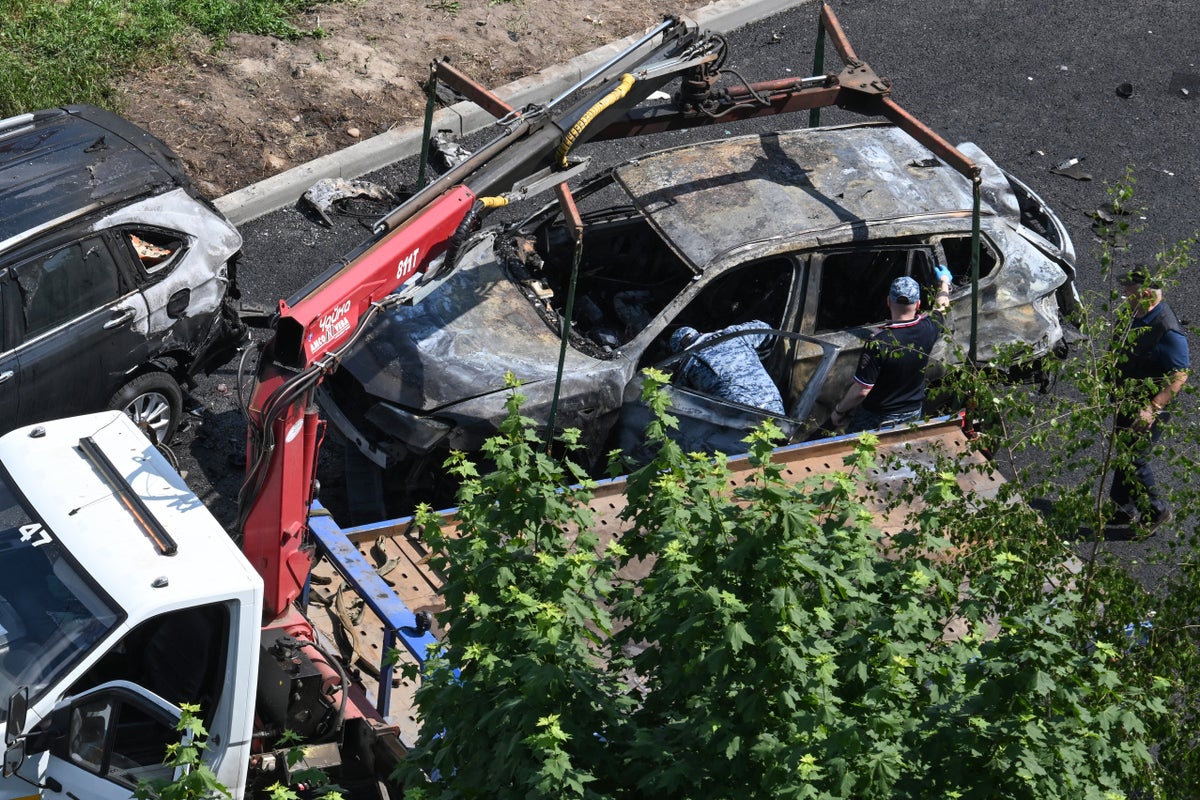
You can't hide a car bomb from the people who live next door.
Early on Tuesday morning in Balashikha, an eastern Moscow suburb built specifically to house military families, a BMW X3 started its engine. It was 5:30 a.m. Seconds later, a blast packed with the equivalent of 500 grams of TNT tore through the vehicle. Bystanders rushed to pull the driver from the flaming wreckage. They managed to extinguish his burning T-shirt, but it was too late.
The driver was Colonel Damir Davydov. He wasn't a frontline commander dodging drones in the Donbas. He was the chief of the Main Missile and Artillery Directorate (GRAU) of Russia's Defense Ministry. Basically, he was the guy responsible for keeping the Russian army supplied with artillery shells and missile ammunition.
This isn't an isolated tragedy for the Kremlin. It's a message. If you wear stars on your shoulders in Vladimir Putin's military, you're a target—even in your own driveway.
The Balashikha Death Trap
If you're looking for proof that Russia's internal security is cracking, look no further than the Aviatorov neighborhood where Davydov died. This district is a fortress of military retirees and active-duty officers. It's supposed to be one of the safest places in the country.
Instead, it's becoming a hunting ground.
Just over a year ago, in April 2025, Lieutenant General Yaroslav Moskalik was assassinated in a near-identical car bombing in the exact same neighborhood. Moskalik was the deputy chief of the Main Operations Directorate of the General Staff. He was a heavy hitter who helped design Russia's strategic military campaigns.
The fact that an assassin could return to the same military neighborhood, scout a high-value target, plant an improvised explosive device (IED) under a luxury SUV, and detonate it remotely tells us everything we need to know. The Federal Security Service (FSB) is failing at its primary job: keeping the regime's elite alive.
Why the Supply Guys are Dying
For a long time, the public perception of wartime assassinations focused on pro-war propagandists or high-profile field commanders. Think of the 2022 bombing that killed Daria Dugina or the assassination of blogger Vladlen Tatarsky in a St. Petersburg cafe.
Those days are over. The targeting has shifted from symbolic figures to the bureaucratic cogs that actually keep the war machine running.
- Logistics over loyalty: Killing a frontline colonel creates a temporary leadership vacuum. Killing the head of missile and artillery supply disrupts the entire pipeline.
- The internal blame game: The Kremlin's immediate reaction to Davydov's death was telling. Dmitry Peskov practically choked on his words, refusing to officially name the victim even as independent outlets like Astra and Meduza confirmed it. They're terrified of admitting how deep the vulnerability goes.
- The pattern of deletion: Davydov joins a growing list. Before him, we saw the assassination of Lieutenant General Fanil Sarvarov, the head of operational training at the General Staff, who was blown up in December 2025.
The Clandestine Networks Next Door
Let's talk about how these hits actually happen. The Kremlin loves to blame Ukrainian special services, specifically the SBU or HUR. They aren't wrong, but the reality is much more embarrassing for Moscow.
These operations require local eyes. In the case of General Moskalik's assassination, the FSB eventually arrested a 42-year-old Russian national named Ignat Kuzin, who was later sentenced to life in prison. He wasn't a highly trained Ukrainian commando who swam across the Dnipro. He was a local asset recruited online, allegedly paid $18,000 to plant the bomb.
On the very same day Davydov was killed, Russian state media quietly reported another incident in Moscow. A teenage girl allegedly picked up an explosive device from a dead drop under instructions from Ukrainian handlers and passed it to another teenager to target an employee at a scientific-industrial enterprise.
Think about that. The Russian state is so riddled with discontent, poverty, or ideological opposition that foreign intelligence agencies can contract out assassinations to locals using Telegram and cryptocurrency.
What This Means for the Kremlin Elite
If you're a Russian general right now, you aren't sleeping well. You know that checking under your car every morning isn't just paranoia—it's survival.
The psychological impact of these strikes outweighs the tactical damage. When the state can't protect the men who manage its nuclear-adjacent bureaus—remember, Davydov grew up in the closed nuclear city of Penza-19 and his father manufactured nuclear missiles—it sends a wave of panic through the bureaucracy.
It forces the regime to redirect massive security resources inward. Every FSB agent spent guarding a logistics colonel in Moscow is an agent who isn't tracking Ukrainian saboteurs near the border or monitoring dissent in the provinces.
Your Next Steps to Track This Escalation
The war is no longer contained to the trenches of Ukraine. To understand where this shadow war is heading, you need to watch the right indicators.
- Monitor the closed military districts: Watch for sudden changes in security protocols around Moscow neighborhoods like Balashikha, Odintsovo, and Vlasikha. Increased checkpoints and restricted access will signal how panicked the ministry is.
- Follow the money and the tech: Keep an eye on how Russian court cases handle the digital footprints of these assassins. The recruitment method—using encrypted apps and dead drops—is the blueprint for modern partisan warfare.
- Watch the supply chain metrics: Look for delays or sudden shakeups in Russia's artillery distribution networks over the coming weeks. Davydov's death will force a messy transition of power in a bureau that can't afford a single day of downtime.
The frontlines have moved to the suburbs of Moscow, and the ignition switch is the new weapon of choice.


