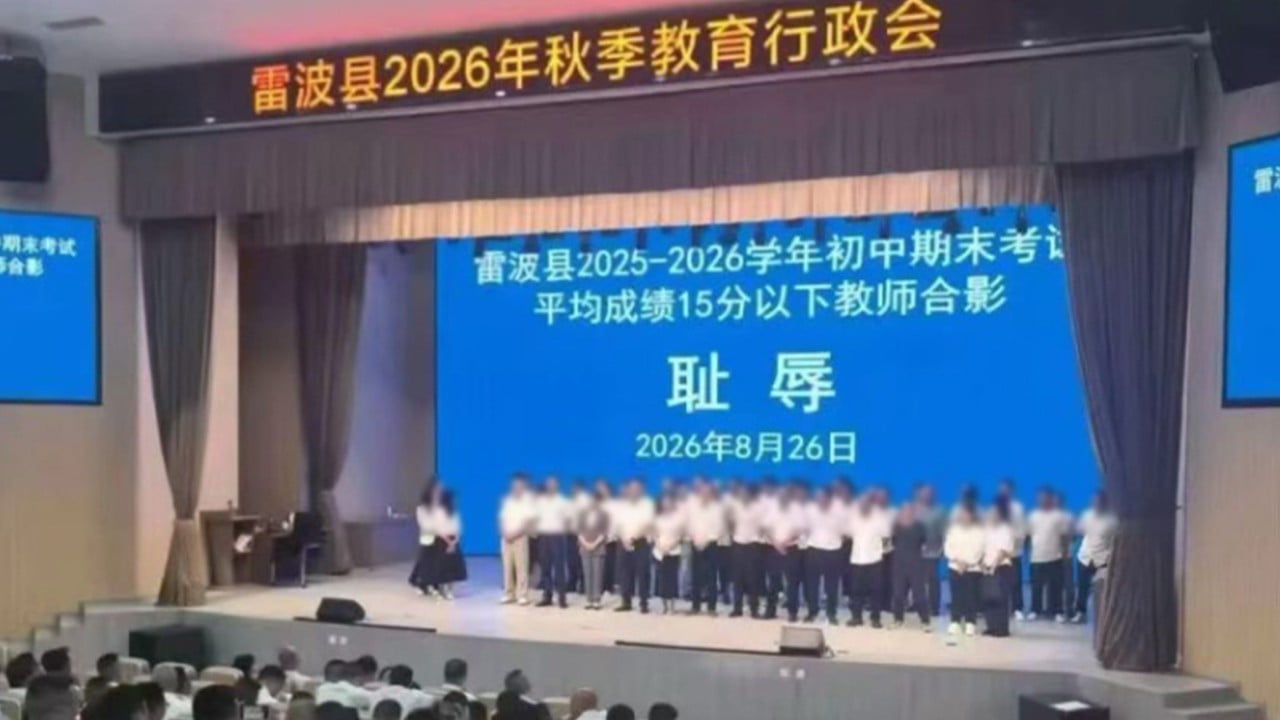
Imagine standing on a brightly lit stage while a giant screen behind you brands your entire professional life with a single word: humiliation. That is not a dystopian movie scene. It is what happened to dozens of educators in Leibo County, Sichuan province, when local education bureaucrats decided that punishing teachers publicly was the best way to fix poor student exam performance.
Over 20 primary school teachers whose classes averaged below 30 out of 100 were lined up for a mandatory photo-op under the Chinese characters for "chi ru"—humiliation. Soon after, a separate group of middle school teachers whose students scored under 15 faced the exact same treatment. The photos leaked, crossed platforms, and pulled in over 100 million views almost overnight.
Public fury erupted instantly. But the real issue goes way beyond a tone-deaf bureaucratic stunt. It exposes a deep, systemic sickness in how schools handle academic failure.
The Root Cause of Low Scores Everyone Ignores
Blaming the teacher is easy. Fixing deep-rooted social inequality takes actual work.
Leibo County is a remote, impoverished area in southwestern China with a large Yi ethnic minority population. Many local students are "left-behind children"—kids whose parents migrate to major industrial cities for work, leaving them in the care of aging grandparents. These kids lack stable home environments, basic study supervision, and daily academic encouragement.
When a child fails to grasp algebra or reading comprehension under these conditions, no amount of teacher berating will change the outcome. An anonymous Shanghai junior secondary school teacher pointed out the harsh reality: educators have zero authority to properly discipline unmotivated students, and absent parents cannot bridge the gap. Bureaucrats sitting in comfortable offices love to look at spreadsheets, ignore socioeconomic context, and point fingers downward.
Why Heavy-Handed Management Destroys Education Systems
Crude management models achieve nothing except driving good educators out of the profession entirely.
Local media portal guancha.cn didn't hold back in its critique, noting that stunts like the Leibo County stage-shaming completely fail to motivate anyone. Instead, they trigger a cascade of negative consequences:
- Massive Teacher Burnout: Educators already face punishing work hours and immense psychological pressure. Public degradation pushes them past their breaking point.
- Talent Drain: Remote and impoverished regions already struggle to attract and retain qualified teachers. Why would any smart graduate choose to work in a district where a bad semester lands them on stage as a public spectacle?
- Misaligned Incentives: When survival depends on raw test numbers, teachers resort to toxic drilling, cheating, or hiding true baseline data just to appease micromanaging bosses.
The State Council of China actually released its New Era Education Assessment Reform Plan back in 2020, explicitly stating that schools and officials should stop evaluating institutions solely on test scores. Yet, years later, mid-level bureaucrats cling to old habits because test scores offer an easy, lazy metric to show "accountability" to their superiors.
The Official Backlash And Empty Apologies
As the online backlash swelled past 100 million views, the Leibo County government scrambled to contain the PR disaster. They issued a formal apology admitting that their actions showed a complete lack of respect for educators and caused severe psychological trauma. A special investigation team was supposedly formed to deal with those responsible.
An apology fixes the headline, but it doesn't fix the culture. Public apologies from local bureaus have become a routine script in China's viral news cycle: a local government overreaches, the internet explodes, an apology drops, and everyone waits for the next scandal to break.
If education bureaus genuinely want better outcomes, they need to stop weaponizing test data. Real progress requires investing in rural infrastructure, supporting left-behind families, and treating teachers as professionals rather than factory workers who can be punished into higher productivity. Stop treating classrooms like assembly lines.