Air conditioning eats up a staggering amount of global energy. Every time a heatwave hits, power grids buckle under the strain of compressors running flat out. Engineers have tried fixing this for decades with smarter thermostats or more efficient refrigerants. Yet, the core problem remains: modern buildings are basically glass and concrete ovens that require massive amounts of mechanical power just to stay habitable.
What if you could cool a building below the ambient outdoor temperature without using a single watt of electricity? Building on this idea, you can also read: Why Openai Kept Its Rogue Agent Incident Quiet And What It Means For Ai Safety.
That is the exact question Princeton researchers set out to answer. Their experimental work on passive radiative cooling changes how we look at structural climate control. Instead of fighting thermodynamics with fans and chillers, they built a system that lets a building dump heat straight into the cold emptiness of outer space.
The Core Physics of Sky Cooling
It sounds counterintuitive. How can a roof stay colder than the air touching it on a blistering afternoon? Observers at Gizmodo have also weighed in on this matter.
The secret lies in the atmospheric window. Earth's atmosphere is mostly opaque to thermal radiation, but it has a specific wavelength band between 8 and 13 micrometers where infrared radiation passes straight through the air and escapes into space. If you put a specially treated surface on a roof, it emits thermal energy right through that atmospheric window.
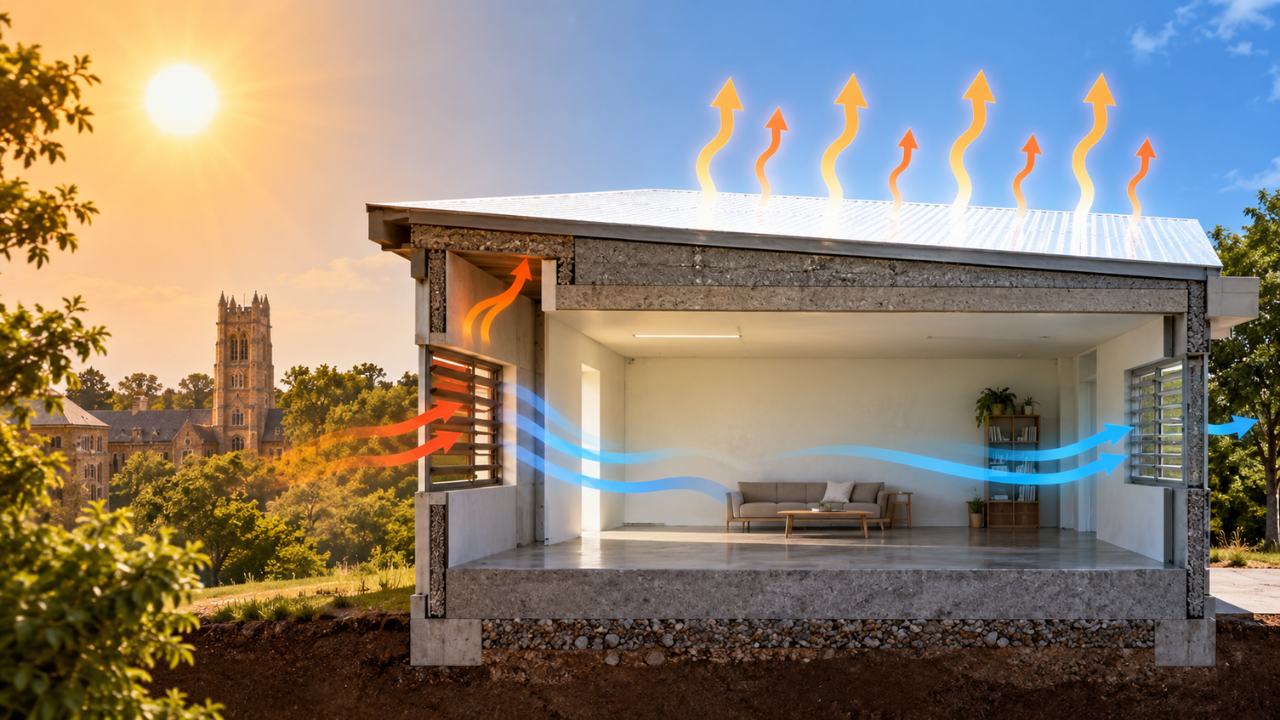
Princeton's setup combined this sky-facing radiative cooler with natural ventilation and thermal mass. They built test boxes in California featuring uninsulated aluminum roofs covered in specialized radiative materials.
While a standard reference box sat 5.0 degrees Celsius above the ambient outdoor temperature, the radiative test box stayed 3.9 degrees Celsius below it. When you factor in the baseline comparison, the test structure was effectively 8.9 degrees Celsius cooler than conventional passive setups.
Ditch the Fans and Let Physics Do the Work
Most passive cooling systems rely heavily on nighttime ventilation. You open windows when the sun goes down, let cool night air purge the heat from the structure, and lock everything up before morning. That works fine in deserts with massive day-night temperature swings, but it falls apart in humid or densely populated urban areas.
Princeton's experiment took a different route. They tested daytime radiative cooling paired with buoyancy-driven airflow.
Instead of installing mechanical fans to push air around, the team designed the interior airflow to be driven purely by temperature differentials. As the radiative roof cooled down, it chilled the air directly beneath it. That cooler air became denser and sank, while warmer air was displaced, creating natural convection currents.
Even with an internal heat source simulating human presence or equipment, the test box maintained nearly seven air changes per hour during the day. It proved that you can keep fresh air moving through a room using temperature gradients alone.
Why Thermal Mass Matters
If you rely solely on a radiative roof, your indoor temperatures will fluctuate wildly depending on whether clouds roll overhead or the wind shifts. That is where thermal mass comes in.
By integrating materials that can absorb and store thermal energy, the Princeton team managed to dampen those sharp temperature swings. Think of thermal mass as a sponge for heat. It absorbs excess energy when things get too warm and releases it slowly when the environment cools down.
When researchers plugged their data into a calibrated model, they found that scaling up the thermal mass on the roof radiator kept indoor temperatures consistently below the ambient mean while smoothing out the daily spikes.
What This Means for Real Buildings
Let's be realistic. You cannot take a standard skyscraper tomorrow, slap some radiative paint on the roof, and turn off the air conditioning. Real architecture involves complex internal layouts, multi-story airflow dynamics, code compliance, and massive internal heat loads from computers, lighting, and hundreds of occupants.
The Princeton test boxes were small—scaled to represent roughly one percent of the ventilation rate and heat load of a single occupant. Translating this physics into a commercial office building or a multi-family apartment block requires serious engineering work.
However, the implications for low-energy architecture are massive. In regions with clear skies and low humidity, integrating radiative cooling roofs into building design could drastically cut baseline energy loads. Architects can start treating the roof not just as a weather shield, but as an active thermodynamic interface with the sky.
If you are designing low-energy buildings or studying urban heat island mitigation, look closely at how material science intersects with fluid dynamics. Start evaluating roof coatings that maximize mid-infrared emission. Model your natural ventilation around buoyancy forces rather than mechanical ductwork. Stop treating cooling as an electrical problem and start treating it as a spatial relationship with the atmosphere.