You wouldn't automatically link a grand piano to a sterile operating room. Yet, medical students who spend years practicing an instrument often breeze through their first knot-tying and suturing tutorials. It sounds strange until you look at the physical demands of both worlds. Holding a scalpel with precision requires the exact same bimanual coordination and micro-control as playing a complex Bach sonata on the strings or keys.
Recent research confirms what seasoned clinical instructors have suspected for decades. Prior musical training heavily influences how quickly a medical novice picks up fundamental surgical skills. If you have ever wondered why certain trainees master laparoscopic tools or delicate tissue handling faster than their peers, looking at their childhood hobbies might give you the answer.
The Overlooked Motor Skills Connection in the Operating Room
Surgery isn't just about textbook knowledge. You can memorize anatomy until your eyes blur, but if your hands lack independent finger movement and steady spatial awareness, you're going to struggle under bright theater lights.
Think about what happens when a pianist plays. Each hand performs entirely different patterns simultaneously. The left hand reads bass clefs and handles rhythmic accompaniment, while the right hand navigates rapid melodic phrasing. Now translate that exact capability to a laparoscopic procedure. You're holding long, rigid shafts, looking at a two-dimensional monitor, and forcing your hands to operate in opposite directions with millimeter precision.
Musicians train their brains to handle high-sensory loads early in life. They listen for pitch, tempo, and dynamics while executing complex motor routines. When these individuals enter medical school, their neural pathways are already primed for split-second adjustments based on visual and tactile feedback.
What the Data Actually Shows About Musicians and Surgeons
Data from medical education studies point to distinct advantages for musically trained students, though the benefits show up in specific ways.
Researchers evaluating novice trainees often test dominant hand dexterity, knot-tying speed, and laparoscopic peg transfers. Consistently, students with a background in instruments like the piano, violin, or guitar display superior baseline dexterity. In multiple assessments, they finish basic procedural tasks faster and rack up higher Objective Structured Assessment of Technical Skills scores.
Does this mean non-musicians are doomed to be clumsy surgeons? Absolutely not. Raw musical talent or long-term training acts as a head start rather than an absolute barrier. Non-musicians catch up through sheer repetition and deliberate practice inside simulation labs. But the initial learning curve flattens out dramatically for those who grew up practicing scales.
Translating Finger Independence to Scalpels and Sutures
When you stand at a surgical table, your hands are your primary instruments. Let's look at what happens during basic wound closure:
- Needle driver control: You must rotate your wrist smoothly while keeping your fingers relaxed to avoid tearing tissue.
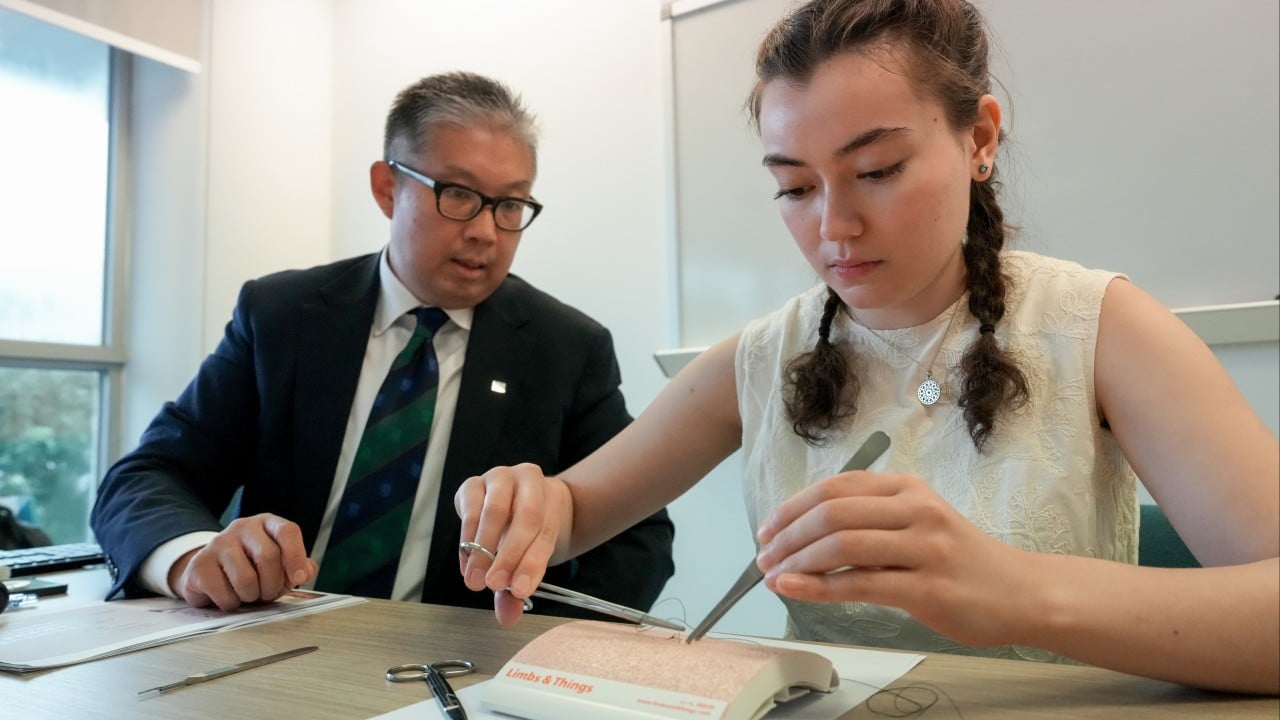
- Bimanual tension: One hand holds forceps to stabilize skin edges while the other guides the suture needle through an exact arc.
- Knot security: Tying square knots with surgical instruments demands tight, consistent loops without excessive friction.
Musicians spend years mastering finger independence. A violinist's left hand presses strings against a fingerboard with exact pressure while the right arm draws a bow at a precise angle. That muscle memory converts smoothly to handling delicate surgical instruments. You already understand how to micro-adjust your grip strength when resistance changes.
Common Misconceptions About Hobbies and Surgical Aptitude
People love to look for silver bullets in medical admissions. Some assume that playing video games, typing fast, or playing sports provides the exact same mechanical benefit as classical instrument training.
While hand-eye coordination from fast-paced gaming helps with screen-based laparoscopic interfaces, it rarely builds the tactile sensitivity required for open tissue handling. Video games rely heavily on digital button-mashing or thumbstick manipulation. Musical instruments require continuous analog feedback—adjusting to the physical resistance of a weighted key or the tension of a string.
Another misconception is that the type of instrument dictates your surgical specialty. You won't find data proving that cellists make better orthopedics residents or that flutists dominate plastic surgery. The core benefit comes from general bimanual coordination, discipline, and spatial-temporal reasoning rather than specialized finger placement for a single instrument.
How Medical Schools Can Adapt Training Models
If musical background provides a clear baseline advantage, medical educators should rethink how they structure early skills labs. Right now, every student walks into their first suturing workshop treated as a blank slate.
Programs could implement tiered simulation training. Students with zero background in fine-motor hobbies might benefit from supplemental dexterity modules before jumping straight into biological tissue models. Simulators can bridge the gap, giving everyone equal footing regardless of whether they spent childhood playing Chopin or playing soccer.
Ultimately, your past hobbies shape how your brain adapts to physical stress in medicine. If you play an instrument, keep practicing. It turns out that preserving your artistic side might just make you a safer, more precise clinician when it counts the most.