What started as an environmental outcry over a luxury resort has exploded into a full-scale political crisis. For 35 consecutive nights, tens of thousands of Albanians have flooded the streets of Tirana. This isn't just a local grievance anymore. It’s an escalating stand against government corruption, backroom real estate deals involving elite international figures, and a system that citizens say treats public land like a private playground.
The nightly demonstrations reached a fever pitch on Saturday, July 4, 2026. The timing couldn't have been more poetic or more confrontational. It was the 62nd birthday of Prime Minister Edi Rama. It also marked well over a month of continuous, unyielding civil unrest.
The Sparks Behind the Pink Flamingo Revolution
If you want to understand why people are risking tear gas and water cannons night after night, you have to look at the coast. Specifically, you need to look at the Narta Lagoon, an ecologically critical, protected wetland along the Adriatic Sea.
The Albanian government greenlit a massive luxury resort development project right in this protected area. The developer? A firm linked directly to Jared Kushner, the son-in-law of U.S. President Donald Trump.
For the locals, this was the final straw.
- Environmental Devastation: The Narta Lagoon serves as a vital nesting and migration site for thousands of pink flamingos. Environmentalists warn that heavy construction and luxury tourism will permanently wreck this ecosystem.
- The Flamingo Symbol: Protesters began carrying pink flamingo balloons and cardboard cutouts. The imagery gave birth to a striking moniker: "the pink flamingo revolution."
- Backroom Deals: To the average Albanian, handing over pristine public land to elite foreign investors smells of textbook cronyism.
What began as an effort to protect migratory birds rapidly evolved into something much larger. It’s now a unified demand for the resignation of Prime Minister Edi Rama, constitutional reform, and a temporary replacement of the current administration with a neutral government of technicians.
Birthday Cakes Made of Cement and Toppled Statues
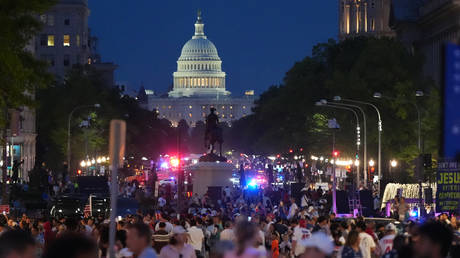
The 35th night of protest was heavy with deliberate, biting symbolism. Tens of thousands of people choked Tirana's main boulevard, marching determinedly toward Skanderbeg Square.
Because the protest landed precisely on Prime Minister Rama's birthday, the crowd brought gifts. They carried "birthday cakes" molded entirely out of heavy gray cement. It was a direct, sarcastic jab at the administration's obsession with concreting over the country's natural beauty for profit. The crowd even sang an ironic, mocking rendition of "Happy Birthday" that echoed across the plaza.
Then came the night's defining image. Protesters erected a tall, imposing bust of Rama in the middle of the square. A thick rope was looped around its neck. With a coordinated yank from the crowd, the bust came crashing down.
The historical resonance wasn't lost on anyone. This precise act mirrored the historic February 1991 toppling of the statue of Enver Hoxha, the brutal communist dictator who kept Albania isolated for decades. By staging this performance, the protesters sent a clear message. They view Rama’s long-standing rule not as a democracy, but as a modern autocracy.
Escallation and Clashes with Police
The energy on the streets is undeniably tense. While the marches usually start peacefully, the frustration is boiling over.
After a couple of hours in Skanderbeg Square, a massive faction of the crowd redirected their march toward a local police station. Their goal was straightforward. They wanted the immediate release of dozens of fellow demonstrators who had been arrested during violent clashes outside the parliament building just two nights prior.
Things escalated fast. Protesters began hurling rocks and smashing the windows of the police station. Law enforcement didn't hesitate to retaliate, deploying high-pressure water cannons to fracture and disperse the crowd.
This followed a pattern from earlier in the week. On Thursday, police used heavy streams of tear gas and pepper spray to push back crowds who were pelting officers with eggs, bottles, and chunks of concrete. At least 12 officers were injured in those skirmishes, and the state has shown zero signs of backing down. Interior Minister Besfort Lamallari has repeatedly condemned the unrest, labeling the protesters' actions as criminal vandalism against public servants.
Why Vague Government Promises Aren't Working anymore
The government’s defense of the Kushner-linked luxury project relies on a familiar economic narrative. Rama and his allies argue that entering the ultra-high-end tourism market is exactly what Albania needs to supercharge its economy. They claim these projects will create jobs, put the nation on the global luxury map, and accelerate its long-sought admission into the European Union.
But the citizens don't buy it.
The wealth generated by these massive projects rarely trickles down to the people who actually live there. Instead, public spaces vanish, local ecosystems get destroyed, and the profits flee offshore. The people on the streets aren't anti-development. They are anti-exploitation.
What Happens Next
This movement isn't fizzling out. Thirty-five nights of consecutive protesting requires immense coordination, stamina, and genuine fury. If you're looking to track where this crisis goes next, keep your eyes on a few specific pressure points.
- International Fallout: Watch how the U.S. administration reacts. Because the development is linked to the Trump family, international scrutiny will only intensify as the images of tear gas and flamingo balloons hit global news cycles.
- Economic Stagnation: If the protests continue to shut down the capital city night after night, the economic toll might force the hands of Rama's inner circle.
- The Opposition's Unity: Keep tabs on whether the decentralized "flamingo revolution" can successfully transition into an organized political coalition capable of forcing the constitutional reforms they are demanding.
The immediate next step for observers is to monitor whether the government opts for harsher crackdowns or blinks first and offers concessions on the Narta Lagoon project. One thing is certain. The cement cakes and toppled busts prove that the people of Albania are done staying quiet.