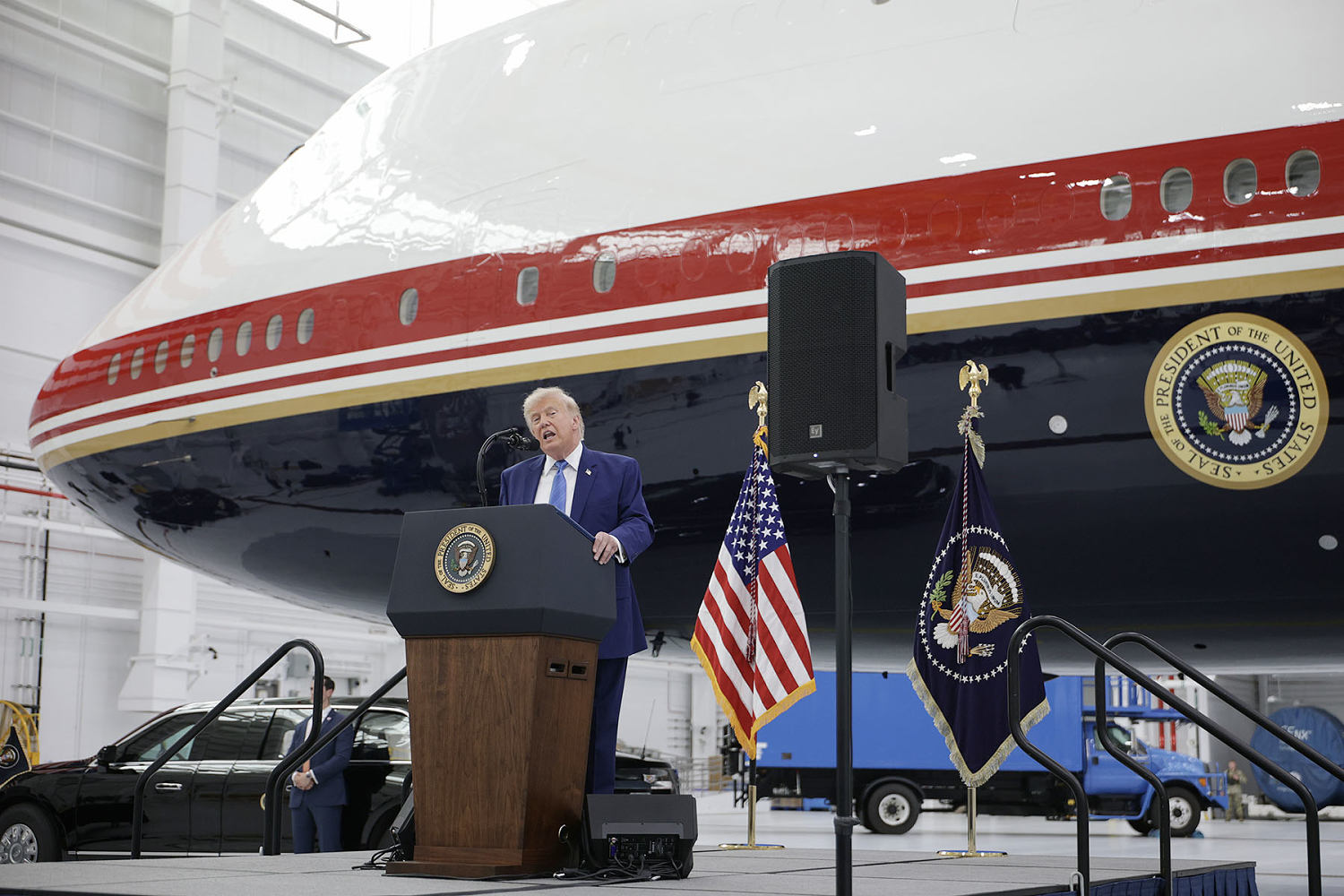
Donald Trump just pulled off one of the most audacious upgrades in presidential history. On Friday, June 19, 2026, the president walked out of a massive, specially built hangar at Joint Base Andrews and stepped onto the tarmac from a glistening Boeing 747-8. It is the new, temporary Air Force One.
It did not cost the American taxpayer a single dime to purchase. Instead, the luxury jumbo jet was handed over as a direct gift from the royal house of Qatar.
Predictably, the political world is melting down. Critics are shouting about constitutional violations, national security risks, and backroom diplomatic favors. Supporters are cheering it as a masterclass in dealmaking that saves taxpayers hundreds of millions of dollars. But if you look past the standard partisan shouting matches, the real story of this aircraft is far more fascinating, messy, and technically complex than what you are seeing on the evening news. This is not just a shiny new plane. It is a flying luxury fortress born out of procurement failures, geopolitical maneuvering, and Trump's unapologetic taste for opulence.
The Bridge Aircraft Born From Boeing Failure
To understand why the United States military accepted a secondhand luxury liner from a Middle Eastern emirate, you have to look at the absolute disaster that is the official presidential aircraft replacement program.
For over thirty years, American presidents have flown around in two highly modified Boeing 747-200 series aircraft, officially designated as VC-25As. They are mechanical marvels, but they are also old. They went into service back in 1990 when George H.W. Bush was in office. Maintenance crews have been working miracles just to keep them parts-certified and safe.
During his first term, Trump negotiated a deal with Boeing to replace these aging workhorses with two brand-new, highly secure 747-8 platforms. That program has turned into a total money pit. The timeline slipped completely out of control. Delivery dates pushed past 2024, then 2025, and now those official planes might not be ready until 2028. Meanwhile, the projected cost ballooned from an already eye-watering $3.7 billion to over $5 billion.
Trump was furious with the delays. He hated the idea of flying around in thirty-five-year-old planes while foreign heads of state showed up to international summits in newer, bigger, more modern aircraft.
Enter the VC-25B Bridge program.
When the Qatari government offered up one of their private royal fleet aircraft last year, the administration jumped at the chance. It solved an immediate operational crisis. The Air Force desperately needed an interim plane to relieve pressure on the ancient VC-25A fleet, and Qatar had a pristine, low-hour Boeing Business Jet 747-8 sitting around that they had struggled to sell on the open market.
It was a marriage of convenience. The Air Force got a modern airframe immediately. Trump got his shiny new toy. Qatar secured an incredible amount of goodwill with the sitting American president.
Ditching JFK Classic Look
The most striking change isn't something hidden away in the avionics bay. It is the exterior paint job.
For more than six decades, Air Force One has been instantly recognizable by its classic robin's egg blue and polished aluminum livery. That iconic design was dreamed up by industrial designer Raymond Loewy and First Lady Jacqueline Kennedy during the early 1960s. It was elegant, understated, and represented a specific era of American global leadership.
Trump completely tossed that tradition into the garbage.
The new bridge aircraft sports a dramatic, aggressive color scheme that looks remarkably similar to Trump's personal private Boeing 757. The top half of the fuselage is a crisp, bright white. The bottom belly is painted a deep, commanding navy blue. Separating the two halves is a sharp red stripe running the entire length of the aircraft.
Even the American flag on the tail got a redesign. Instead of the static, flat flag seen on previous presidential aircraft, the new livery features a stylized flag that looks like it is actively waving in the wind.
During his remarks to service members inside the Andrews hangar, Trump did not hide his personal pride in the new look. He made it clear that the colors and layout were tailored precisely to his own specific taste. When Joe Biden was in office, he briefly canceled Trump's proposed paint scheme, citing concerns from an Air Force review that claimed darker colors could cause overheating issues on the tarmac and drive up maintenance costs. The moment Trump returned to the Oval Office, he reversed that decision and ordered the dark blue paint to be rolled out.
Royal Luxury Meets Military Security
When reporters were allowed to tour the plane following the unveiling, they discovered something surprising. The United States military did not strip the plane down to build a standard, utilitarian flying office.
The interior remains almost entirely what the Qatari royal family designed.
The Air Force explicitly stated that they prioritized operational readiness over aesthetic changes. In plain English, that means they didn't want to waste time or money ripping out millions of dollars worth of high-end finishes. The inside of this plane looks like a flying seven-star hotel.
The cabin features deep, glossy brown wood paneling and custom cabinetry. Light fixtures are accented with gold. The carpeting is a plush, immaculate tan. Instead of the standard, cramped seating found in the staff sections of the old Air Force One, this plane is packed with oversized cream and tan leather seats that recline completely flat. For staff members and security details accustomed to sleeping uncomfortably at a partial recline during long transoceanic flights, this is an unbelievable upgrade.
The layout includes a massive master bedroom, a dedicated guest bedroom, multiple sprawling lounge areas, and a private executive office for the president. There are two full bathrooms alongside nine additional lavatories scattered throughout the multi-deck jumbo jet.
The military did make a few subtle branding updates. The most notable is the addition of specialized seatbelts. Every single seat in the main passenger areas now features a heavy buckle permanently embossed with the official gold presidential seal.
But beneath that veneer of Middle Eastern royal luxury lies a massive network of American defense technology. Defense contractor L3Harris spent months modifying the aircraft at a secure facility. They jammed the plane full of classified, hardened communications arrays, satellite uplinks, and advanced defensive countermeasures designed to jam incoming missiles and protect the commander-in-chief in the event of a nuclear conflict.
The Toxic Political and Financial Firestorm
You cannot talk about this plane without talking about the massive controversy surrounding how the United States acquired it. Accepting a $400 million luxury asset from a foreign power is unprecedented in modern American politics.
The ethical questions are staggering. The United States government technically has a strict $50 limit on unsolicited gifts from foreign entities within a single calendar year. To get around this, the Pentagon officially accepted the aircraft on behalf of the military, rather than Trump accepting it as an individual.
Trump took to Truth Social to mock his critics. He asked why the American military and taxpayers should be forced to shell out hundreds of millions of dollars for a new plane when they could get one entirely for free from an ally. To him, it was a simple business transaction. Turning it down would be foolish.
The legal team at the White House, led by Counsel David Warrington and Attorney General Pam Bondi, issued formal opinions stating the gift was completely legal under a specific condition. To avoid violating the Foreign Emoluments Clause of the Constitution, the plane cannot remain in Trump's personal possession after his term concludes in January 2029. Instead, ownership will be legally transferred to his official presidential library foundation for permanent public display.
The financial details are raising eyebrows on Capitol Hill. While the airframe itself was free, converting a commercial VIP transport into a secure military command center is never cheap.
The Air Force publicly insists that the cost of retrofitting the Qatari plane was contained under a $400 million threshold. However, an investigative report published by The New York Times dropped a bomb on that narrative. They uncovered an unexplained transfer of $934 million that was quietly diverted from a classified intercontinental ballistic missile modernization program directly into the jet retrofitting project.
That revelation has triggered intense bipartisan scrutiny. Lawmakers are demanding to know why nearly a billion dollars was pulled away from critical national defense projects just to fast-track a luxury bridge aircraft for the president.
What Happens Next
The new Air Force One is not entering active service tomorrow morning. The Air Force is kicking off a rigorous schedule of commissioning flights. This is essentially a grueling final exam for the aircraft. Pilots, navigators, and maintenance crews need to log dozens of hours validating the plane's capabilities, testing the secure communication arrays under stress, and establishing fixed operational protocols.
If everything goes according to plan, the White House has big milestones lined up for the new jet.
Officials want the plane fully cleared for a major domestic flight to Mount Rushmore ahead of the July 4th weekend. That date is incredibly symbolic. It marks the United States' 250th anniversary. Trump wants this specific plane to lead a massive, celebratory military flyover directly above the United States Capitol on Independence Day.
Shortly after the holiday celebrations, the plane will get its first taste of international diplomacy. Trump confirmed he will fly the converted 747-8 to Ankara, Turkey, for the upcoming NATO summit. He also teased an upcoming high-stakes trip to China later this autumn for the Asia-Pacific Economic Cooperation summit.
If you want to track the reality of this situation moving forward, keep your eyes on the following milestones:
- Watch for the official Air Force commissioning announcements over the next two weeks to see if the plane passes its final operational tests.
- Monitor congressional defense committee hearings to see if lawmakers force a full financial audit of that rumored $934 million fund transfer from the missile program.
- Look out for the first official photos of foreign leaders boarding the plane during the NATO summit in Turkey next month to see how the international community reacts to the flying fortress.

,webp/025/311/183/v2/2560x1440.217.webp)