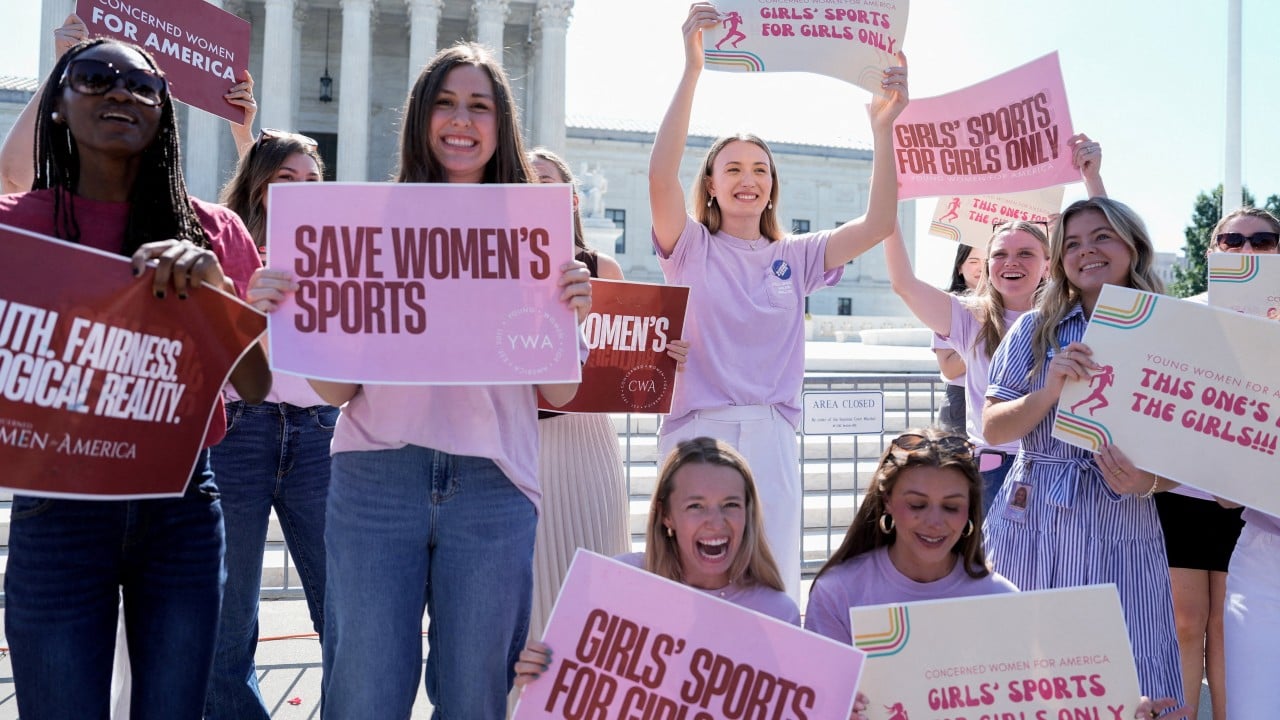
The national debate over fairness, biology, and civil rights in school sports just reached a definitive turning point. Today, the US Supreme Court handed down a massive decision upholding state laws in Idaho and West Virginia that bar transgender girls and women from competing on female athletic teams.
If you are looking at the headlines, you might think this is just another standard party-line culture war outcome. It isn't. The actual mechanics of the ruling reveal a much more complex legal reality. It changes the playing field for high school and collegiate sports across the entire country.
To truly understand what just happened, you have to look past the political grandstanding on both sides. The high court split its decision in a way that surprised many legal observers. The justices ruled unanimously, 9-0, that these state bans do not violate Title IX, the landmark 1972 federal law designed to ensure equal opportunities for women in education. But when it came to the Fourteenth Amendment's Equal Protection Clause, the court fractured along its usual 6-3 conservative-liberal lines.
Justice Brett Kavanaugh wrote the majority opinion. He made it clear that the court believes local legislatures and school boards, not federal judges, are the ones who should be drawing these lines.
Let's break down exactly what this ruling means, how we got here, and the massive ripples it's sending through American schools.
The Legal Fault Lines of Title IX and Equal Protection
The high court was forced to balance two completely different legal arguments that have been working their way through lower federal courts for years.
On one side was Title IX. For over 50 years, Title IX has been the bedrock of women's sports. It transformed female athletics by forcing schools to provide equal funding, facilities, and roster spots. When Title IX was written in 1972, "sex" was universally understood to mean biological sex at birth. Two years later, regulations explicitly allowed schools to operate separate athletic teams for males and females to ensure fair competition.
On the other side was the Fourteenth Amendment's Equal Protection Clause. This clause prevents states from denying any person equal protection under the laws. Lawyers representing transgender athletes argued that banning a student from a team based on their gender identity is a direct form of sex discrimination.
The majority opinion rejected that argument. Kavanaugh noted that because Title IX explicitly permits sex-segregated teams, states are entirely free to define eligibility based on biological sex. He wrote that separate sports teams for biological males and biological females are entirely reasonable. Given the inherent physical differences between the sexes, allowing only biological females to play on women's teams reduces the risk of injury and ensures fair competition.
The three liberal justices, led by Justice Sonia Sotomayor, actually agreed with the conservative majority that West Virginia's ban did not violate Title IX. That 9-0 agreement is what many commentators are missing. The liberal wing only dissented on the constitutional Equal Protection argument.
Sotomayor read a summary of her dissent directly from the bench. That is a rare move used to signal deep disagreement. She argued that the majority ignored crucial factual and scientific nuances. She emphasized that the state actor can now deny young athletes these critical life experiences simply because of a presumed athletic advantage, even when specific medical evidence shows an individual does not possess it.
The Two Students Behind the National Spotlight
Supreme Court cases often seem abstract, but this battle was driven by the specific stories of two young athletes who wanted nothing more than to compete.
In West Virginia, the case centered on Becky Pepper-Jackson. She is a 16-year-old high school sophomore who has identified as a girl since age eight. She has been taking puberty-blocking medications and holds a state birth certificate recognizing her as female. She wanted to run cross-country and track. She was the only transgender athlete in the entire state of West Virginia who was openly seeking to compete in girls' sports.
Her legal team argued that because she transitioned before undergoing male puberty, she never developed the physiological advantages typically associated with male development, like greater bone density or muscle mass.
The Idaho case involved Lindsay Hecox, a student at Boise State University. In 2020, Idaho passed the first-in-the-nation law excluding transgender women from female sports teams. Hecox sued to challenge it so she could try out for the university's cross-country and track teams. Ironically, her lawyer later revealed in court that Hecox didn't even make the squad because she wasn't fast enough, though she did participate in club-level sports. Hecox later tried to dismiss her case to avoid ongoing harassment, but the high court pushed forward to resolve the legal question once and for all.
The legal teams for Idaho and West Virginia countered these individual stories with broad athletic data. They presented studies showing that non-transgender boys and men consistently perform better in athletic events across all age categories. They argued that making exceptions for individual medical histories would make the laws impossible to enforce fairly.
What This Means for the 27 States with Active Bans
The immediate impact of this ruling is highly practical. There are 27 states that have already passed laws restricting transgender student-athletes to teams matching their sex assigned at birth.
Before today, many of these laws were tied up in federal appeals courts. Some were blocked by injunctions, while others were partially enforced. Today's Supreme Court decision effectively gives all 27 of those states a green light. The legal cloud over those statutes has vanished.
If you live in a state with one of these laws, the rules are now set in stone. Public schools, middle schools, high schools, and state universities must enforce eligibility based on biological sex.
But what about the rest of the country? The Supreme Court intentionally left a massive loophole.
Kavanaugh's opinion explicitly noted that the court was not ruling on whether states are required to ban transgender athletes. It only ruled that states can ban them if they choose to. This means liberal states like California, Connecticut, and New York can keep their inclusive policies intact.
We are about to see a starkly divided landscape for high school and college sports. A transgender girl can freely run on a high school varsity track team in Los Angeles, but if her family moves to Phoenix or Boise, she will be legally barred from the girls' team.
This geographic divide creates a logistical nightmare for regional and national tournaments. If a high school team from California with a transgender athlete travels to a tournament in Texas, which state's rules apply? The Supreme Court didn't answer that question.
The Sports World Explodes in Fractured Reactions
The sports community has been deeply split on this issue for years, and today's ruling triggered immediate reactions from iconic athletes on both sides of the debate.
A coalition of legendary female athletes publicly supported the state bans. Tennis icon Martina Navratilova, Olympic swimmers Summer Sanders and Donna de Varona, and beach volleyball star Kerri Walsh Jennings have all argued that biological differences cannot be fully erased by hormone therapy. They view the Supreme Court's decision as a massive victory for the integrity of women's sports, preserving the protected category that Title IX created.
On the other side, prominent modern athletes expressed deep heartbreak. US soccer stars Megan Rapinoe and Becky Sauerbrunn, along with WNBA champions Sue Bird and Breanna Stewart, had filed briefs supporting the transgender students. They argue that sports should be about inclusion, belonging, and mental well-being, especially for vulnerable teenagers.
The numbers show that this issue carries immense political weight despite affecting a tiny fraction of student athletes. In 2024, NCAA President Charlie Baker testified to Congress that out of more than 500,000 collegiate student-athletes in the United States, his office was aware of only about 10 transgender athletes participating on women's teams.
Ten athletes across the whole country. Yet the political apparatus spent tens of millions of dollars on this single issue. During recent election cycles, political campaigns ran television ads focusing on transgender athletes more than 15,000 times. It became a powerful shorthand for broader cultural anxieties.
The general public appears to align with the court's decision. An Associated Press poll conducted late last year found that roughly six in 10 US adults supported requiring student-athletes to compete only on teams matching their sex assigned at birth. Only two in 10 opposed the restrictions, while the rest held no strong opinion.
The Broader Legal Campaign Against Transgender Rights
You cannot view this sports ruling in a vacuum. It is part of a larger, highly coordinated judicial strategy by conservative states and advocacy groups.
Just last year, this same conservative supermajority upheld a Tennessee law banning gender-affirming medical treatments like puberty blockers and hormones for minors. Following that decision, 25 states quickly moved to criminalize or ban those medical treatments for anyone under 18. Some states are already trying to extend those restrictions to adults using public funds.
The Supreme Court is steadily chipping away at the broad LGBTQ protections it seemed to establish a few years ago. Back in 2020, the court ruled in a major case that federal workplace discrimination laws protect gay and transgender employees. At the time, the court stated that sex plays an unmistakable role in an employer's decision to fire a transgender worker.
But the justices are drawing a sharp line between the workplace and physical arenas like locker rooms and sports fields. The states successfully argued that Title IX requires a completely different analysis than employment law. In sports, physical differences matter in a way they simply do not at an office desk.
The legal restrictions are expanding past sports and medicine. Three states—Montana, Oklahoma, and Tennessee—have completely banned transgender individuals from changing the sex marker on their birth certificates. Other states have barred changes on driver's licenses or eliminated gender-neutral options on state documents.
Practical Next Steps for Administrators, Parents, and Athletes
The Supreme Court has spoken, and the political debate will rage on. If you are an athletic director, a parent, or a student-athlete, you need to know how to navigate this new reality immediately.
First, school administrators in the 27 states with bans must review their athletic registration protocols. You need to ensure your school's enrollment and physical forms clearly collect birth-assigned sex to remain compliant with state law and avoid losing state or federal funding. Do not wait for a formal audit.
Second, national athletic organizations and tournament organizers must establish clear governing rules for interstate competitions. If you operate regional tournaments that draw teams from multiple states, you must clearly outline eligibility guidelines in your tournament bylaws before teams register.
Third, families with transgender children residing in states with active bans should look into alternative athletic outlets. The Supreme Court ruling applies strictly to public schools and institutions receiving federal funds. It does not govern private, independent youth sports leagues, community recreational clubs, or certain private organizations. These local clubs often operate under their own inclusive guidelines, providing a vital space for kids who still want to play, stay active, and be part of a team.
The legal battles over identity and sports are far from over. While the supreme court settled the question for public school bans, the fight will now shift to individual athletic governing bodies, private organizations, and state-level challenges in liberal territories. The court refused to force a single uniform standard on the entire nation, leaving a divided map where a student's civil rights depend entirely on the state line they stand behind.